A Day in the Life of a Software Engineering Manager: Matthew Compton on the Developer-to-Manager Leap, Psychological Safety, and Why He’d Happily Code Again
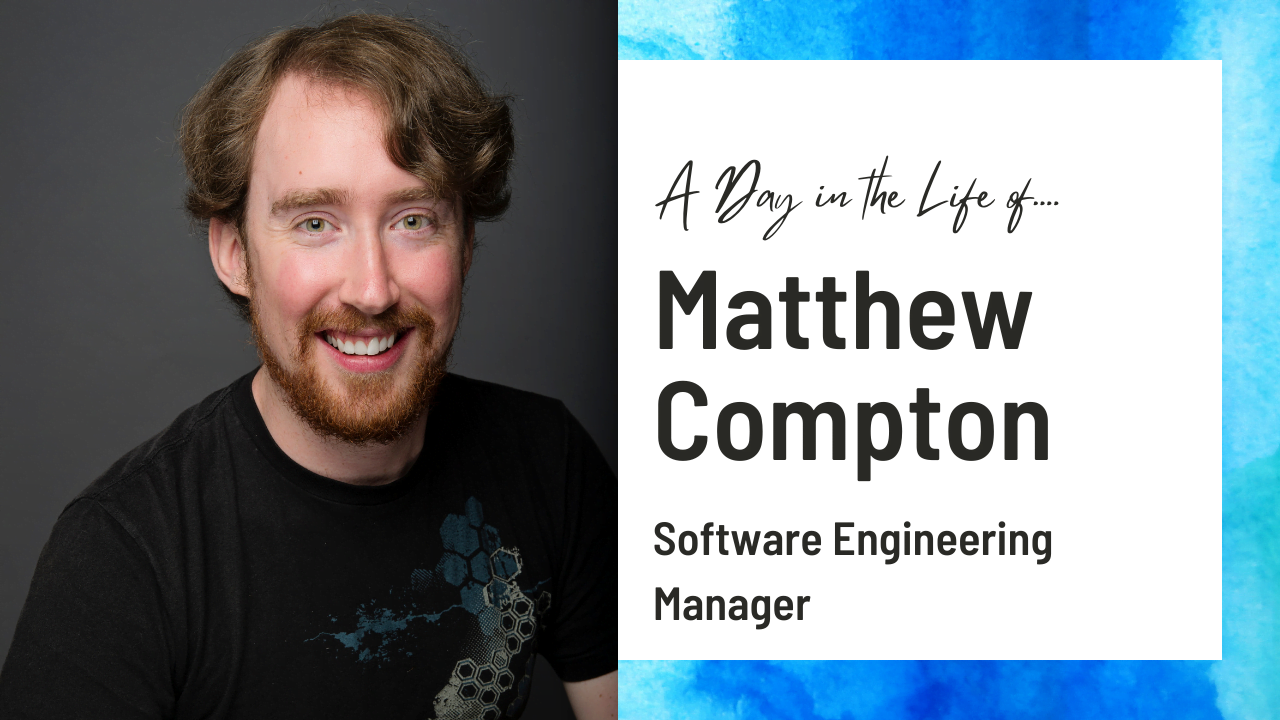
Matthew Compton is a software engineering manager who has led teams at three different companies, and he will tell you, without hesitation, that he could walk back into an engineer’s chair tomorrow. That is the surprising thing about him. He climbed the ladder people are told to climb, and he holds it loosely.
He started as an Android developer, building his first apps so he and his friends could keep score in Magic: The Gathering and Yu-Gi-Oh, and worked his way up through titles that kept changing while the work mostly stayed the same. Now he manages engineers, and he has strong opinions about who should follow him into management and who should stay right where they are.
This is the full picture: what the job actually looks like, how he got there, and the life around it, from kickboxing and online chess to a Swiss wife and a baby due any day.
What a software engineering manager actually does all day
If the reputation for management is that it is mostly meetings, Matthew will confirm it. A typical day runs on one-on-ones, product spec meetings, sprint planning, and daily stand-ups, with his team and with the product managers and designers he builds alongside. Between those meetings he writes up performance notes, tracks sprint velocity, and decides what the team focuses on next, since nobody hands an engineering manager a task list.
That last part surprises people who move up from engineering. As an individual contributor, someone is usually asking how your sprint task is going and how many points you have left. As a manager, the calendar and the priorities are his to fill, and he fills a lot of them with data. He is in JIRA most of the day pulling velocity reports, and in tools like Mode, Crashlytics, and Firebase to read the health of the app: crash rates, slow load times, cold-start issues. He describes his own job as two things braided together, relationship building and investigation, and the investigation half is where much of his value comes from. That instinct for reading the numbers is the same one that carries some engineers toward data-focused paths and founding their own companies.
The relationship-building half got harder when work went remote. Before the pandemic, a one-on-one might mean a walk through Piedmont Park or a coffee, the kind of easy face time that builds trust almost by accident. Remote work took those happy accidents away, so now he chooses to be intentional about it. He would rather walk beside someone than sit across a table staring at each other, which he finds shapes the whole conversation.
How Matthew became a software engineering manager
Matthew’s path started with video games, though not the way he first pictured it. As a teenager he liked to mod browser games and write little extensions, giving himself extra points and poking at how the games worked under the hood. His dad was a programmer, so there was guidance close at hand. The plan was simple: go to Georgia Tech, study computer science, and maybe build video games for a living.
Once he was deep in his coursework, the gaming industry looked less like a dream and more like a grind, so he redirected. Mobile apps caught him instead. He built Android apps for the games he and his friends actually played, tracking scores and keeping everyone honest, and loved the quick feedback loop of changing something and watching it appear in front of you. That pull carried him to his first real job as an Android engineer at Big Nerd Ranch.
From there his title kept shifting, from Android developer to lead developer to Android engineer to software engineer to manager, even as the day-to-day work held mostly steady. He has a working distinction between the labels: a software developer tends to go deep on one stack, like Android or iOS, and drive results inside that narrow domain, while a software engineer works on broader, more math-heavy problems like computation, data structures, and algorithms. By the time the management door opened, he had already led on small startup teams, at agencies and consultancies, and at large companies with millions of daily users.
How do you move from software developer to engineering manager?
The most useful thing Matthew says about this move is that it is less a promotion than a lane change. Being an engineer and being a manager are, in his words, two completely different career ladders with different skill sets and expectations, and the overlap is smaller than people assume. You need enough context to manage engineers well, but the job is not a senior version of engineering with a nicer title.
So he pushes people to be honest about why they want it. One of his direct reports came to him convinced that the only way to keep growing was to become a manager, the same pressure Matthew had once felt, and he talked him out of it. The paycheck is not the reason, since a strong individual contributor can earn as much as a manager or more. The pull has to be the actual work of management: the coaching, the one-on-ones, the planning and structure and team building that also anchor adjacent roles like program management.
If you’re getting into management for the wrong reasons, I think you’re setting yourself up for complete misery.
Matthew Compton
For anyone still on the engineering side and curious what it takes, his advice is grounded in the mobile world he came up in. Learn fast, because Android and iOS change every year, with new APIs and shifting permissions models at the whims of Google and Apple. Stay adaptable. Enjoy building user experiences, and enjoy working shoulder to shoulder with product managers and designers, since collaboration is most of the job. Those same habits, learning and partnering, make a good manager later.
The best and hardest parts of engineering management
Ask Matthew what he loves and he goes straight to one-on-ones. Getting to know people, building trust, forming a real relationship, that is the fun of it for him. The harder parts are the ones you would expect: performance reviews that run long, and the sticky conversations about pay or someone heading out on leave. He is clear that carrying people through the hard stretches is half the job, not a detour from it.
What makes management its own discipline is the ambiguity. An engineer gets discrete problems with correct answers: build this screen, write this function to meet this acceptance criteria. Management refuses to work that way.
As an engineer, we have discrete problems with a right answer. With management, there’s never really a right answer, like, go handle this person’s emotions, and there are a lot of wrong things you can do.
Matthew Compton
Because there is no single correct move, he has learned to find his own style and flex it per person, since what lands with one direct report can miss another. The feedback loop is long, too. You often cannot judge a manager in the moment. You find out six months later, when a team either falls apart or turns out to be humming, and he has watched both arrive on delay.
Is engineering management a good career? Matthew’s honest take
Matthew’s honest answer is that management is a good career for the right person, and he makes sure people know they can opt out. He is confident he could return to engineering without much drama, maybe a few months to ramp back up and a title that slides down a notch. A friend of his did exactly that, stepping from senior leadership back into an iOS engineering seat, and called it a vacation for how much pressure lifted. That safety net matters to him. Engineering is what pulled him into the field, and knowing he can go back keeps management from ever feeling like a trap.
When he talks about what separates a healthy team from a doomed one, he keeps returning to one idea: psychological safety. A team where people trust each other, and trust their manager, can fail without harsh punishment and can speak honestly. Get that right and a team has a real shot at high performance. Get it wrong and the rest hardly matters.
Without psychological safety, your team is pretty much doomed to fail. You have to have it.
Matthew Compton
He also knows the kind of place where he does his best work. After stints at tiny startups, agencies, and companies with millions of users, he prefers the middle, around 500 to 1,000 people, like Pandora or his current employer. Big enough to have real systems and best practices in place, small enough that he can walk in and make an outsized impact. Too small and everything feels on fire, with burnout close behind. Too big and the question creeps in of whether he even matters, or is one more replaceable part in a large machine.
The life around the work
Outside of work, Matthew has a fresh obsession. He picked up kickboxing about a month before the interview and has stuck with it a couple of times a week, gloves and hand wraps and all, and it has become his favorite way to burn off stress. He is also a longtime gamer, into online competitive play like League of Legends and chess, where he happens to be a ranked player who loves teaching the game to beginners. Walks, exercise, and time with his wife round out the balance.
His sense of place has shifted over the years. He grew up in Buford, Georgia, back when it still felt like a small town of dirt roads before Gwinnett County built up around it, and went to Mill Creek High School. Moving to Atlanta for Georgia Tech cracked his world open: new people, city living, the novelty of walking places instead of driving everywhere. These days he and his wife live near Decatur, where he can hop on public transit or walk to most of what he wants, and he has decided city life suits him better than the quiet he came from. Neither one is better than the other, he is quick to add. They are just different, and he knows which one he wants right now.
His wife has widened his view even further. She is Swiss, with a Swiss father and a Guatemalan mother, and spent her teenage years in Switzerland before settling in the US. Matthew grew up with a US-centric mindset, having traveled abroad only a couple of times before they met, and being with her has him asking sharper questions about why things are done the way they are at home. Even the dinner table looked different: her family treats politics and current events as ordinary conversation, which took him a while to get used to after a childhood where those topics rarely came up.
And then the big one. When the interview was recorded, Matthew was days away from becoming a dad for the first time. He had just built the stroller, still had a car seat to install, and had parental leave lined up. Excited and nervous in equal measure, he had been collecting advice from every parent in his life, and it all landed on the same note.
Nothing will prepare you. You’re unprepared, and that’s okay. Just go with the flow, you’ll figure it out.
Matthew Compton
FAQ
A few of the questions people ask most about becoming a software engineering manager, answered from Matthew’s own experience.
What does a software engineering manager do?
He leads a team of engineers and spends the day in one-on-ones, sprint planning, product spec meetings, and stand-ups, while coordinating with product managers and designers. Between meetings he fills his own time with data work, tracking velocity in JIRA and reading app health in analytics tools. Matthew sums the role up as relationship building plus investigation.
How do you become an engineering manager?
Usually by growing from a developer or engineer role and then stepping onto a separate management track. Matthew started as an Android developer, moved through lead and engineer titles, and has now managed at three companies. He stresses that it is a different skill set, not just a more senior version of engineering.
Should you become a manager or stay an individual contributor?
Matthew says choose management only if you genuinely enjoy coaching, planning, and people, and not for a bigger title or paycheck, since strong individual contributors can earn as much or more. If the people side does not light you up, staying an engineer is a legitimate and often happier path.
Can you go back to engineering after becoming a manager?
Yes. Matthew is confident he could return with a few months of ramp-up, and he watched a friend step from senior leadership back to an iOS engineering role and describe it as a relief. Knowing the door stays open makes management feel like a choice rather than a one-way trip.
What makes a software team successful?
Matthew points to psychological safety first: a foundation of trust where people can fail without harsh consequences and speak openly. Without it, he says, even a skilled team tends to come apart.
Final thoughts
The thread running through Matthew’s story is that he trusts himself to know what he actually enjoys, and he declines to climb a ladder just because it happens to be there. He moved into management for the parts he loves, the coaching and the connecting, and he keeps a clear-eyed path back to the engineering that drew him in, so the title never owns him.
If you knew you could always return to the work that first made you fall in love with your field, how differently would you choose your next step?