A Day in the Life of a PhD Student: Anne Chance on World Heritage Sites, Raising Triplets, and Chasing a UNESCO Dream
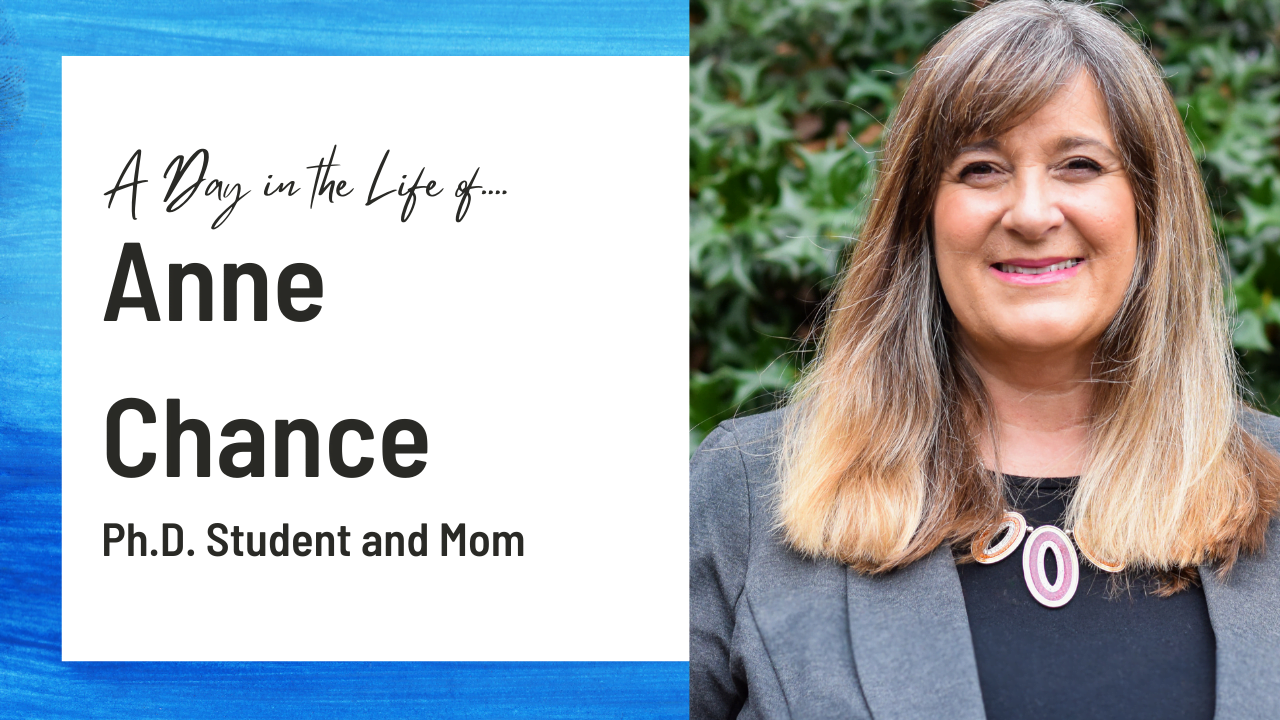
Anne Chance is a PhD student at Kennesaw State University, and her field is a mouthful she delivers with a grin: international conflict management, peacebuilding, and development. It is an interdisciplinary program whose graduates land at places like the State Department and the United Nations. Her own aim sits a little higher up the map. She wants to work for UNESCO.
Here is the surprising part. Anne is doing all of this while raising nine-year-old triplets and an adult son, twelve years after she finished a master’s degree and swore she was done with school for good. She writes music in her basement to stay sane, plans elaborate cardboard-and-cosplay builds for fan conventions, and studies whether the world’s most treasured heritage sites actually make peace more likely.
This is the full picture: the research, the winding path back to a doctorate, and the life crammed in around it.
What a PhD student actually does all day
Anne’s dissertation asks a question most people never think to ask. World Heritage Sites are supposed to protect the places humanity holds in common, but do they actually help bring about peace? To answer it, she is running a program evaluation of the sites themselves, paired with a hard look at a common criticism: that the nomination process presses democratic ideologies onto the communities it touches.
Her method is mixed. Two quantitative studies plus qualitative case studies, because she spotted a gap in the field. Anthropologists had written plenty of critical, qualitative work on how UNESCO decides what counts as universally significant, yet nobody had tested those claims with numbers.
You’re judging for all of mankind at that point. So a lot of the anthropologists I’ve been reading are very critical of the process. They did a lot of qualitative work, but nobody’s done any quantitative work.
Anne Chance
Filling that gap means long stretches at a keyboard. During the heaviest months of the pandemic, a normal day could run fourteen hours: back-to-back meetings, then a class, then another meeting, then three hours writing a grant. She also holds a graduate research assistant post with the Children and Family Programs at KSU, where she co-wrote a grant to support student-parents, a group most universities do not realize they have.
Her research can get delightfully granular. For one paper, she needed to measure something slippery: why some people resist telling a more inclusive history at heritage sites. She grounded it in a framework from psychologist Dr. Shalom Schwartz, a values model she describes as a wheel broken into roughly seventeen human values. She and a second coder tagged interview transcripts line by line, one value at a time, then averaged their results into weighted wheels. One value she watched for was “face,” a person’s concern with how the world sees them. The pattern surprised her: the people most reluctant to include marginalized histories clustered in self-protection and tradition-bound values. That paper is not published yet, though a taste of it lives on her LinkedIn page after she presented it as a lightning talk at a heritage unconference called Dismantle Preservation. Anyone drawn to that kind of public-facing scholarship will recognize the same nerve in the path to becoming a published author.
How Anne Chance ended up back in school for a PhD
Anne’s route to a doctorate was anything but a straight line. She earned a master’s degree, closed the door on higher education, and meant it.
When I got my master’s I said never again, I’m never going back to school. And then here I am, twelve years later.
Anne Chance
What pulled her back was the work itself. Before the pandemic she was building a career as a preservation consultant, and a project she took on during her studies lit a fuse. She found herself standing where heritage and conflict overlap, a place that turns out to be crowded with real-world stakes, from contested monuments to whose story a site is allowed to tell. The deeper she went, the more she wanted the tools and the credential to do something serious with it.
Her grounding in preservation gives her research a practical edge. She knows how a site actually earns protected status, because the machinery is similar to the United States National Historic Register: fill out the forms, invite an assessment, and prove the site’s significance. She can also trace how the whole idea has shifted. World Heritage began right after World War Two, when much of Europe lay in ruins and the point was to save what was left. That origin skewed the early list heavily toward Europe, and one long-running critique is that UNESCO’s lens stayed Western for decades. The correction underway now includes far more sites from the global south, and, in a move Anne clearly loves, a category called Intangible Heritage: dancing, songs, oral histories, poetry, the parts of a culture you cannot put behind glass. Her fascination with how communities keep cultural identity alive puts her in good company with educators who teach heritage and history for a living.
How to get a PhD while raising a family
Ask Anne how someone actually pulls this off, and her advice is concrete. The first piece is choosing a program that fits the question you care about, even a broad one. Hers is interdisciplinary by design.
Just as important is finding a system to ground your research. Anne’s coding project came alive once she borrowed Schwartz’s values framework, and she is quick to tell other researchers that a reliable method for turning messy qualitative material into something measurable is worth the search. She also expects the dissertation to keep moving. Hers has narrowed and shifted as she reads, which she treats as ordinary rather than alarming.
The timeline deserves honest planning, especially with kids in the house. Student-parents, she points out, are usually strong students who simply take longer, often because of money and childcare rather than ability. The grant she co-wrote exists to close that gap and help parents finish in four to six years instead of ten to fifteen. She is also blunt about how unevenly the load is shared.
Why would you go to school if you have a baby? Well, nobody asks the father that.
Anne Chance
Her own survival kit is practical. She guards the creative time that feeds the harder thinking, protects her exercise, and has made peace with a dissertation that gets finished rather than polished to some outside standard. Her supervisor believes the writing can be done by spring.
The best and hardest parts of a PhD
The best part, for Anne, is people. She is an extrovert who lights up around a crowd, and her program brings the world to her doorstep: classmates from Iraq, Syria, Yemen, Nigeria, Ghana, Trinidad and Tobago. Hearing how they see the United States is the kind of education that never shows up on a syllabus, and she calls it eye-opening.
The hardest part is what the pandemic did to the margins of her life. With homeschooling, the research assistantship, and the dissertation all landing at once, the first thing to slip was basic self-care. In her telling, that meant the floor-level version: a shower, brushing her teeth, a few minutes to herself. Fourteen-hour days at the computer left their mark on her back and hips, which is why exercise stopped being optional. She works out now so her body can simply function.
She is also honest about the invisible tax that lands on mothers in academia. Student-parents often hide the fact that they have kids at all, and the assumption that a mother with a baby has no business in school is one she has heard plenty and rejects on sight. Plenty of women in her orbit are proof otherwise, including friends who have defended a dissertation with an infant on one hip.
Is a PhD worth it? Anne’s honest take
Anne is chasing the doctorate for a concrete reason. Her ideal job is UNESCO: managing a major heritage site, or being the person who travels out to World Heritage Sites and helps local teams build their preservation plans. She calls it her dream job. That is the north star, coordinating preservation on the ground the way a seasoned project manager steers a complex effort with many stakeholders. She is also clear-eyed and funny about the economics. When a professor pressed her on what she would do with the degree, she gave the UNESCO answer and then the real one: in the end, she will work for anyone who will pay.
Salary is only part of it for Anne. The PhD has widened her world, sharpened her thinking, and given her a shot at a career built around protecting cultural identity. Finishing also carries private weight. She has described herself as someone with a long trail of unfinished projects, so crossing this finish line will mean something real.
The life around the work
Anne’s off-hours are as full as her calendar. Her main way to decompress is music. She plays guitar, sings, and writes songs down in the basement where her gear is set up, and she does not hold back.
Everybody knows I go down in the basement where I have my stuff set up, and I just get it all out. I can’t tell you how many broken picks are lying on the ground.
Anne Chance
Once a year she treats herself to a four-day songwriting retreat run by an Atlanta guitarist and songwriter she admires, four days to focus fully on the creative side that the brainy work tends to crowd out. She is candid that a doctorate can starve exactly the inspiration a person needs to do their best thinking, so she protects that well on purpose.
Then there are the conventions. Anne is a fixture at Dragon Con, the enormous Atlanta science-fiction and fantasy gathering, where she books a hotel downtown even though she lives in the city, because the whole thing runs around the clock and she refuses to miss a minute. She loves it for its sheer scale and its people-watching. Her other favorite, JordanCon, is its opposite: small, friendly, and built around Robert Jordan’s Wheel of Time series, which she finally finished, with Brandon Sanderson at the helm, while pregnant with the triplets. With friends she plans elaborate group builds out of cardboard, from pirate ships to a 1939 Packard styled after the Addams Family car. Her own costumes run from a dark fairy to an old-school, orange-and-green Aquaman.
The triplets, now nine, keep the house loud. Two are identical twin boys, one a rule-follower named Lorenzo and one a cheerful rule-bender, and their sister Bella is an artist who once treated the family walls as her canvas. When the boys team up to argue a case past their parents, Anne jokes that it is the law firm of Atkinson and Atkinson filing an appeal. She met her husband through a friend’s determined setup, showed up in jeans with zero makeup to a match she assumed would go nowhere, and found a fellow history nerd who debates the same events from the opposite angle she does. She grew up all over the East Coast, from New York to North Carolina to Connecticut to Florida, and settled in the Atlanta area in the mid-to-late nineties. City life suits her for a reason she names easily: in a city, she says, you can be different, and people simply do not care, which beats the suburbs where difference draws attention.
FAQ
A few of the questions people ask most about pursuing a PhD, answered from Anne’s own path.
How long does it take to get a PhD?
It varies, and life circumstances stretch it. Anne notes that student-parents can need ten to fifteen years when unsupported, while the program she helped build aims to get them across the line in a more typical four to six. Her own supervisor believes she can finish the writing by spring.
Can you do a PhD while raising kids?
Yes. Anne is doing it with nine-year-old triplets and an adult son, and she knows women who have defended their dissertations with a newborn in arms. The obstacles she names are practical, money and childcare, rather than ability.
What is a World Heritage Site, and how does a place become one?
It is a site recognized for significance to all of humanity, protected under a system created after World War Two to save what survived the destruction in Europe. A place earns the status through a nomination and assessment process similar to the United States National Historic Register, where you document the site and establish its significance.
Do you need to know exactly what your dissertation is about before you start?
No. Anne’s has shifted and narrowed as her research has progressed, and she treats that evolution as part of the work rather than a sign she is off track.
Final thoughts
Anne’s throughline is self-trust in slow motion. She left school certain she was finished, then followed a question about heritage and conflict all the way back to a doctorate, and she is building a life where triplets, a basement full of broken guitar picks, and a dream of protecting the world’s cultural treasures all fit under one roof. She did not wait for perfect conditions or an empty calendar. She started, and she is finishing.
If a question you could not stop asking led you back to something everyone assumed you were done with, would you follow it? What have you been telling yourself you are too busy, or too far along, to begin?