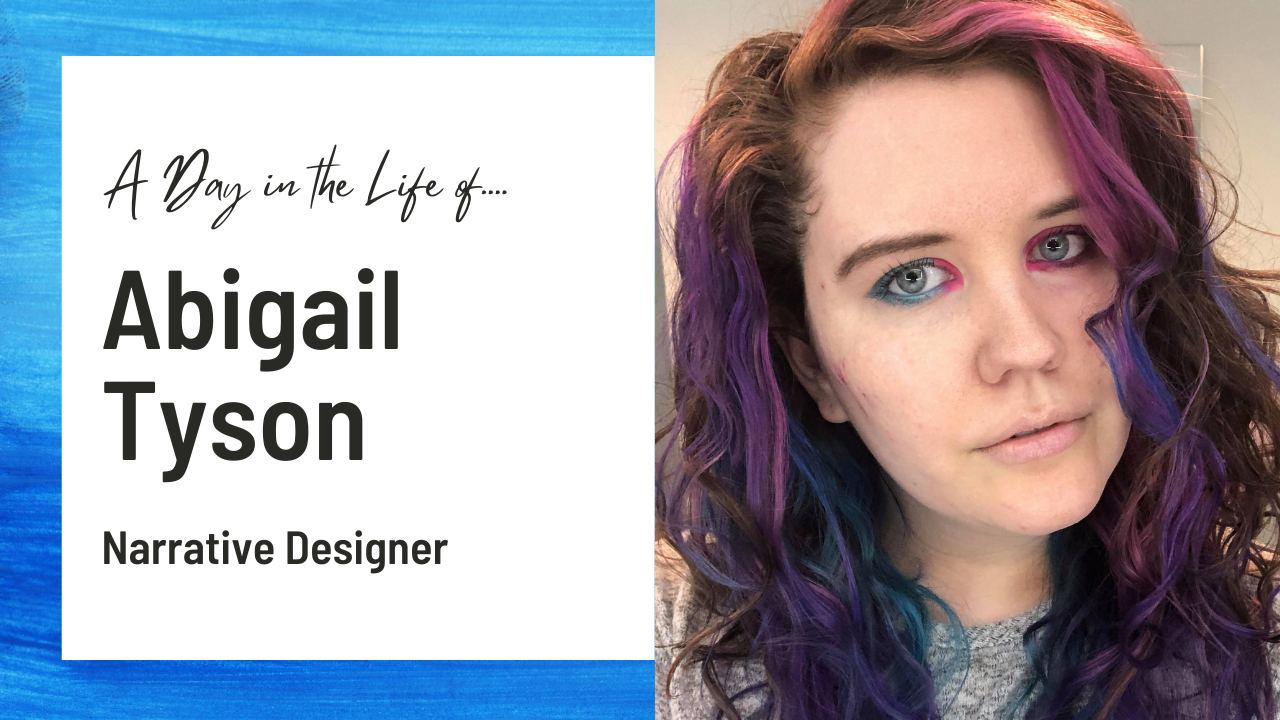
A Day in the Life of a Narrative Designer: Abigail Tyson on Breaking Into Games, Writing Stories, and the Life Off the Clock
Abigail Tyson is a narrative designer at Arkane Studios, which is a fancy way of saying she gets paid to build the stories, dialogue, and hidden text inside video games. She got there by a wonderfully crooked road that started in book publishing.
Her story is a good answer to anyone who thinks the games industry has one door and a secret password. It has neither. This is the full picture of how she got in, what the work is really like, and the life she keeps around it.
From book publishing to games
Abigail started in book publishing as an assistant publicist, a job she took reluctantly and then genuinely enjoyed, once setting up a choose-your-own-adventure blog tour for an author in about a week. She moved into editorial for young-adult and children’s books, the genre she loves, and it went badly.
I sort of thought the care that goes into these books goes into the books. Turns out it goes into people’s careers. The industry, especially on the children’s and YA side, is very competitive and very aggressive. I was disillusioned, and I left after a little over a year.
Abigail Tyson
She had always wanted to work in games and had no idea how to start, until a friend in Atlanta got her a QA contractor position at Adult Swim Games. Six months later she was hired full time as a production assistant, moved into marketing, and became a community manager at Bethesda Softworks for several years before the narrative-design role at Arkane opened up.
What a community manager actually does
Before the writing job, Abigail spent years as the bridge between players and the studio.
A community manager is the liaison between the fans and the studio. You make sure people know about cool games and updates, but in a fun way, not just, hello user, new content available. And you make it safe for players to tell you what they want, or when something’s broken.
Abigail Tyson
Her favorite project was an alternate-reality game for a Prey expansion: coded breadcrumbs and distorted images that led fans to a secret account and, finally, a simultaneous announcement and launch. It was her idea, and she is quick to credit the PR, brand, and influencer teams who made it real. That collaborative, many-hats reality overlaps with roles like product and UX design.
What a narrative designer does
Abigail has wanted to write since she was seven, when she pestered her mother for synonyms for the word “said.” Narrative games are the medium she cares about most, so the job was an instant yes.
I touch dialogue, pickup bubbles, the things you read when you pick them up, the overall story, and sometimes a very specific vignette where we ask, what can we add to make this a story. Anything that could be narratively related, I help with.
Abigail Tyson
If you have ever read the item descriptions in The Sims or gone digging through the lore books in a fantasy game, that is the kind of writing she means, and yes, she says, it is exactly as fun as it looks. Any writer will recognize the pull, including a novelist chasing a book deal.
How to break into the games industry
Abigail is refreshingly blunt that there is no standard path or degree.
Everyone I meet has a funny path. I know people with no interest in college who do great, and people with doctorates. Your mileage varies. What helped me was that all the writing work I did in college made my writing better times a billion.
Abigail Tyson
Her other piece of advice is the one people hate to hear and she would have hated too: sometimes it is who you know. A good friend who will vouch for you can make all the difference. So, she says, make friends with cool people. It is the same lesson other guests learned when they changed careers on the strength of a single relationship.
A day in the life, mostly heads-down
Abigail took the Arkane job during the pandemic and had never seen the office. What she values most is a supportive umbrella that treats “my brain just isn’t working today” as a real thing.
A lot of days it’s nose to the grindstone. I wake up, look at my to-do list and my checklist, and write what needs to be written. Forever and ever, which is great, because it’s exactly what I want out of a job.
Abigail Tyson
She likes meetings only when something is genuinely too complex for a four-paragraph email, and is candid about a harder edge of the work: being a woman in games. At the studios she has felt safe and well treated, and sees other women treated well too. The upsetting moments, she says, have almost always come at events rather than at work, where they are harder to guard against.
The life off the clock
Off hours, Abigail does slightly different versions of her job: she reads, she plays games, she writes. She loves baking for the simple reason that you end up with something delicious. She plays Dungeons and Dragons with her fiancé, whose two-year campaign ended with the party dispatching the final boss so fast the dungeon master reran it on hard mode. And she has a cabinet full of board games, having joined a Bay Area group and leaned, during the pandemic, on Board Game Arena.
She has thought a lot about why she plays the way she does.
I’ve learned to lean toward collaborative games rather than who’s-going-to-win games, because I get so mad, and that’s no fun for anybody.
Abigail Tyson
She is also clear about what draws her to young-adult stories, and she is protective of teenagers getting books that are for them.
Being a teenager is complicated. Big feelings about small things, crushes you don’t know what to do with. Teens need books to tell them the stuff they’re afraid to ask an adult they don’t trust. When I was in the industry and marketing said a book had no adult appeal, so no, that was infuriating. Teens need books for the things they are dealing with.
Abigail Tyson
She is getting married soon, after a long engagement she and her fiancé chose on purpose, and she rounds out the conversation with genuinely useful advice on keeping wildly colored hair healthy, cold water and sulfate-free products, which is its own kind of craft.
FAQ
Some of the most common questions about breaking into games, answered from Abigail’s winding path in.
How do you become a narrative designer or get into the games industry?
There is no single path or required degree. Many people enter through adjacent roles like QA, production, or marketing, then move toward the work they want. Strong writing and relationships matter; Abigail moved from book publishing through QA and marketing before landing narrative design.
What does a narrative designer do?
Writes and shapes everything story-related in a game: dialogue, in-world text, item and pickup descriptions, lore, and the overall narrative, often collaborating closely with designers and other writers.
Do you need a degree to work in games?
Not necessarily. Abigail has a bachelor’s degree and found that college sharpened her writing, but she knows successful people in the industry with no college and others with doctorates.
Is working in games a good career?
Abigail loves it and calls the daily writing exactly what she wants from a job. She is honest that playing games can bleed into work in your head, and that women in the industry still face harder moments, in her experience mostly at events rather than at supportive studios.
Final thoughts
The thread in Abigail’s story is that she followed the one thing she never stopped caring about, stories, straight through a career that looked nothing like a straight line. Publishing, QA, production, marketing, and finally the writing room were all the same pursuit wearing different job titles. She did not wait for permission or a perfect path. She kept moving toward the work that lit her up, and let the people she met open the doors.
What is the through-line you keep coming back to, no matter what job you are technically doing? What door might a single honest relationship open if you asked?