A Day in the Life of a Music Educator: Michael Nestor on Teaching, Jazz, and Getting Comfortable Being Uncomfortable
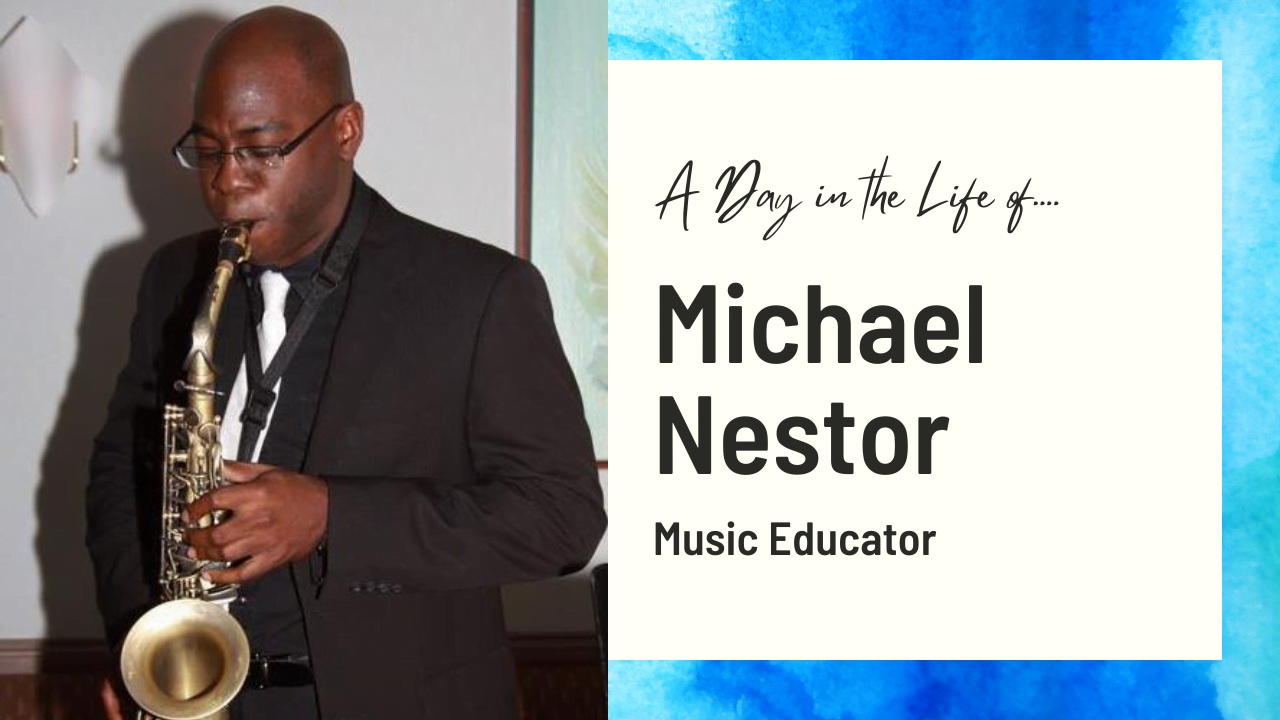
Michael Nestor is a music educator, a band director now teaching jazz and middle-school music at an independent school in Atlanta. He did not arrive at music the usual way, and he almost left it for a computer screen.
His story keeps circling one idea: the willingness to be bad at something, in front of people, until you are not. It shaped how he learned music, how he chose teaching, and what he tries to hand his students. This is the full picture, work and life.
How he taught himself to read music from a hymnal
Michael grew up in a military family and spent ages six to twelve in Germany. The church they attended had no instruments, only a pitch pipe and hymnals, and a young Michael worked out music from the page on his own.
I noticed when the pitch goes up, the notes go up. When it goes down, they go down. Then I wondered why all the ladies sang the top and the guys the bottom, so I tried the bottom. I basically taught myself to read music before I moved back to the States.
Michael Nestor
He plays saxophone for a wonderfully unglamorous reason: his dad liked smooth jazz and simply told him to. He has played since sixth grade.
Why he chose teaching, in a dark computer lab
Michael first went into music education thinking he was naturally good at it. Partway through college he got discouraged and switched to computer science for about half a year. He remembers the exact moment he switched back.
I walked into the programming class, it was dark and quiet except for the clackety-clack of keys, and I realized I needed the randomness of working with musicians, with kids, because kids are always random. Everything can’t be easy. Hard work is hard work no matter what.
Michael Nestor
He wanted the struggle that came with the thing he loved, rather than an easier path he did not. Anyone weighing that kind of switch will recognize the shape of changing direction on purpose, and of finding the teaching career that actually fits.
What it takes to become a music teacher
An instrumental music major has to be ready to teach every instrument, so Michael filled his cup while he could.
My thought was, if I don’t have an instrument in my hands, I’m going to have to sing, so choir is great. I’m a bassoonist, so orchestra gets me in. I took string methods because I’m terrible at strings, and if I’m going to conduct an orchestra someday, it helps to know exactly what I struggle with.
Michael Nestor
He volunteered for every ensemble he could, on the theory that not knowing what was coming was the best reason to learn everything. Performing ensembles were the highlight of his college life.
Why he loves teaching sixth through twelfth grade
Michael has taught almost every stripe of middle and high school, and now leans into jazz, partly by design and partly because small independent-school numbers make a jazz combo the ensemble that works. He can name what each grade gives him.
Sixth grade is the last time a student looks at you as the person who knows, and just wants to learn. Seventh grade is a sea of emotions. Eighth grade, you get to see the many people they might become. By senior year there’s this close-to-fully-formed person about to go to college, and then the ride’s over.
Michael Nestor
He also believes jazz grows kids faster than a concert ensemble, because improvisation puts them out on their own. And the way he teaches improvisation is really a lesson about fear.
You’re the only person who knows what you meant to play. Everyone else is just there to experience what you put out. Nobody knows you made a mistake unless you let the cat out of the bag.
Michael Nestor
On getting good at anything: keep running into the wall
Michael is honest that understanding an instrument is not the same as playing it, and that skill is just time. His favorite way to make that point is to talk about how anyone starts.
A great player sounded like a hot dumpster fire for a good while. We only hear people after they’re amazing. Kids just run through every musical brick wall as many times as it takes to knock it down, then keep running. As adults we look at the wall and say there’s no way through. Yes there is. Just keep running into it.
Michael Nestor
At forty, he figures, if he ran into the wall every day, he could knock it down by sixty. His practical advice for adults who want to keep playing is to find a community group, learn tunes by ear off recordings, and stop worrying about practice.
Don’t even worry about practice. Just have fun on your instrument. Playing every day is the thing that gets things moving, because you’re doing it because you want to.
Michael Nestor
A day in the life, and a pandemic pause
Michael had not conducted a school ensemble since March of 2020, the day before a large-group performance evaluation was shut down. He is clear-eyed about the loss and the openings it created.
It gave us educators time to stop and figure out what skills we could add. I got good with a ring light, with spreadsheets to organize the library, with the YouTube resources I was hunting for inspiration in. Somewhere out there a couple of players practiced their backside off every day, and we’ll hear about them in five to ten years.
Michael Nestor
The life around the music
At home, Michael is, by his own description, his kids’ favorite jungle gym. Since moving to the Atlanta area, the family walks a new city or trail most weekends. He tinkers with carpentry when he can, makes electronic music in Logic purely for his own enjoyment, and cooks for the family, though his daughters have been known to reject his salmon for peanut butter and jelly.
There is a neat wrinkle at work: his wife is the head of the middle school, though he reports to the arts coordinator, which his six-year-old has already turned into material, once asking whether his boss yelled at him for being late. Both girls love to sing, and he lights up describing the two-year-old catching upbeats in time and the six-year-old, Amelia, eyeing the bass after watching Esperanza Spalding.
That comfort in front of a room took him years to earn. Moving from welcoming Germany to small-town Georgia at thirteen was a jolt, and it taught him something he still teaches.
It got me to a point where I realized I’m just going to be comfortable being uncomfortable. I’m not worried about anyone else’s seal of approval. I’m just going to do what I do.
Michael Nestor
FAQ
A few questions people often ask about teaching music, answered from Michael’s years in the classroom.
How do you become a music teacher?
Most music educators earn a degree in music education, which trains you to teach a wide range of instruments and ensembles. Michael advises playing in and volunteering for as many ensembles as possible, since you rarely know which grades, instruments, or styles you will end up teaching.
What does a music educator actually do?
Teach instrumental and vocal music across grade levels, direct ensembles like concert and jazz bands, build programs sometimes from scratch, and, increasingly, create digital learning resources. Much of the real work is meeting each student where they are.
How can an adult stay involved in music?
Join a community band or ensemble (only a small fraction of high-school players continue in college, so many adults want to play), learn tunes by ear from recordings, and use free online play-alongs. Michael’s advice is to stop worrying about formal practice and just play every day for fun.
Is music education a good career?
Michael loves the daily unpredictability and being part of kids’ formation over six to twelve grades. He is honest that it is demanding, and that the pandemic forced hard changes on how music gets taught.
Final thoughts
The thread in Michael’s story is that he keeps choosing the harder, more alive version of things: the noisy classroom over the quiet code, the instrument he is bad at over the one he has mastered, the improvised solo where a wrong note only matters if you flinch. What he really teaches, under the scales and the jazz tunes, is how to be comfortable being uncomfortable, and to keep running at the wall.
Where in your own life have you been standing back from a wall, telling yourself there is no way through? What would it look like to just keep running at it?