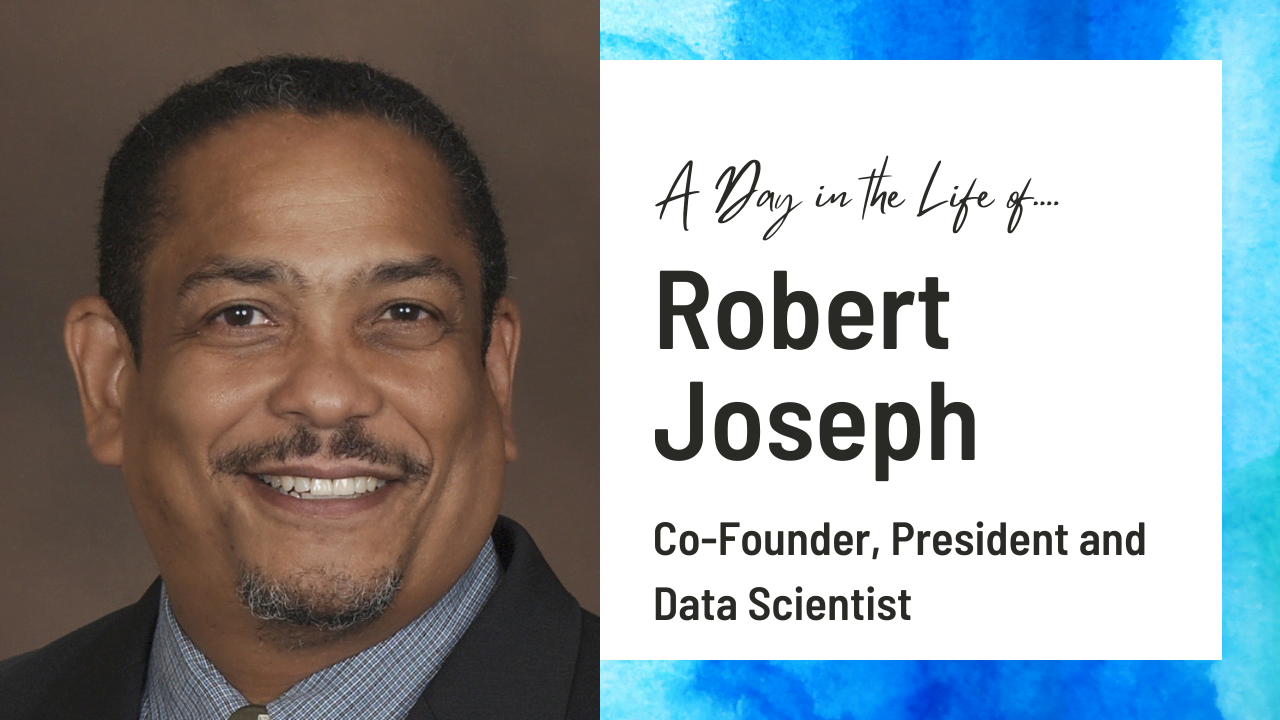
A Day in the Life of a Data Scientist and Entrepreneur: Robert Joseph on AI, Building Companies, and the Mindset That Changes Everything
Robert Joseph has had, by any measure, several careers: physicist-turned-electrical-engineer, AI researcher, software developer, data scientist, university educator, and co-founder of two companies. The thread running through all of it is a single piece of advice he keeps returning to: follow your passion, and put food on the table while you do.
His story is a rare long view of a technology career, from the days when, as he puts it, “AI was almost cool,” to now. This is the full picture: the work, the companies, and the mindset he teaches everyone he meets.
A career that came full circle
Robert started college intending to be a physicist, took one calculus-for-physicists course at MIT, and realized he wanted something more hands-on. He became an electrical engineer, fell for an AI course along the way, and went on to a Carnegie Mellon PhD in computer science with an AI minor. From there his path wound through a telephone company doing early AI, then software development of every kind, and eventually looped back to data science.
My career has gone from AI to development to a lot of different kinds of development, and then full circle, and now I’m back as a data scientist. And I’ve always had a passion for education.
Robert Joseph
He has watched the field transform. One of his early projects was a piano-tutoring system that taught people to play with no human intervention, pushing the limits of what AI could then do. Faster computers and breakthroughs in neural networks did the rest.
Now, with open-source tools, anybody can do sophisticated AI. It’s no longer a cost thing. It’s brought AI to the doorstep of anybody willing to spend the time.
Robert Joseph
Do you need a PhD to be a data scientist?
Robert loves school, so he is careful not to oversell his own path.
You do not have to get a PhD. There are people in high school, even elementary school, doing AI now. But if you have a passion for it, follow that.
Robert Joseph
He does note two real advantages a PhD confers: it is now effectively required to teach at a university, and it signals, permanently, that you know how to take a project somewhere no one has taken it before, which buys you the leeway to explore. That same curiosity about how systems come together shows up in adjacent roles like software development and product management.
The mindset he teaches everyone
Robert’s company, Team Mindshift, is built around a lesson he has repeated to adult learners for years. Students would tell him they were not good at math.
I’d ask, what’s one plus one? They’d say that’s easy. But at some point in your life that was hard. It’s not about easy or hard, it’s about turning the unknown into the known. The thing you control is what you tell yourself. Instead of ‘I’m not good at math,’ say ‘I’m getting better at math.’ That puts you in the driver’s seat.
Robert Joseph
It is a small reframe with a large reach, and it maps almost exactly onto the work of reclaiming your own internal authority over what you are capable of learning. He pairs it with a belief in conceptual learning over memorizing “how to do X,” since technology moves too fast to keep up any other way.
Building companies, and how he decides what to build
Robert has been an entrepreneur, in his words, “since I was knee-high to a grasshopper,” selling decorated matchboxes for a nickel at age five. He and his business partner have known each other since undergrad and run companies together, remotely, for decades, which made the pandemic shift less jarring than it was for most. When they weigh a new direction, four questions decide it.
Does it fit our expertise and unique value? Is it something we actually want to do and like doing? And will it make money in a sustainable way, not just as a fad? All of that goes into the decision.
Robert Joseph
The life around the work
Robert follows his passion into his hobbies the same way he follows it into work: he picks something up, and if he likes it, he goes deep. Lately that has been jigsaw puzzles, with friends and with his kids. He swims, watches movies, travels when he can, and listens to sci-fi and self-help audiobooks while he walks or rides a stationary bike.
Family, though, comes first, and he is deliberate about it. When his sons were young and taking Taekwondo, he joined the group and trained alongside them. He treats their events as sacred on his calendar and simply tells clients so.
I put the kids’ stuff on the calendar and I call that time sacred. I’ll tell people, my kids are important to me, is there another time that works? If someone says they’re more important than my kids, maybe that’s not who I want to work with.
Robert Joseph
Watching his two sons grow into their own personalities, he says, has been the most rewarding part of it all.
FAQ
A few of the questions people ask most about a career in data science, answered from Robert’s long view of the field.
How do you become a data scientist?
Build a strong foundation in math, programming, and the concepts behind AI and machine learning. A computer science or engineering degree helps, but open-source tools now let people at every level practice. Robert came up through electrical engineering and a PhD, but stresses there is no single path.
Do you need a PhD to work in data science or AI?
No. Robert is emphatic that high-school and even elementary students do AI work today. A PhD is worth it if you love school, want to teach at a university, or want the research credibility that opens certain doors.
What does a data scientist actually do?
Apply AI and analytical techniques to real problems, from vision and natural-language processing to building and personalizing software. In Robert’s case, that increasingly means AI-driven education tools built around how people actually learn.
Is data science a good career?
Robert has found decades of range in it, from research to development to entrepreneurship. He frames it as following your passion while making sure the work also supports your life.
Final thoughts
The thread in Robert’s story is that curiosity, followed honestly and for long enough, compounds. A physics course he did not love led to engineering, which led to AI, which led to companies and classrooms and a philosophy of learning he now hands to everyone. And underneath all of it is the reframe he teaches: you are not “bad at” the hard thing. You are getting better at it, the moment you decide to be.
What is the thing you have been telling yourself you are “not good at”? What changes if you say instead that you are getting better at it?