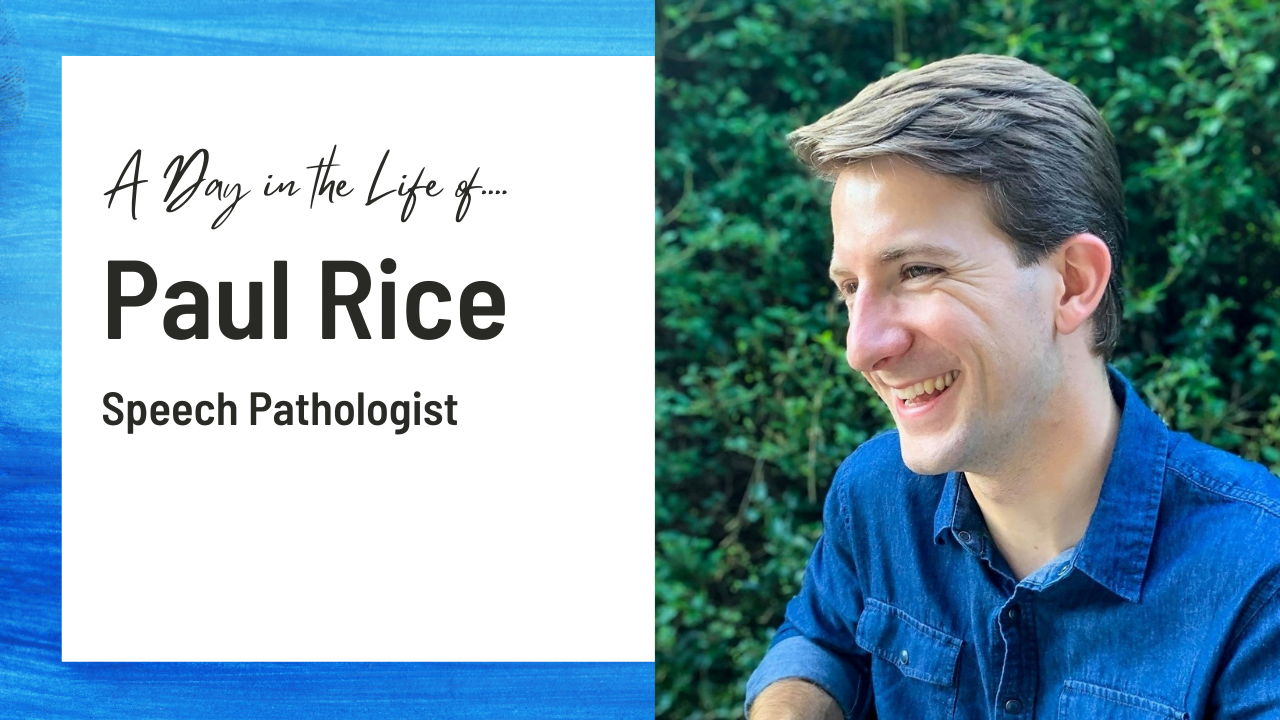
A Day in the Life of a Pediatric Speech Pathologist: Paul Rice on Leaving the Newsroom, School Days, and the Life Around the Work
Paul Rice spent his early career at a newspaper, editing copy and designing pages, before an unexpected assignment set him on a completely different road. Today he is a pediatric speech pathologist, working with children in the school system on the sounds and the language that let them make themselves understood.
His path is a good argument against the idea that a career has to be a straight line. The same curiosity that made him a strong journalist, wanting to get exposed to lots of different things and figure out what mattered, is what led him into a field he had barely considered. This is the full picture: what the work is, how he got there, and the life he has built around it.
What does a pediatric speech pathologist actually do?
Paul works mainly with kids, mostly in schools, on two fronts. The first is speech itself, the sounds of English that a child is not yet making, or not making correctly.
Think about all the different sounds we make in English. A lot of these kids aren’t making those sounds, or not making them correctly for whatever reason, so we’re working to rehabilitate that.
Paul Rice
The second is language, which runs from grammar on the advanced end all the way down to the most basic act of communicating at all, sometimes with words, sometimes through signing or picture boards. His caseload stretches from early intervention with children from birth to three, up through school age.
And because his clients are young, the method looks a lot like play.
As adults we learn through work and lectures, a very formal way. For kids, work is play. That’s how they learn, how they pick things up, how they experience a lot of life. So I make sure there’s a good balance of play-based therapy and the specific goals we’re working on each session.
Paul Rice
How Paul went from the newsroom to speech therapy
Paul started at a newspaper as a copyeditor and page designer, then moved into a digital content coordinator role, running the paper’s website and social channels. He knew from the start it probably was not his long-term home, and he treated it as a place to get exposed to as much as possible.
The turn came from a single assignment: a year-long project on neonatal abstinence syndrome, the condition of babies born dependent on opioids. Reporting it, Paul kept interviewing speech therapists who work in neonatal intensive care units, rehabilitating skills like swallowing and feeding.
That brought me back to speech pathology, which I’d heard about through some linguistics courses in college. For whatever reason it hadn’t clicked. But talking with these people, I thought, actually, this seems kind of awesome.
Paul Rice
He started shadowing, then took the prerequisite courses at night while still at the paper, then went to graduate school. He began by looking at the highly specialized NICU branch and ended up gravitating toward pediatric therapy in schools and private practice. For anyone considering a similar pivot, his story sits alongside other guests who have navigated a real career change.
How to become a speech pathologist
Paul’s route ran through a bachelor’s degree and then a master’s, with a stack of prerequisites in between. He counted roughly six courses specific to the field.
Phonetics, so the international phonetic alphabet from a clinical point of view. A lot of anatomy and physiology of both speech and hearing, the oral mechanisms, respiratory, ears. A lot of neurology, since we’re working with language. And typical language development. It’s laying the groundwork so you have a strong framework for all the different things you’ll see.
Paul Rice
He is quick to say the science courses paid off, especially physics, which underpins voice work: measuring the amplitude of the sound a person produces. That opens a whole other niche, working with professional voice users like singers, pastors, and especially teachers, whose vocal folds take a beating from heavy daily use. It is one reason his field overlaps with people figuring out a teaching career and with professional musicians who rely on their instrument.
A day in the life: libraries, hallways, and Mr. Potato Head
Paul works as a contractor, through a private practice that contracts with school districts to cover the surplus caseload the schools’ own therapists cannot reach, at no cost to the district. In practice, that means he has no classroom of his own.
I don’t have a set-aside classroom since I’m not a school employee, so I practice in all kinds of locations. I’ve worked out of a library, at tables in the hallway.
Paul Rice
He is up around six, at school by 7:30 or 7:45, and into back-to-back twenty-minute sessions. For speech goals, that means heavy repetition made bearable with board games and activities, a mirror nearby so kids can watch what their teeth, lips, and tongue are doing.
If they have to think too much about the fact that they’re working, it’s not going to be enjoyable for anyone.
Paul Rice
For language goals with the youngest kids, he reaches for toys, blocks, and Mr. Potato Head, and works from what he calls communication temptations.
A lot of kids could be perfectly happy and never say anything. Everyone needs a reason to communicate. So I get to know what a kid likes and wants to do, and use that to create reasons to communicate.
Paul Rice
Afternoons bring the birth-to-three early intervention clients at daycares and homes. He wraps with notes and billing and drives home around four. The one constant is that no two days look the same, and in a hard year the schedule can change week to week, which he admits can tip from refreshing into overwhelming.
The life around the work: board games, Edward Hopper, chess, and a garden
The half of Paul that has nothing to do with speech goals is just as full.
He designed his own board game, a resource-and-railroads strategy game inspired by Titan, Ron Chernow’s biography of John D. Rockefeller. He got the idea listening to the audiobook and imagining the messy, rules-free early oil business: crude coming out of the Pennsylvania mountains, railroads to monopolize, refineries in the cities. It has been through two playtests and still needs work, which he takes with good humor.
He paints, too. He took art lessons from age five through eighth grade, dropped it entirely in college for lack of time and mental space, then picked it back up. During lockdown he made careful acrylic copies of Edward Hopper paintings, including the famous late-night diner scene, Nighthawks. His advice for a beginner is acrylic over watercolor, because you can build it up and rework it, though it dries fast.
Chess became a lockdown ritual, five or ten focused minutes on chess.com that pulled his mind off everything else. His mother taught him growing up, and he has still never beaten her. Like a lot of players, he finds the endgame the hardest part, when only a few pieces are left and the whole thing has to be brought home. Lately he has been playing a casual game against his young cousin over a phone app, and losing gracefully.
And he gardens. After moving to a new home, he planted blackberry vines and blueberry bushes, then started tomatoes, peppers, and eggplants from cheap seed, growing everything with just dirt, water, and sunlight. It is the same instinct that runs through his hobbies, a preference for the slow, hands-on, offline version of a thing, the kind of unplugged attention that is easy to lose.
FAQ
The questions people ask most about a career in speech pathology, answered from Paul’s path and his day-to-day.
How do you become a speech pathologist?
Most speech-language pathologists earn a bachelor’s degree, complete prerequisite coursework (phonetics, anatomy and physiology of speech and hearing, neurology, and language development), then finish a master’s degree with supervised clinical internships. Paul came to it after a first career in journalism, so a nonlinear path is common.
What does a pediatric speech pathologist do all day?
Back-to-back short sessions with children, working on either speech sounds (through repetition, a mirror, and games) or language (through toys and play that create reasons to communicate), often across more than one school, plus early intervention with the youngest kids and end-of-day notes and billing.
Do you need a science background for speech pathology?
It helps. Paul found biology and especially physics valuable, since voice work involves measuring sound, and the field covers a lot of anatomy, physiology, and neurology.
Is speech pathology a good career?
Paul describes it as fun, varied, and rarely the same day twice, with real reward in helping a child communicate. He is also candid that a constantly shifting schedule can become overwhelming, so the variety cuts both ways.
Final thoughts
The thread in Paul’s story is that nothing he loves is walled off from anything else. The curiosity that made him a good journalist made him a good clinician. The patience it takes to teach a child a single sound is the patience of a slow chess endgame, a garden grown from seed, an acrylic copy of a Hopper. He did not so much switch careers as follow his attention where it wanted to go, which is its own quiet form of trusting yourself.
When a job you took as a stepping stone points you somewhere you never planned to go, do you follow it, or talk yourself out of it? What has your own attention been pointing at lately?