A Day in the Life of a Project Manager: Dan Carroll on the Russian-Translator Path Into IT, Running Media Relations for Dragon Con, and Knowing What You’re Good At
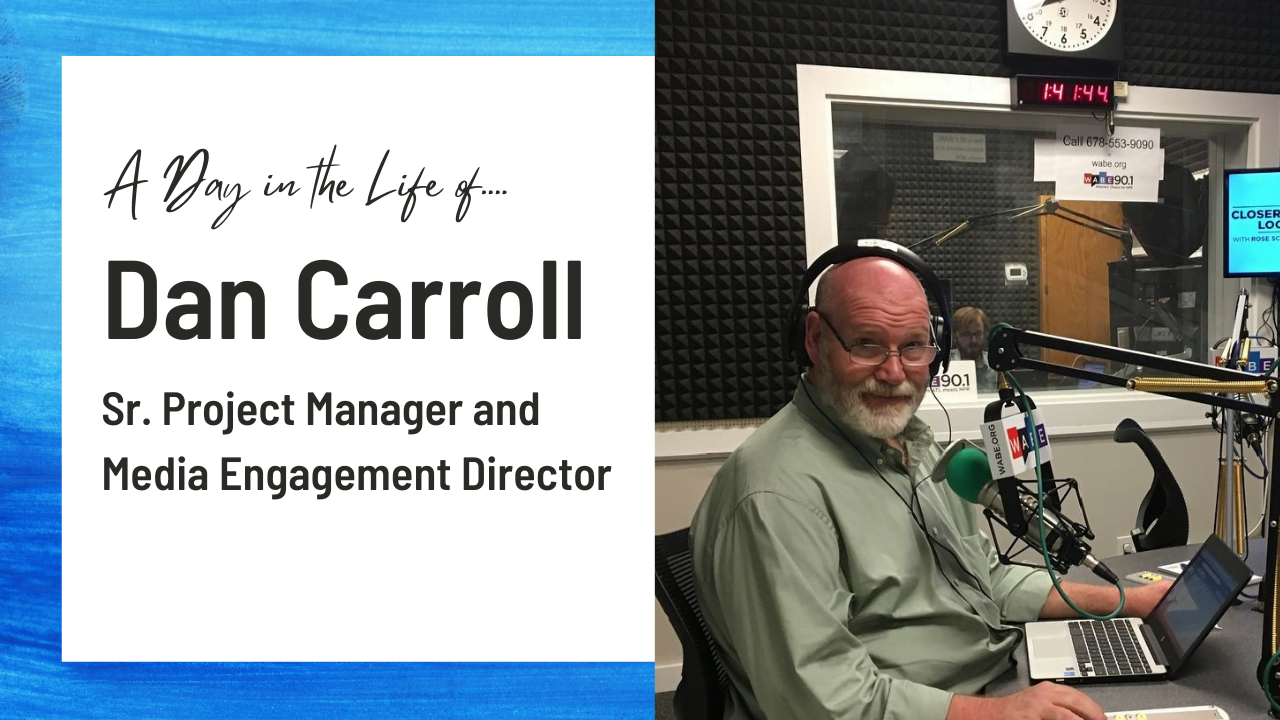
Dan Carroll lives two working lives at once. By day he is a senior project manager and contract consultant in Atlanta’s IT world, delivering software and data-center projects on scope, budget, and timeline. The rest of the year he runs media relations for Dragon Con, Atlanta’s largest science-fiction and fantasy convention, the spokesperson who fields the press for a Labor Day weekend that takes over downtown Atlanta.
The surprising part is where he started. Before the certifications and the contracts, Dan was a Soviet analyst and Russian translator in the Navy, on track for a PhD in Soviet studies and a year in Siberia. Then the Soviet Union collapsed, the funding vanished, and he built a whole new career out of a few computer skills he had taught himself on the side.
This is the full picture: the day job, the second life, and the throughline connecting them. Dan is also a longtime mentor to the graduate students and volunteers who pass through his media relations team at MomoCon and Dragon Con.
What a project manager actually does all day
Dan keeps his definition simple. A project is a set of goals delivered inside a fixed timeline and a fixed budget, so his job is to manage scope, budget, and timeline until the result exists. In practice that means running several at once: in his current role, a risk-management project going through February and a separate HR project wrapping in September, each with its own meetings and moving parts.
As a contract consultant, most of his career has been project-based, which suits him: he can take shorter or longer contracts as the work fits. Since the shift to remote work, his day starts with an hour set aside for himself before anything else, a video game or an episode of Loki or Bob’s Burgers or The Bad Batch. He handles his Dragon Con email before 8:30, because he holds himself to answering within eight business hours year-round. He does not drink coffee. Then he opens his work inbox, coordinating with partners scattered across every US time zone, and logs off at five, keeping a hard stop so a contractor’s forty-hour week stays a forty-hour week.
The meetings are the center of the day, and he prepares deliberately, blocking a half hour for each and taking a four-minute meditation before he walks in. What he is really managing, he says, is the room as much as the schedule.
Project management is 50% organization and 50% diplomacy. I find that’s kind of a true statement.
Dan Carroll
Half the job, in other words, is confidence and team building: showing focus and leadership so the people around him find their footing too. The role has a lot in common with a program manager juggling parallel workstreams, and with a product manager who lives and dies by scope and timeline.
How Dan became a project manager
Dan calls his path a convoluted trail, and he is not exaggerating. It began in the Navy, where a plan to become a journalist ran into a test score that steered him elsewhere. Offered a year in Monterey, California, learning a foreign language, he hoped for Chinese, German, or Japanese and got a choice between Arabic and Russian. Already at home with the nineteenth-century Russian writers, he chose Russian: forty-seven weeks of class, six hours a day plus three hours of homework, then classified schools and three years stationed in Spain, sailing through the Middle East on occasion.
He came out a Russian translator with a PhD track ahead of him and a scholarship to study at Oxford. Then the Soviet Union collapsed, Soviet-studies funding evaporated, and the academic future he had trained for closed almost overnight. He had some computer skills, so he leaned on them. Within a couple of years he was writing HTML, back when the role was called “HTML author” and the word “developer” barely existed yet. He taught himself SQL and back-end development, worked as a Microsoft developer in a language called ASP, and near the end of the dot-com bust landed his first job with “manager” in the title: documentation manager on a $75 million data-center design with seventeen departments expected to work together, and sometimes against each other.
That project taught him something about himself. He loved organizing the chaos, and it showed. He earned a corporate award for organizational excellence, which amused everyone who knew him as a scatterbrained, self-described ADD personality who had somehow become the hyper-organized one in the room. He sat for the Project Management Professional exam, the PMP, earned the certification sixteen years ago, and has worked in project management ever since, mostly in IT with an emphasis on software delivery, and often on infrastructure and data centers. Before any of that, though, he was a working software developer, which is a large part of why he can still speak both languages fluently.
How to become a project manager
The formal credential is the PMP, a well-regarded certification that Dan holds and renews on a cycle. But that is not the whole story of how he built a career; his real advice is about positioning. Early on he realized he was good at building connections and bad at asking for money, which made him a poor salesperson but a natural translator between the people who write the requirements and the people who build the software. Working alongside colleagues from India, Pakistan, and across the US, he became the one who could turn plain business language into technical terms and back again.
That crossroads became his entire pitch.
You will find better developers, and you will find better consultants. What you’re not going to find is somebody who’s going to live at that crossroads between technology and communications. And if that’s what you need, I’m your guy.
Dan Carroll
His guidance for anyone starting out is to figure out the one thing you do better than most and say it plainly, even if that means minimizing what you are weaker at. He took jobs from stronger technical developers precisely because that was not what he was selling. That instinct to brand and sell himself has an entrepreneurial streak, closer than you would expect to the leap from data scientist to entrepreneur: know your value, name it, and deliver on it.
The best and hardest parts of the job
The freedom is the draw. Contract work lets Dan choose the length and shape of each engagement, and over time he found a rhythm that paid: three-month contracts often came in at a higher hourly rate, and when they extended into eighteen months or two years, he kept the rate. He tells the story of a recruiter who chased him to Omaha years ago, where he named a rate high enough to end the conversation and instead got the interview, the job, and a company that taught him SQL.
The harder parts are less visible. Diplomacy can mean walking into a 24-hour data-center build for a major Atlanta airline where a single failure escalates to the top of the organization within minutes. Dan is candid about his own temperament, too: he is patient with the people he works with, sometimes too patient, and patient with himself, so he pushes the other way to project the confidence a room needs.
Is project management a good career? Dan’s honest take
Dan’s honest answer has little to do with salary bands. What made his career durable, he says, was consistency of character: he told interviewers exactly who he was, showed up as that same person, and left references who could vouch that he did what he said. In a field where trust is the currency, that reputation compounded across contract after contract.
He points back to a pattern that started long before project management. In a Navy department full of polyglots and communicators, he was the one the senior chief tapped to write the recommendations, because he was good with words. His career, he notes with a laugh, is documented proof of the one skill he has always been able to name, even if he is a terrible typist.
Dan’s second life: media relations at Dragon Con
The second life started from a hard year. After a close friend died suddenly in 2006, Dan took stock of how he was spending his time, right as his children were leaving for the Navy and college and the house was going quiet. He looked at Dragon Con, learned that a one-time $20 fee bought a lifetime of volunteering, and signed up for what he assumed was guest services. In convention terms, “guests” means the celebrities, so he was pointed to information services instead, where he spent three years telling people where to find the bathroom.
When a role then called “press liaison” opened up, he went through a three-month volunteer interview process to get it, and the first thing he did on arrival was rename it media relations. He has since been promoted to lead the whole operation, focused on the spokesperson side rather than the paperwork. The scale he handles has grown fast: Dragon Con went from 29,000 attendees the year before he took over to roughly 85,000, with 90,000 expected the year the pandemic capped attendance, a threefold jump in eleven years.
The stories are the payoff. On his first day at the help desk, a man with a cane asked for help finding his friend; Dan stood up out of respect, looked at the badge, and realized he was talking to David Prowse, the body of Darth Vader, searching for Peter Mayhew, the body of Chewbacca.
So my first full day working, I turned into Lando Calrissian and was able to turn Chewbacca over to Darth Vader.
Dan Carroll
Not every moment was so charming. He once chased a crew of reporters across three connected hotels after they cornered Carrie Fisher backstage and refused to let her leave without an interview. It got heated enough to land on video, until a group of cosplayers wandered into frame and clowned around so thoroughly the footage was ruined. As Dan tells it, the monkeys saved him.
The life around the work
The Russian that started his career came back around in the best way. His son followed him into the Navy wanting to be a cryptologist, ended up learning Russian too, and later married a Ukrainian wife, so Dan can now talk with his granddaughter in the language he once thought had cost him a future.
His fandoms are wide and a little bit ungovernable. Stargate and Dead Like Me first pulled him toward Dragon Con. He grew up on Marvel comics and once sold three copies of Giant-Size X-Men #1 for pennies at his father’s insistence, long before they were worth a fortune. He is a lifelong Dune reader, and he spent the pandemic listening to more than 400 hours of Brandon Sanderson’s Stormlight Archive before starting The Wheel of Time ahead of its show. His concert history runs from a Springsteen-adjacent bar band to bubblegum pop, which tells you most of what you need to know.
What he keeps circling back to is a microphone. He used to host a radio show and podcast, and he is building a new show about revisiting the pilot episodes of forgotten television with people who love them, hate them, or were not alive when they aired.
I always assumed I would either end up as a priest or a minister, or I would end up as a stand-up comedian. Either way, I get a microphone, and people have to listen to me.
Dan Carroll
FAQ
A few of the questions people ask most about becoming a project manager, answered from Dan’s own career.
What does a project manager do all day?
They manage the scope, budget, and timeline of one or more projects at once, running meetings, coordinating people across teams and time zones, and keeping everyone aligned on the goal. Dan describes the work as half organization and half diplomacy.
How do you become a project manager?
Many project managers earn the Project Management Professional certification, the PMP, as Dan did. Just as important is the ability to sit at the crossroads of the technical and the human, translating between the people who build things and the people who need them built.
Do you need a technical background to be a project manager?
It helps, though it is not the only route. Dan came up through HTML, SQL, and back-end development, and that fluency lets him translate requirements. He is quick to say his value is communication and organization, not being the best coder in the room.
Is project management a good career?
Dan thinks so, especially for people who like variety and can hold a room together. He values the flexibility of contract work and the trust he has built over the years, and he is honest that the job runs on diplomacy and confidence as much as on process.
Final thoughts
The thread running through Dan’s story is that he kept choosing work that matched who he actually is, even when the plan he trained for fell apart under him. A collapsed empire moved him into computers, a hard year toward a microphone and a volunteer badge, and the constant was a man who knew what he was good at and was not shy about saying so.
If the future you were preparing for disappeared tomorrow, what skill of yours would carry you into the next one?