
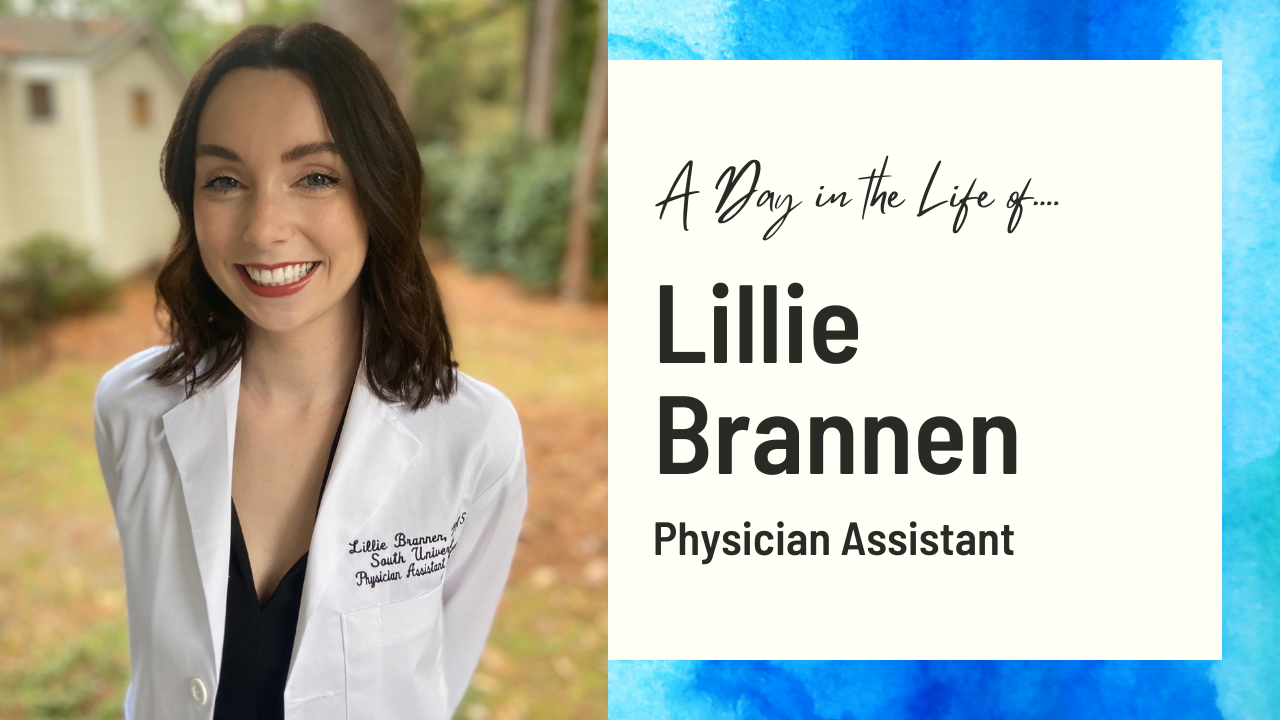
A Day in the Life of a Physician Assistant: Lillie Brannen on the Winding Road In, the Real Cost of PA School, and Lateral Mobility
Lillie Brannen is a physician assistant, a career she landed in almost by accident, after trying hard to prove she was not meant for medicine at all. The original title said it best: it was a backfiring plan.
Her story is unusually useful for anyone considering the field, because she is candid about the parts most people skip: the winding road in, the real price tag of PA school, and the freedom that drew her in the first place. This is the full picture.
The plan that backfired
Lillie never wanted to be in medicine. She had dreamed of being a veterinarian since she was little, until a pre-vet friend walked her through the harder realities of the job and she realized her version had been idealized. Adrift but good at science, she assumed she would end up in a lab. Her parents kept nudging her toward medicine, and she pushed back.
It was almost one of those things where I was like, fine, I’ll take this career test and prove to you guys I’m not meant to be in medicine. And it backfired.
Lillie Brannen
The test returned five results, all of them physician assistant. She decided her senior year, left a biology master’s program she had already been accepted into, worked as a medical assistant and then a research assistant, got denied from PA school twice, and applied a third and final time. Anyone whose plan took an unexpected turn will recognize that kind of career change.
What a physician assistant actually is
Lillie is used to the confusion, so she explains it cleanly. A physician assistant (soon to be called a physician associate) is a provider.
A PA can see their own patients, write prescriptions, order and interpret labs, do minor surgical procedures, and work in any specialty. We’re kind of the intermediary, we share duties with doctors and with nurses and medical assistants.
Lillie Brannen
She also clears up the PA-versus-nurse-practitioner question: the roles are nearly identical, but the path differs. Nurse practitioners come up through nursing. PA school was created at Duke for military medics who had medical training but were neither doctors nor nurses, so it still draws EMTs, medical assistants, and techs who want to do more without starting over. It sits alongside other care and communication roles like a pharmacist, a nurse, or a veterinarian.
The part she loves: lateral mobility
Ask Lillie the biggest draw and she does not hesitate.
PAs have what’s called lateral mobility. We can move between specialties, no residency required. I can work primary care, then the ER, then dermatology. I couldn’t imagine doing one thing for the rest of my life, and as a PA I don’t have to.
Lillie Brannen
The hardest part, she says, is having to defend her right to be there, since some still view PAs as “pretend doctors.” She takes comfort that PAs and nurse practitioners, both mid-level providers, tend to stand together.
The real cost of PA school (the part nobody mentions)
This is the section Lillie most wanted to talk about, because she thinks it gets glossed over.
People say PA school is cheaper than med school. Technically true. But I live with my parents for free and I’ll still come out around $110,000 in tuition debt, and that’s before cost of living or applications.
Lillie Brannen
She lays out the hidden math: the centralized application runs a few hundred dollars per school, you are told to apply to at least seven, supplemental applications add more, and a non-refundable deposit holds your seat. Her program had roughly 2,000 applicants for 70 spots, and most PA schools take only 40. Worth it, she insists, for both the pay and the fulfillment, but not a decision to make because you think it will be cheap.
How to become a physician assistant
The route runs through a bachelor’s degree and then a roughly 27-month master’s, with a stack of prerequisites and patient-care experience in between. PA school is intensely competitive, and Lillie’s own three-application journey is a fair warning that persistence is part of it. Her second year is all clinical rotations: seven required ones (primary care, internal medicine, emergency, general surgery, pediatrics, ob-gyn) plus an elective, each at a different site, with housing you find and pay for yourself.
A day in the life on a surgery rotation
On clinic days you start seeing patients around 8:30, gallbladders, hernias, scheduling surgeries and walking through the risks. On OR days you’re first assisting: suctioning, holding retractors, closing wounds, stitching. Three or four surgeries on a busy day, then you check on your post-op patients.
Lillie Brannen
She started PA school in January 2020, so the pandemic pushed much of it online, which meant a lot of at-home suturing and knot-tying practice, and constant worry about exposing her family between rotations.
The life around the work
Lillie is the first to admit her work-life balance is rough: if she is not at work she is studying, and if she is not studying she is on TikTok or asleep. On a break she loves new restaurants and, especially, interesting bars. Her boyfriend collects board games, so they play a lot of them, the stranger the better, and she is a devoted reader of anime, manga, and webtoons like Lore Olympus and Tower of God.
Her long-term dream is to become a traveling PA, working locum tenens assignments across the country, three months here, three months there, seeing every specialty. She wants a home base near her parents so she can take real time between assignments, and if she ever finds the thing she loves most, she can settle into it for good.
FAQ
A few of the questions people ask most about becoming a physician assistant, answered from Lillie’s own path.
How do you become a physician assistant?
Earn a bachelor’s degree, complete prerequisite coursework and patient-care experience, then finish a roughly 27-month master’s PA program and pass certification. Admission is very competitive, so many applicants apply more than once, as Lillie did.
What is the difference between a physician assistant and a nurse practitioner?
The roles are nearly identical in what they do; the training path differs. Nurse practitioners come up through nursing, while PAs enter from a broader mix of medical backgrounds through PA school.
How much does PA school cost?
More than people expect. Even living at home, Lillie will graduate around $110,000 in tuition debt, on top of roughly $1,000 to $1,500 just to apply and a non-refundable seat deposit.
Is being a physician assistant a good career?
Lillie finds it fulfilling and well paid, and prizes the lateral mobility to switch specialties without a residency. She is honest that PA school is expensive and competitive, and that PAs sometimes have to defend the value of their role.
Final thoughts
The thread in Lillie’s story is that the plan she made to avoid medicine handed her exactly the career she needed. She stopped fighting the evidence, applied until she got in, and chose a profession built around never having to be just one thing. Her honesty about the money and the rejections is its own kind of care, the same instinct that makes her good at the job.
If a career test told you the truth you had been arguing with, would you listen? What have you been quietly ruling out that might be worth a second look?