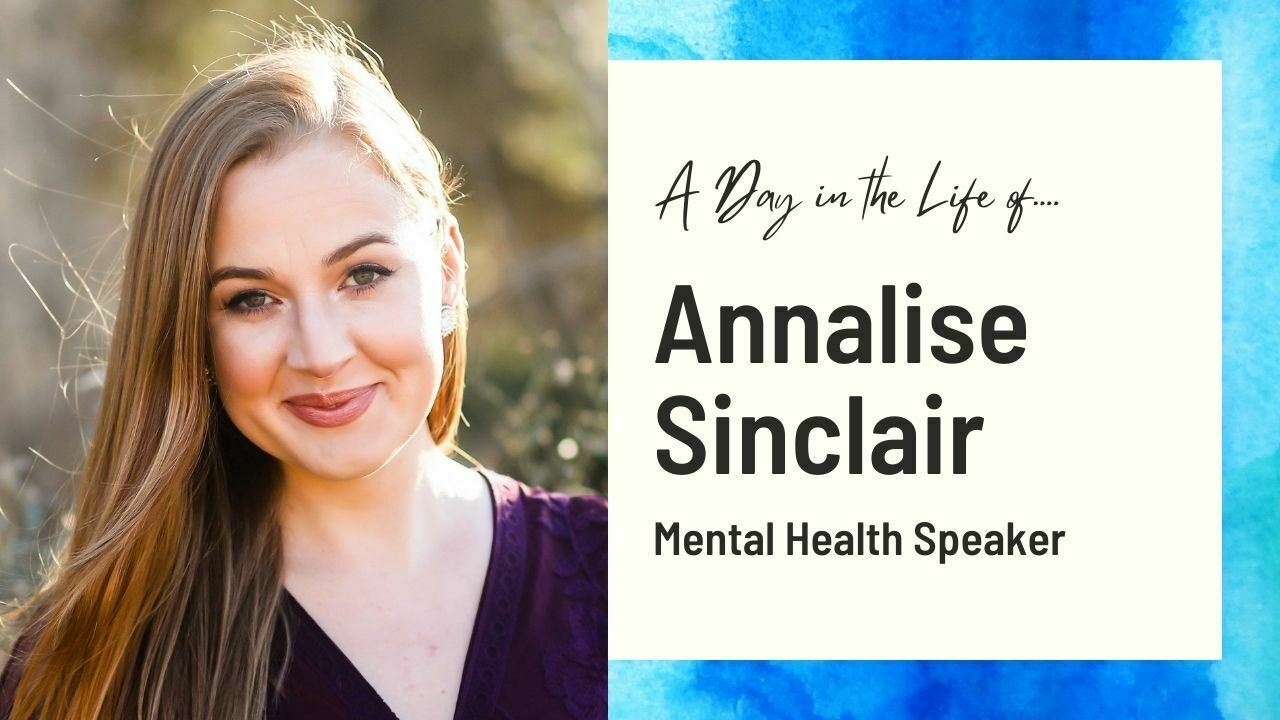
A Day in the Life of a Mental Health Speaker: Annalise Sinclair on Speaking Openly About Bipolar Disorder, Building a Business in a Pandemic, and Why You Are Enough
Annalise Sinclair spent years telling college students to be themselves while keeping her own biggest secret locked away. She was diagnosed with bipolar disorder at nineteen, early in her sophomore year, and told no one: not her friends, not her roommate, not her parents. Then she stood up in front of a room full of students, said it out loud, and turned the thing she had hidden into her entire career.
Today she is a full-time mental health speaker who keynotes for college audiences, runs an art-and-mental-health Etsy shop called The Bipolar Creative, and teaches high school color guard on the side. Her path there ran through Greek life, a fraternity headquarters, a blog, a pandemic, and a good deal of stage fright.
This is the full picture: the work, the winding road that led to it, and the life she has built around it.
What a mental health speaker actually does
Annalise builds and delivers keynotes, mostly for college students, and the core of the job is turning a personal story into a lesson an audience can carry out of the room. She thinks of a keynote as curriculum. There is a framework underneath the storytelling, a structure designed so people leave having learned something and ready to change something.
She is candid that a large part of the craft is entertainment. By her own estimate, about twenty percent of what she does on stage is stand-up comedy, the hook that keeps students listening long enough for the real message to land. She points to fairy tales as the model: the Brothers Grimm, The Little Mermaid, stories that entertain while delivering a lesson you keep.
The heart of it is vulnerability. Annalise stands in front of large audiences, one of them 4,500 students, and tells them the thing she once hid from everyone she loved.
I stand on stage in front of thousands of students and reveal my deepest, darkest secret, and now that I’ve done that over and over and over, I don’t feel shame anymore about having bipolar disorder.
Annalise Sinclair
Her audience of choice is deliberate. She believes college students, roughly eighteen to twenty-four, are living through one of the hardest stretches of life, in high-risk environments, with the prefrontal cortex still developing. Her whole aim is to give them a touch point: permission to fall apart, to be imperfect, to take care of themselves. That focus on care puts her in good company with other guests who tend to people at their most vulnerable, like the nurse who shares her own recovery story.
How Annalise became a mental health speaker
Her path was anything but a straight line. She started out working on college campuses, in student involvement and orientation, specifically with fraternities and sororities. She loved her own college experience and wanted to help other students have the same. After a few years the work started to burn her out, so she raised the stakes and went to work for a fraternity headquarters, where, as she puts it, she saw some stuff.
Underneath all of it, she was keeping her diagnosis a secret. She had carried it alone since nineteen, through college, through grad school, and into her first job, out of perfectionism and the stigma around mental illness. The turning point came when she noticed the gap between her message and her life.
I realized I was telling students to be themselves and to be confident and believe in themselves, and here I am lying every day.
Annalise Sinclair
So she started sharing her story. While working at Presbyterian College, she began a blog about living with bipolar disorder, and an agency owner read it and called to ask whether she had thought about speaking. She had not, but she realized a stage could reach far more people than a blog. She spoke for four years alongside her day job, and in 2019, right before the pandemic, she made speaking her full-time work. The move from campus administrator to full-time speaker is its own kind of career change, the deliberate kind where you follow the thing that keeps pulling at you.
How to become a mental health speaker
Annalise is refreshingly practical about what the job takes. Her honest answer on whether you need a specific background is yes and no. Anyone can learn to get on a stage and talk. The harder part, and the one that matters, is having something worth saying. The hardest thing for any speaker, she says, is figuring out your true message, because you can be a great storyteller and still leave people unsure what lesson they were meant to carry home.
Her own foundation helped. She studied anthropology and sociology as an undergraduate at USF, then worked in higher education administration, where she learned student development theory and how young adults form their identity. She loves to study people, and that habit is what lets her build a keynote that teaches something real.
Then there is stage fright, which she had badly. Her chest would flush and go splotchy. What got her past it was preparation.
You have to plan, you have to prepare, you have to be confident in your story, and that makes it easy to get over that stage fright because you believe in what you’re doing.
Annalise Sinclair
She also had to learn the business behind the art: negotiating her own contracts, building her own marketing, and pricing her work, which she found genuinely hard because she would happily do it for free. A friend who runs a confidence-coaching business called College Moxie showed her a sliding scale, where larger schools with bigger budgets pay more so smaller schools can still afford to bring her in. Her single most important organizing habit is almost comically small: make your bed in the morning, because a made bed is what keeps her up and moving.
The best and hardest parts
The best part, by a distance, is freedom. Annalise spent years terrified of anyone seeing a single imperfection, and saying her secret out loud, again and again, dissolved the shame. As she describes it, she can be messy now, and that is fine.
The hard parts are real too. Revealing your deepest secret to thousands of strangers is emotionally heavy work, even once the fear is gone. The money side stayed uncomfortable for a long time, because putting a price on a message she considers a calling felt like a contradiction. And the leap into working for herself came at the worst possible moment.
In December 2020, after a hard year, she had a falling out with the agency that had represented her whole speaking career, deciding their values no longer matched her own and that she wanted to protect her own message and her own mental health. She remembers sitting on the floor crying, and her husband telling her she could do this on her own. Three weeks after launching her own educational company, she started an Etsy shop too. Her verdict on the timing is one of her best lines, and worth keeping exactly as she said it: ten out of ten, do not recommend starting a business in the middle of a pandemic.
Is being a mental health speaker a good career? Annalise’s honest take
For Annalise, impact matters more than the paycheck, though she has learned to value both. She had to get comfortable charging what she is worth, covering her travel and her time, without pricing herself out of the smaller schools she most wants to reach. The sliding scale is how she squares that: a business that pays its way and still gets the message to the students who need it.
The message itself is simple, and she repeats it because she means it. So much of what makes young people feel small, she says, comes from a social-media culture that insists you are not enough unless you are perfect. Her counter to that is a single line she will give anyone who tells her they cannot.
You’re enough right now. What you bring to the table is enough. So try.
Annalise Sinclair
She is a believer in “fake it till you make it,” which for her means practicing the behavior you want to grow into, paired with real intention about where your life is going. That mix of self-trust and daily practice is close to what wellness guests describe too, whether it is the language of raising your vibration or the whole-person approach of a holistic lifestyle coach.
The life around the work
Off stage, Annalise keeps her days deliberately varied, because she gets bored easily and knows that people keep her steady. She makes a point of leaving the house at least once a day, and she is a big believer in staying active. She is lucky enough to live near the Swamp Rabbit Trail in Greenville, South Carolina, more or less in her backyard, where she bikes, runs, or walks the dog. Stepping away from screens and getting outside is her version of a digital detox, the reset that keeps her well.
Her afternoons rotate through three things she loves: volunteering at the Humane Society, volunteering at a resale store that supports women’s advancement, and teaching color guard at a local high school. Color guard is a thread that runs all the way back. She did it for three years in high school, chose USF partly for its nationally ranked program, and spent a year on their winter guard team, which placed eighth in the world at the WGI championships. Now she coaches teenagers on flag, rifle, and saber, and lights up describing the eighth grader on her team who could barely contain her smile when she made the saber line.
There is also The Bipolar Creative, her Etsy shop, which grew out of using art as therapy. When she is depressed or fighting racing thoughts, she channels it into making something. She has cross-stitched since she was twelve, after a Girl Scout trip to the Juliette Gordon Low house in Savannah, and she has a fondness for subversive cross-stitch, the kind that swaps flowers and doves for slogans like “resist.” These days she mostly makes stickers with mental health messages, along with embroidery and anxiety-busting kits, and she makes every piece herself, from the design on her iPad to the laminating and cutting.
Home life is its own story. Annalise met her husband on Tinder, and by her account it was the worst first date of her life: she is a committed extrovert, he is the most introverted person she has ever met, and when she ran out of small talk she started interviewing him with questions from her career-counseling background, like his earliest childhood memory. He gave her a side hug and, somehow, agreed to a second date. She told him within two weeks that she would marry him. Seven years later, they have built an eclectic home out of her love of farmhouse vintage and his mid-century minimalism, and share it with Minnie, a Boston terrier and miniature Australian shepherd mix she calls the bossiest dog on the planet, and Addie, the cat who has stuck with her since freshman year. In the evenings she and her husband play video games, everything from The Legend of Zelda to The Sims. Her advice on marriage is plainspoken: marry the right person, and be willing to compromise.
For all of it, her definition of taking care of herself is simpler than bubble baths. She reframes self-care as self-compassion: on the hard days, when the intrusive voice says she is not enough, she sits with a few mantras and chooses to be kind to herself.
FAQ
A few of the questions people ask most about becoming a mental health speaker, answered from Annalise’s own path.
How do you become a mental health speaker?
Start with a message you can teach, and build the skills to deliver it. Annalise drew on a background in higher education and a habit of studying people, began by blogging about her experience with bipolar disorder, got noticed by an agency, spoke for four years while working, and went full-time in 2019.
Do you need a special degree to be a keynote speaker?
Not exactly. Annalise studied anthropology and sociology and worked in higher education administration, which taught her how audiences learn, but she is clear that the real requirement is having a message worth building a keynote around and the willingness to prepare for it.
How do you get over stage fright?
For Annalise, preparation is the cure. Her chest used to flush and go splotchy, and what steadied her was planning, practicing, and believing in her own story rather than winging it.
Is being a mental health speaker a good living?
It can be, though it takes work to price it right. Annalise negotiates her own contracts and uses a sliding scale so bigger schools help subsidize smaller ones, which keeps the work sustainable without putting her out of reach of the students she most wants to serve.
What is The Bipolar Creative?
It is Annalise’s Etsy shop, born from using art as therapy. She handmakes stickers, embroidery, and cross-stitch, many carrying mental health messages, as a way to turn hard days into something and to share that practice with others.
Final thoughts
The thread running through Annalise’s story is that she stopped hiding and turned the truest thing about herself into her work. She spent years telling students to be themselves while doing the opposite, and the moment she closed that gap, the shame lost its grip and a career opened up. She did not have it all mapped out. She paid attention to the pull, said the hard thing out loud, and kept saying it until it set her free.
If the thing you have been keeping quiet is the very thing you are meant to share, what would it take to say it out loud?