A Day in the Life of a Comic Book Artist: Rashad Doucet on Wishing for 75-Hour Days, Going All-Digital, and Building a Black Superhero Family
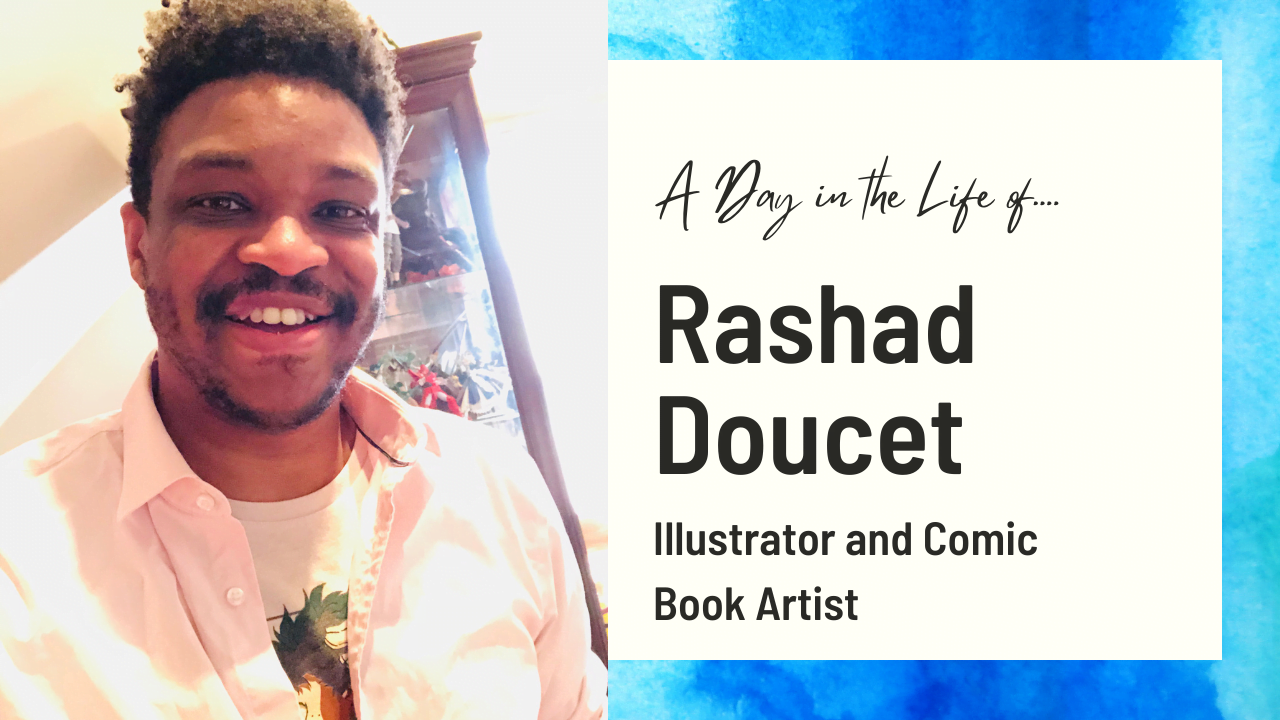
Rashad Doucet is a comic book artist and illustrator, a professor at the Savannah College of Art and Design, and the creator of Pax Samson, whose first volume earned him a feature in Publishers Weekly. Ask him how his career is going and the honest answer is that his head fills with ideas faster than his hands can draw them.
I wish there were 75 hours in the day so I can get all the things I want to get done.
Rashad Doucet
That line is the key to Rashad. He calls himself a hustler and chases new work the way some people chase rest. His story runs from a small-town childhood full of doodles to Eisner nominations and licensed work on Rick and Morty and Invader Zim, and it is as much about the life he built around the drawing as the drawing itself.
What a comic book artist actually does
On a normal day, Rashad is drawing, and there is more of it than most people picture. A single comic page can carry five to ten separate illustrations, each one planned, inked, and colored, which is why he calls comics both the joy and the grind of his week. He sets that against children’s book work like Jeremiah Justice, where a page might hold two or three images instead of ten. The two projects trade off. When the density of a comic wears him down, he switches to the picture book, and when he wants the bigger canvas back, he returns to the comic, recharged.
Then there is the licensed work. Rashad has drawn covers for Rick and Morty, contributed to books tied to Invader Zim, and taken on projects across the DC universe. Every property carries its own rulebook. On show-based comics he has to stay close to the animation, keeping the characters recognizable without redrawing them from scratch, and on Invader Zim the original creator signs off on everything. With the big superhero names, he draws them however the current house style has them, and he still gets to bring his own line to the costume he is handed.
Almost all of it happens on a screen now. He sketches on an iPad or a drawing computer and only reaches for paper at conventions or signings. The move to digital was practical. Boxes of sketchbooks piled up every time he moved, the paper felt like a fire hazard stacked around him, and working on the computer solved the problem that used to drain his wallet back when he painted: mixing a color he loved, running out of it, and never quite matching it again. Now he saves the color and moves on.
And because he teaches, a real slice of the job is being in front of people, whether that is a SCAD classroom, a convention panel, or a book signing. He gets the pre-show jitters like anyone, then settles once he starts, as long as nobody hands him a script.
How Rashad became a comic book artist
The path traces back to his grandmother. Rashad spent much of his childhood living with his grandparents in a small town, often at their church, and to keep him busy his grandma would set him drawing. She told him bedtime stories about superheroes and reshaped them so a kid would find them funny, like the Hulk climbing out of a washing machine. He started reading comics at eight, buying them at the local drug store, and by Friday nights he would fill a whole notepad with characters.
Writing came next. He loved literature and wrote constantly, but he kept snagging on the same thing: describing a tree, a room, a face in sentence after sentence bored him. Comics fixed that. The artist draws the tree, so the page can hold the pure bones of the story, the dialogue and the action. Around fourteen or fifteen he stopped being afraid to draw his own comics and started turning his writing into panels, which puts him in good company with any published author who found their real form only after trying another one first.
Life pulled him sideways for a while, and then Hurricane Katrina became the hinge. He decided to refocus and go all in, applying to a master’s in sequential art at SCAD in Savannah, a school an old math teacher had first mentioned to him years earlier because he kept drawing on his math tests instead of finishing them. He got in, earned the degree, kept freelancing straight through, and simply never stopped.
How to become a comic book artist
Ask Rashad what education you need and his answer is honest about the range. School helped him, and he recommends it if you can swing it, because a focused program taught him comics specifically and put him in a room with people he would never have met otherwise. That networking, he says, is worth a lot. He is just as clear that school is one option among several.
I implore everybody to always study, learn, but then find out what works best for you.
Rashad Doucet
The internet, he points out, means a driven person can teach themselves from artists, tutorials, and videos, as long as they stay self-motivated and, in his words, work smart and not only hard. He wants aspiring artists to aim their effort at something real, applying for jobs and building an audience, rather than perfecting the same circle alone in a room. It is the same blend of formal training and stubborn self-teaching that shapes plenty of creative lives, including many a working musician.
His practical advice comes down to a few things. Study life, but do it fast: instead of laboring three hours over a single vase the way he did in fine-arts school, sketch a hundred vases in quick passes and learn more from the volume. Find the tools that fit you and set the rest aside. His own favorite is Clip Studio Paint, a program built specifically for comics, which he prizes for its brushes, its 3D and lettering features, and a price that stays friendly next to a subscription. He points beginners who feel overwhelmed toward Procreate on the iPad, and he keeps Photoshop in the rotation. The gear matters less than the fit.
The best and hardest parts
What Rashad loves is the hunt. New opportunities light him up, and he collects job leads the way a kid collects Pokémon, wanting all of them and going after as many as he can. The ideas themselves are the fuel; he describes them getting stuck like cobwebs until he draws them out.
When I see something I don’t like, instead of just being upset about it, I go, what would I do to fix that? How would I tell that story differently?
Rashad Doucet
Meeting readers at signings lands somewhere between humbling and surreal, especially when someone he has never met tells him his work meant something to them.
The hard parts run underneath. He is a messy artist by his own account, and part of his craft is using digital tools to steady his hand and clean his lines. Big presentations still bring nerves. And the constant drive has a cost: he has learned to let his hand physically rest, to guard against burnout, and to protect the blocks of time his imagination needs, since it wants a running start rather than a flip of the switch. He is the friend who leaves the hangout early because there is work waiting, and he has made peace with people occasionally taking that personally.
Is comic book art a good career? Rashad’s honest take
Rashad is plain about how he picks projects. Asked how he decides, his short answer is money, followed by whatever fits the time he has. Early on he took what he could get, with one rule: keep a list of the work you will not do. When someone offered him well-paid pornographic work, he passed, because he always knew he wanted to make PG and family-friendly stories, the kind of thing, like Star Wars, that anyone in a household can enjoy.
He is genuinely optimistic about the field, and a little impatient with people who call it impossible. There is far more work available now than when he started, he argues, and landing even a few gigs a month can carry the bills. He is candid that the climb is real. He turned down other jobs, borrowed nothing, and spent two focused years on art after Katrina, knowing that if it went badly the responsibility was his alone.
Dreaming is great, but you also have to have a dream with an action plan, because just saying it all the time doesn’t make it happen.
Rashad Doucet
He is also a believer in leaving what does not fit. Graphic design and painting were part of his training, and he still puts them to use, but he knew his daily work lived elsewhere, so he moved on without treating the years as wasted. That permission to change direction runs through the RR archive too, like the honest look at changing careers on purpose when a path you trained for stops fitting.
The life around the work
The engine behind all of it is time management, which Rashad runs almost entirely in his head. He times how long a grocery run takes, how long he draws, how long he watches a movie or plays a game, and he gives himself swing room rather than a stopwatch. He sleeps only six to eight hours, has deliberately taken on fewer projects in recent years, and works to do it all without being cruel to himself about it.
His creative fuel is unapologetically fannish. He grew up hunting down anime in the 1990s, when it traveled the country as worn VHS tapes recorded over and over, and he fell for the storytelling first through a Final Fantasy game on the Super Nintendo, whose depth felt like a movie next to anything else he was playing. That same appetite for story is the current that carries people into a career in games, and it shows in what he keeps around him. His workspace is full of toys, and posing them, even staging photo fights between characters who would never meet, is his real downtime now that drawing became the job. He surrounds himself with heroes who stand up to adversity because, he says, they remind him it can be done.
Family sits at the center of the work itself. Pax Samson grew out of one of his earliest characters and became the thing he most wanted to see as a kid: a Black superhero family who lead the story rather than backing someone else up. He modeled its matriarch on his own grandmother, the woman who first handed him that notepad, and made her the Superman of that world. He co-wrote the book with his friend Jason Reeves and shepherded it through several publishers before its first volume arrived. He married recently, meeting his wife when they both worked in admissions, and says the real work of it was training himself to step away from the drawing board and simply be present.
FAQ
A few of the questions people ask most about becoming a comic book artist, answered from Rashad’s own path.
How do you become a comic book artist?
There is more than one route. Rashad earned a master’s in sequential art, which gave him focused training and a network, but he insists you can also teach yourself through online tutorials and other artists if you stay self-driven. Either way, he says to study constantly, build an audience, and apply for real work rather than practicing in isolation.
What software do comic book artists use?
Rashad’s main tool is Clip Studio Paint, which was built specifically for comics and illustration. He also uses Photoshop and recommends Procreate on the iPad for beginners who find the others overwhelming.
Do you need an art degree to draw comics?
No. Rashad found school valuable for its focus and its connections, but he is emphatic that a motivated person can learn the craft online instead. His advice is to work smart, aim your effort at paying work, and choose the path that actually fits you.
How do comic artists handle licensed characters like Rick and Morty?
It depends on the property. Show-based characters have to stay close to the animation and often go through the original creator for approval, while established superheroes let you use your own style as long as you keep the costume and current design intact.
Final thoughts
The thread in Rashad’s story is trust in what actually lights you up. He chased the work that would not leave him alone, from grade-school notepads to a superhero family named for his grandmother, and he backed the dream with a plan every single time. He learned his tools, kept what fit, let the rest go, and treated a childhood full of comics as a direction rather than a detour.
If your imagination keeps handing you the same idea, over and over, what would it take to give it the hours it is asking for?