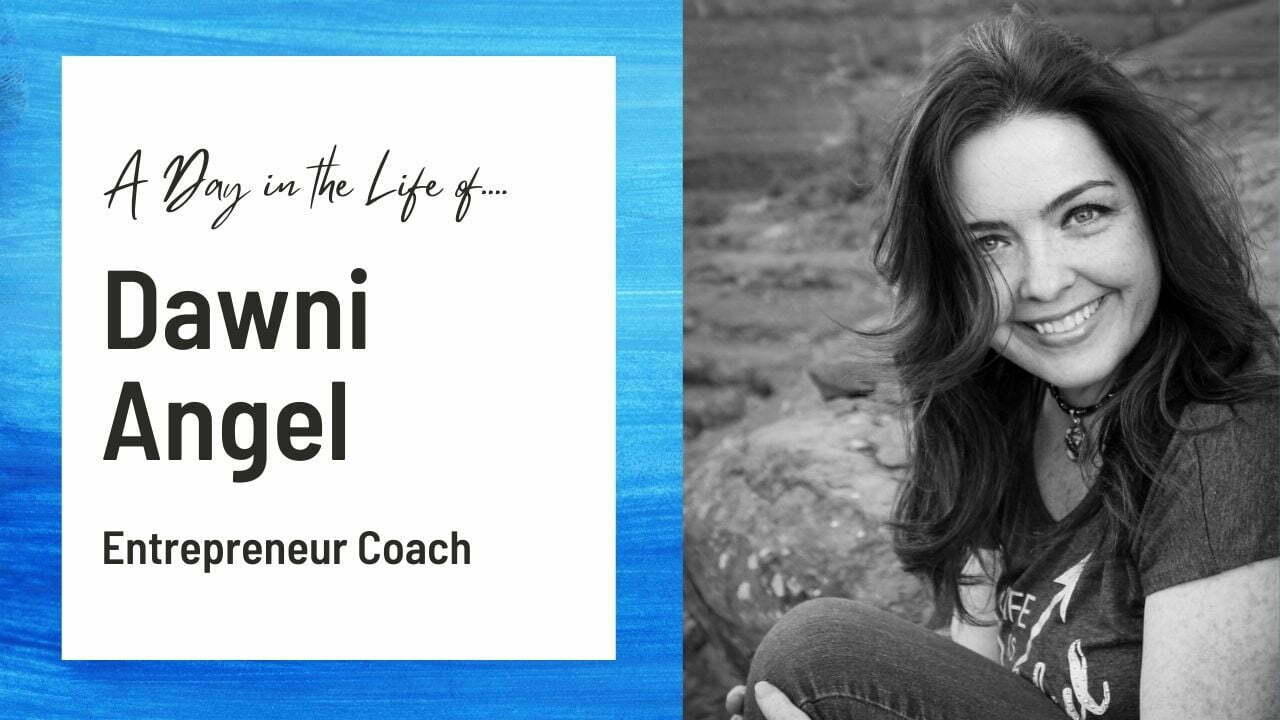
A Day in the Life of an Entrepreneur Coach: Dawni Angel on Core Values, Launching Your Purpose, and Going from Psychic to Business Coach
Dawni Angel is an entrepreneur coach who runs her practice under an LLC with an unexpected name: The Practical Mystic. The name fits. She spent years working full-time as a psychic, and she still trusts her intuition in every session. She is also, by her own description, deeply practical, the kind of coach who will help you sort out your branding and your website in the same afternoon she helps you clear whatever is blocking you from launching.
She started her coaching business in 2002, almost by accident, after people kept hearing her speak and asking to work with her one-on-one. Today about 80 percent of her work is entrepreneurial coaching, helping people turn a mission they care about into a business that pays them for it. This is the full picture: what the work looks like, the winding path that led to it, and the life she has built around it on a mountain in Utah.
What an entrepreneur coach actually does
Dawni’s tagline is a question: are you ready to launch your purpose? Most of her clients already have a job or a side business and are ready to go full-time and make a real living at it. She works with a lot of mission-based, heart-based founders, artists, bodyworkers, therapists, coaches, and a surprising number of nurses. She calls them soulpreneurs, people building a business out of what their soul is here to do.
The work splits into two halves. One is deeply practical: branding, structuring the business, and the strategy behind a website (she does not build the site, but she has studied websites for 12 years and knows exactly how one should be designed). The other is clearing the blocks that keep talented people from launching. That combination is the whole point of The Practical Mystic, intuitive and reliable, two things she long ago stopped treating as opposites.
Her measure for whether any of it is working is a single word.
One of my favorite words in the world is satisfaction. I know I’m on my path when I’m feeling fully satisfied, and I know I’m off my path when I’m feeling frustrated.
Dawni Angel
A good day, for her, can be a day snowed in at home on the mountain with her husband, still working and still making money, with time to have lunch together and finish the Christmas decorations. That is the life she helps clients build toward, and the reason she is such a believer in doing what you are meant to do and getting paid for it. She is quick to add that this path is not for everyone, and that plenty of people find their purpose somewhere other than their income.
How Dawni Angel became an entrepreneur coach
Entrepreneurship runs in the family. Her dad is an entrepreneur, her grandfather was one, and most of her siblings work for themselves. As a kid she was voraciously curious, reading everything she could find about human behavior, astrology, and running a business. She also knew early that she did not do well being told what to do. She started her first business at seven years old and has described herself as “psychologically unemployable.”
In her 20s she worked as a speaker trainer for the Junior Miss pageant program in Utah, coaching young women on self-esteem and confidence. That was the real start. She was also a photographer, which she still does on the side. The coaching business grew from there in 2002, mostly because people who heard her speak or train would ask for a one-on-one. After a couple of years of part-time coaching, she committed, and went through a long stretch of training to become a business coach and a relationship coach.
There is one more chapter most coaches do not have. Before coaching took over, Dawni worked full-time as a psychic. What she describes doing in those sessions sounds a lot like what she does now: people came to her with their problems, and she helped them find their own answers. She is clairvoyant, and images come to her, but she is careful about how she explains her actual skill.
I didn’t pretend to be magic in any way. My mastery is in listening. I’m listening on like twelve different levels at once.
Dawni Angel
She noticed she cared far more about a client’s purpose than about the fortune-telling questions people often brought to a psychic, and coaching gradually took over. Anyone who has watched their own career reshape itself around what they could not stop paying attention to will recognize the pattern, the same one that runs through the story of one guest who left data science to build her own company.
The core values method, and the argument that started it
The center of Dawni’s work now is core values, and she found it in the hardest possible way. In 2009, near the end of her first marriage, she and her then-husband were having one of their worst arguments, the kind where two people finally say out loud that neither of them is happy. She started listing her virtues to defend herself: the clean house, the well-cared-for kids, the paid bills, the affection. What he said back stopped her cold.
He got right up in my face and yelled, I would trade all of it for some security. And I said, I would trade all of that for some connection.
Dawni Angel
The next day, calmer, she asked him what he meant by security. His answer, that he needed her to work a W-2 job, told her the marriage would not last, because working for someone else was never going to be her life. But the exchange lit something up. The same word can mean completely different things to two people, and the real question is what a person means specifically when they use it. That is the golden question at the heart of everything she teaches.
Studying her own life, she assumed connection was her number one value. She is a Gemini, she knows thousands of people, she loves them. Then a friend told her that if connection were really her top value, she would not still be in that marriage. He was right. What she chose above everything else was what she calls workability: order, flow, organization, a schedule that runs. Once she saw it, the idea kept expanding. Core values, she realized, could change how people parent, how they lead teams, how they understand a spouse.
She has spent 12 years on it since. A manager who knows an employee values freedom will stop micromanaging that person and stop losing them, and a team that understands each other’s core values holds together. Her own third value is legacy, which is why she cares most about healing family dynamics. She is convinced these values are fixed: research she cites suggests people are born and die with the same core values, even as the way they express them changes. She sees it in her own children, and even in her dog Mercury, who will choose connection over a treat every time. Once someone has their values dialed in, she says, those words become a compass for the whole of a life.
How to become an entrepreneur coach
Dawni’s path suggests a few honest steps for anyone drawn to this kind of work.
Start with what people already come to you for. Her business began because listeners kept asking for one-on-ones after she spoke. Pay attention to the thing others seek you out for, and treat it as a signal.
Get properly trained. She spent years in business-coaching and relationship-coaching programs, and she now runs a comprehensive training that teaches coaches, therapists, teachers, and sales leaders how to read other people’s core values. Coaching is a craft you can study, the same way a movement coach trains for a specialty.
Learn the practical side alongside the inner work. Dawni built real expertise in branding and websites so she could walk clients through the launch itself, from brand to website strategy. Her advice is to look hard at the skill set you already have and put it to work, because what people are already doing is usually a strong clue to what they are meant to do more of.
Get good at listening. Her edge, from the psychic years through today, is reading tone, breath, cadence, and body language to hear what is true for someone. In a session she says she asks around a hundred questions, because guessing at your core values rarely lands on the right ones.
Name yourself well. She used to market herself as The Practical Mystic, and found that some corporate clients would not take her seriously, so she moved her business to her own name. She is adamant that if you are not fully confident in your business name, that hesitation will show.
The best and hardest parts of the work
The best part, for Dawni, is watching people step into their purpose. She talks about it as lighting up a matrix, one person switching on, then the next, more good work moving into the world as more people do what they are here to do. It is the same instinct that pulls her toward wellness and human potential, a cousin to the ideas in raising your vibration.
The hardest part is that the work is genuinely draining. Her sessions are dense, and she is fully present for every one, which is exactly why they wear her out. She has also made peace with being seen as “out there” by people who hear “psychic” and assume she is not serious. Her answer is to keep the work concrete: no fluffy comfort, just the root and the change that moves someone’s life.
Is being an entrepreneur coach a good career? Dawni’s honest take
For Dawni, the honest answer is that it has given her a life she describes as her daily reality, not a someday goal. She works from a mountain, sets her own schedule, and feels satisfied most days, which is the whole standard she measures her life against. That is a real endorsement of building a business around your purpose, the same throughline that connects her to a holistic lifestyle coach and others who have made wellness their work.
She is also candid that it is not a fit for everyone. It takes training, ongoing learning, and the energy to give clients your full attention and then rebuild your own. Some people’s purpose has nothing to do with how they earn a living, and she respects that completely. Her pitch is narrow on purpose: it is for the person who feels they have something to bring the world, is good at it, and only lacks a way to make it a real business.
The life around the work
Dawni’s own life is a working example of her core-values ideas. She met her husband, Gideon, on Facebook, where they were friends for a while first. He is 22 years younger than she is, a detail she waves off completely, because passing on him over an age gap would have meant passing on the best thing that ever happened to her. He works full-time as a photographer and videographer, handles all her technology, and is, she says, her best friend.
Before they met, she did a lot of clarity work, including an exercise she now teaches: writing down a hundred things you are looking for in a partner. Years later she found her old list.
I found this paper I’d written years ago that said the hundred things I’m looking for, and he was ninety-nine out of a hundred.
Dawni Angel
The one item he did not match was a love of football, which she had lost interest in anyway after her grandfather, her old football-watching companion, passed away. She and Gideon keep working on the relationship on purpose, checking in a couple of mornings a week over coffee about what each of them is facing and how they can support each other. They even teach a relationship course together at her family cabin.
To recharge, she guards two things. One is coffee with a small, carefully chosen set of friends. The other is what she calls puttering: at least two hours a day mostly alone, planning her retreats, a Hallmark Christmas movie on in the background, folding in a little laundry or a few emails between the vegging. She protects that time, because her sessions ask so much of her. She is also the oldest of eight, and her whole family of origin lives within 30 minutes, so Sundays tend to be loud and full.
FAQ
A few of the questions people ask most about core values and about coaching as a career, answered from Dawni’s own experience.
What are core values, and why do they matter?
Core values are the things a person chooses above everything else, like freedom, connection, or order. Dawni argues they are fixed for life and act as a compass, and that understanding your own, and other people’s, changes how you work, parent, and partner.
How do you find your core values?
It is harder than guessing, which is why Dawni runs two-hour sessions with around a hundred questions and listens for shifts in tone and energy rather than taking a first answer at face value. She is also writing a book to help people start the process on their own.
Do you need to be psychic to be a coach like Dawni?
No. Dawni credits her results to trained, honed listening, reading tone, breath, cadence, and body language, far more than to anything mystical, and she teaches those observation skills to other coaches, therapists, and team leaders.
Is coaching a stable way to make a living?
For Dawni it has been, though she is honest that it takes real training, ongoing learning, and the stamina to give clients everything and then recover. She also says outright that an income-generating purpose is not everyone’s path.
Final thoughts
The thread running through Dawni’s story is the one she teaches: get specific about what you value most, then build a life and a business that honor it instead of arguing with it. She traded a marriage that asked her to be someone else, and a psychic’s chair that no longer fit, for work that leaves her satisfied on a snowed-in Tuesday.
If you got specific about the one thing you choose above everything else, what would it be, and how much of your current life is built around it?