A Day in the Life of a Holistic Lifestyle Coach: Justin VanBuskirk on Panic Attacks, the CHEK Institute, and Coaching from a Camper Van
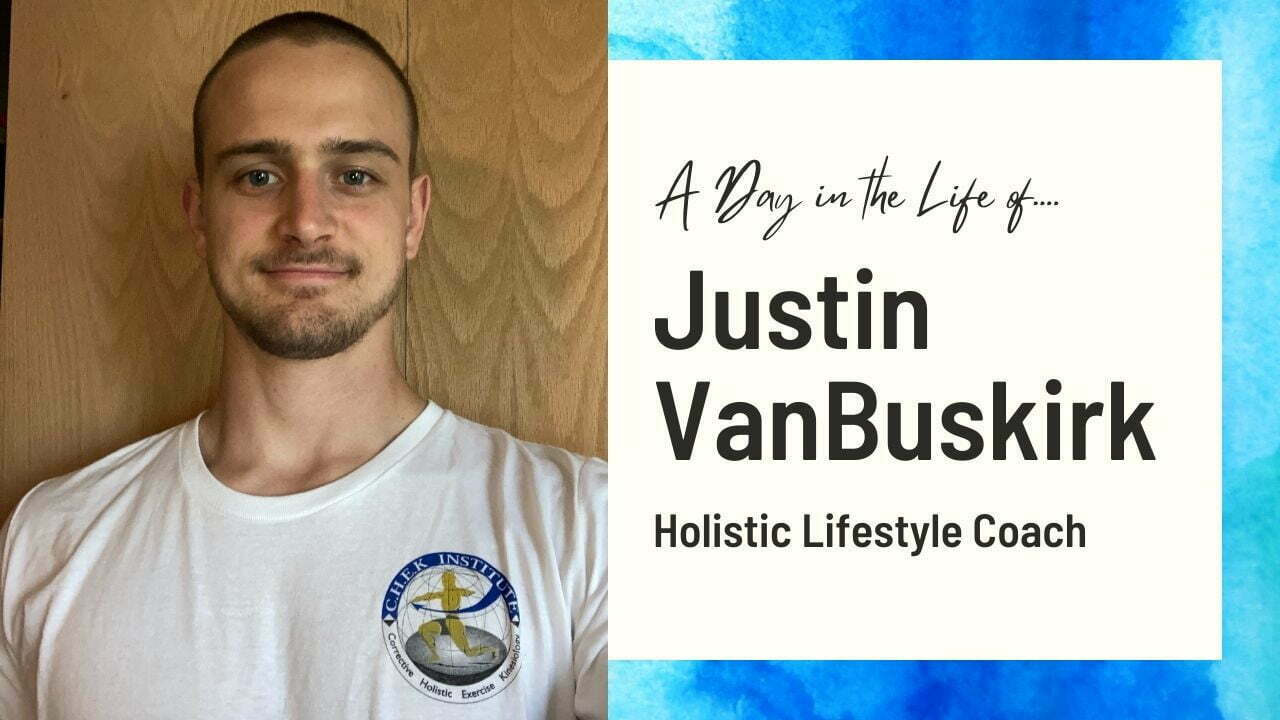
Justin VanBuskirk is a holistic lifestyle coach who runs his practice from a camper van, waking near sunrise to do tai chi before his first client call. He trained through the CHEK Institute, and the reason he does this work at all traces back to something he shares openly: his own years of anxiety and panic attacks.
The surprising part is where his method came from. He lived through the stress he now coaches on before he ever studied it, and looking for a way through his own anxiety is what led him to the work. This is the full picture: what a holistic lifestyle coach does, how he got here, and the life he built around it, dog included.
What a holistic lifestyle coach actually does
A holistic lifestyle coach helps people see how the ordinary things they do every day shape how they feel, then helps them change those things. Justin works from the CHEK Institute’s framework: he takes someone through questionnaires to map their lifestyle and their overall physiological stress, then builds a plan around what that person actually wants.
The backbone is the CHEK Institute’s six foundational principles of health: thinking, breathing, nutrition, hydration, movement, and sleep. Everyone does all six every day, Justin points out, and almost no one has much context for any of them. Breathing is his favorite example. He runs a breathing assessment with new clients early, and every one so far has turned out to breathe mostly from the chest.
Something as simple as shifting the way you’re breathing can completely shift you from fight or flight into rest and digest, and most people don’t even know that.
Justin VanBuskirk
He teaches clients to breathe two-thirds from the belly and one-third from the chest, then watches a few breaths change someone’s whole state. Part of the job, though, is refusing to hand people a generic plan. Justin starts by asking why they even want to be healthy in the first place, and what dream that health might help them reach.
That question separates his work from a standard gym program. He contrasts it with walking into a Planet Fitness and getting handed a routine by someone who has taken no inventory of the stress you are already carrying. A person running “on E,” in his phrase, does not need another hard workout. They need rest, and what the CHEK world calls “working in” rather than working out. His view of movement as something to read rather than override puts him in the same family as a movement coach, who also treats the body as an instrument to listen to, not a machine to push.
How Justin became a holistic lifestyle coach
Justin is candid that the whole thing started with his own suffering. In his early experience with anxiety and panic attacks, he went to a traditional doctor, answered a couple of quick questions, and within two or three minutes was told to take medication.
My own internal suffering really is the pain teacher, as Paul Chek would call it. Mine came in the form of anxiety and a lot of panic attacks.
Justin VanBuskirk
He took the pills meant to help during a panic attack, and they left him feeling, in his word, “zombified,” waking the next morning like “such a zombie.” He had also watched his family take medication and still wrestle with anxiety and depression, so he went looking for another path. Meditation, mindfulness, breath work, eating well, moving his body, even a good cry: he noticed that these took his anxiety from high to almost nothing. That is the origin of the practice he runs now, and turning that personal turnaround into a vocation places him alongside a mental health speaker who builds work out of what they came through.
He is careful not to turn this into a blanket verdict. If medication helps someone, he says, he is their “number one fan.” What bothers him is the story underneath it, the idea that we are faulty machines with something a pill will fix. His counter is that the body is intelligent, and that anxiety is often its way of asking a person to get quiet, listen, and slow down.
His path there was not a straight line. He studied psychology at Western Michigan University with a minor in holistic health, and along the way ran his first painting business through a company called Young Entrepreneurs Across America, knocking on doors with his own crew and getting told to get off plenty of lawns. That one-man painting, flooring, and tile operation carried him through the rest of college, including the strange stretch when COVID shut the world down and he would go paint to clear his head. By December 2020 he had graduated, and 2021 became the year he went all in on holistic health and started taking clients. Anyone who has built something for themselves will recognize the muscle he brought over, the same one a full-time entrepreneur coach leans on.
The training that pulled him in was the CHEK Institute, a worldwide holistic health school founded by Paul Chek, whom Justin calls a “borderline genius” who “seems like he’s left no stone unturned.” He first heard Chek on YouTube around 2017, then kept running into his name through the podcasts he was listening to. What sold him was that Chek seemed to embody the work rather than just preach it. His instructor for both HLC 1 and HLC 2 was Angie, Chek’s wife, whose image stuck with him: if your lifestyle is out of balance, your antenna is bent, and the signal you pull in comes through unclear. Part of what drew him deeper was Chek’s take on psychedelics, which Justin studies for their potential to release trauma that talk therapy cannot always reach, alongside Chek’s blunt caveat: skip the basics of your health and you will not bring much back from that world anyway.
How to become a holistic lifestyle coach
The clearest route Justin describes is the CHEK Institute’s holistic lifestyle coaching program, HLC 1 and HLC 2, which trains people worldwide to run the questionnaires, read someone’s stress load, and build a plan with them. He is quick to note you do not have to become a coach to take it. Plenty of people go through it just to learn tools of health school never taught them.
The mindset matters as much as the certificate. What he loves about the CHEK approach is that it does not claim to hold the one right answer for everyone.
Don’t just trust us because we’re the CHEK Institute. Try it, see what works for you, play around with it, be your own scientist.
Justin VanBuskirk
He points to his friend Justin Feldman, whom he grew close to during training, and Feldman’s reminder that a single Google search for the best diet returns hundreds of thousands of confident results, all from people sure they know what you should do. The CHEK view starts from the opposite place: everyone is different, so the plan has to be tested against your own body. That respect for inner data over outside authority is the whole idea behind trusting internal over external technology.
His other piece of advice is about credibility. Justin was struck by Chek’s point that you would not take nutrition advice from a nutritionist who clearly does not live it, so embodiment, actually practicing what you teach, is the qualification he cares about most. He got started himself by putting himself out there and coaching people from the community he was already part of.
The best and hardest parts
Justin started coaching in August, so he is honest that he is early in it and still building, and he has not settled on a niche yet. Many of his clients are men he already sits with in men’s support work, where the conversations start far deeper than most coaching relationships ever get.
That is the part he lights up about: watching people actually shift. He has seen clients change their diets and their stress and come out different, and he became, in his words, a cheerleader for the practices because they had done the same for him. His own tai chi and qigong practice has helped his anxiety enough that he keeps it in the daily rotation no matter where the van is parked.
The genuinely hard part is subtler, and it is about courage more than logistics. The work he believes in asks people to be vulnerable, and vulnerability stays scary even once you are good at it. He still gets nervous sharing openly with new people. What changed is that he has practiced it enough to treat fear as a caution light rather than a red light, information to move through instead of a stop sign.
What Justin wants you to take from his story
If there is one thing Justin repeats, it is that no one else’s plan is your plan. He likes the image of peeling back a rose one petal at a time, or an onion layer by layer, the way he jokes even Shrek understood that people have layers. You address what you can reach first before going after the harder things underneath, and you go at your own pace.
That belief shows up in how he coaches. One client building a list of everything causing her stress hit a tight knot in her chest, caught between wanting to cry and wanting to scream. Rather than talk her out of it, Justin suggested she scream into a pillow, starting with twenty. They counted up together, all the way to a hundred. By the end the knot had dissipated and her whole demeanor had settled. His method is to follow whatever comes up and trust the body to know what it needs, a hands-on way of raising your vibration.
His larger point is the one at the center of his own story: the pain carried a message, and numbing it would have meant missing it. Anxiety was never the enemy he needed to defeat. It was the thing that finally got him to listen.
The life around the work
Justin lives in a van. He started the trip in mid-October and does not claim to be a seasoned van lifer, but the rhythm suits him. Mornings begin near sunrise with about twenty minutes of tai chi, then a big breakfast and a clean-up before he gets on the computer for emails and client calls. Between sessions he blocks off real time to eat well and takes his dog Cooper out for a walk or a hike. Evenings wind down with dinner and a Harry Potter YouTube video, a film, or a podcast, and he aims to be logged off by ten-thirty.
Cooper, five years old, is “basically my kid,” and a big reason for the trip was giving him a real adventure after years cooped up in college apartments, even if he keeps stepping in Arizona cactus. The other reasons are Justin’s own. At nineteen he lived in Colorado playing junior hockey and saw a lot of the West, though always from a team bus, never free to wander. He had also just come out of a good relationship at the start of the summer and wanted a solo stretch, a journey with himself, before moving into another. Living small has simplified his life in a way he likes.
The route reads like a map of the interior West. Austin, Texas was his first real stop, back when a holistic health course there put him in a room full of fellow Harry Potter fans. From there came southern Colorado, near the San Luis Valley and the Great Sand Dunes and the small town of Crestone, then Fort Collins for a couple of weeks with old family and friends, where he helped his friend Justin run his first men’s retreat. When nineteen-degree nights without a heater got to be too much, he turned south through Utah and Moab and settled in Sedona, Arizona. He promised his family he would be home for Christmas.
Threaded through all of it is his men’s work. For three years Justin has been part of the Mankind Project, an international, peer-led men’s organization, and he now helps organize a group for men thirty-five and under that meets online every other Thursday. The circles borrow practices from psychotherapy to help men name what they feel and take responsibility for it, including the honest work of noticing when someone else is holding up a mirror. He is direct about how much it changed him.
It’s taken me from being a lost boy to stepping into more of a man, and feeling like I’m embodying that, not just a word I say because I’m older.
Justin VanBuskirk
He still watches sports and plans to catch a UFC card on the weekend. The men’s work never asked him to become someone else. It gave him somewhere to bring the whole of his experience, then taught him to carry that same safety into ordinary conversations, where people tell him things they have never told anyone.
FAQ
A few of the questions people ask most about holistic lifestyle coaching, answered from Justin’s own experience.
What does a holistic lifestyle coach do?
They help you see how your daily habits affect your health, then help you experiment with changing them. Justin works from the CHEK Institute’s six foundational principles: thinking, breathing, nutrition, hydration, movement, and sleep, and he builds a plan around what each client actually wants.
What is the CHEK Institute?
It is a worldwide holistic health training school founded by Paul Chek that certifies people in holistic lifestyle coaching through its HLC 1 and HLC 2 programs. Justin notes you do not have to become a coach to take it, since many people go through it just to learn the tools.
How do you become a holistic lifestyle coach?
Justin’s route was the CHEK Institute’s HLC training, paired with actually living the practices himself. He started his business in 2021 and took on his first clients from the community he was already part of.
Can lifestyle changes help with anxiety?
Justin is careful here: if medication helps someone, he supports it. His own path, though, was breath work, meditation, movement, nutrition, and emotional release, which took his anxiety from high to nearly nothing.
Final thoughts
The thread in Justin’s story is that he trusted his own experience over the plan he was handed, and built a life and a livelihood out of listening to it. The panic attacks that once ran his days became the reason he does the work he does, and the antenna he keeps straightening is his own.
If your body has been sending you a signal, what would change if you treated it as information instead of a problem to numb?