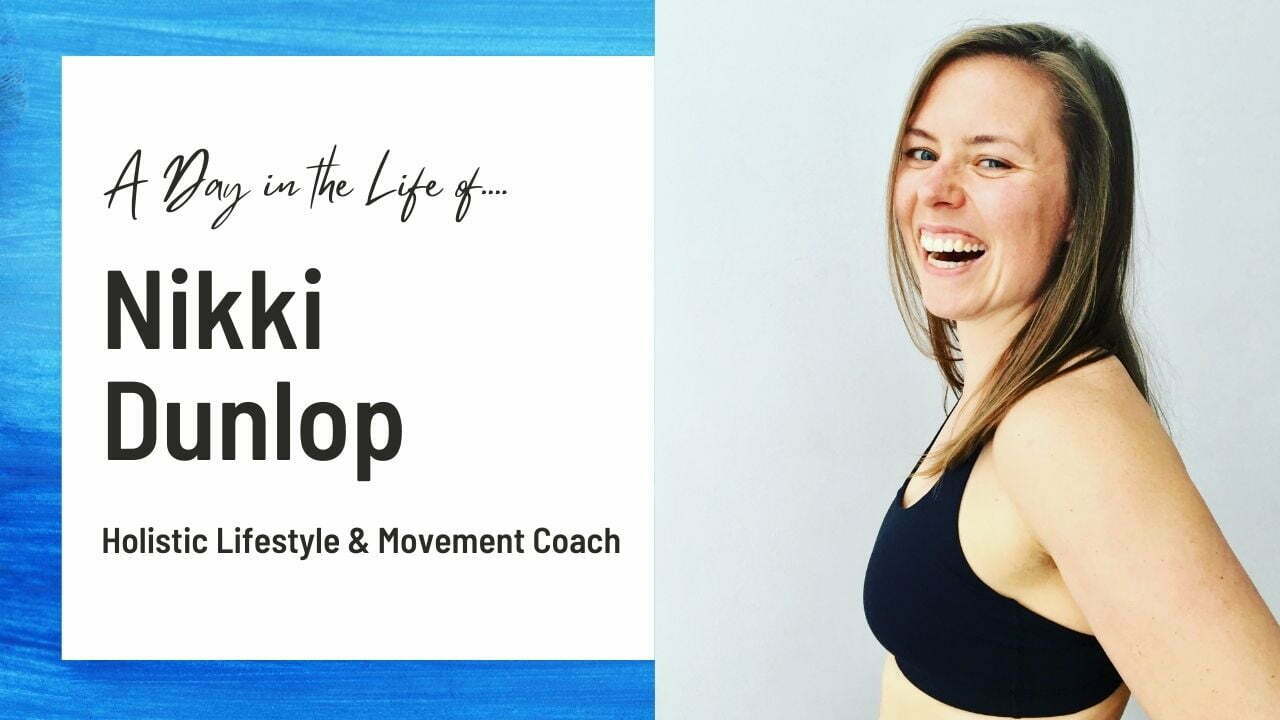
A Day in the Life of a Holistic Movement Coach: Nikki Dunlop on College Hockey, How the Body Holds Emotion, and Grief as a Skill
Nikki Dunlop is a holistic lifestyle and movement coach on Vancouver Island, and she got there by way of a hockey rink. She played five years of college hockey, won a couple of championships, captained her team, and then built a career helping people move their bodies and, more often than she expected, feel their way through what those bodies had been holding.
The surprising part showed up early. When Nikki started out as a personal trainer, she noticed that people opened up to her while they were simply breathing and moving. Deep, private things. Stuff they had not told anyone. That pattern pulled her from reps and sets toward something larger: how the body stores emotion, why we suppress it, and what it takes to let it move again.
This is the full picture of what she does. The coaching, the winding path that led to it, and the life she has built around it on the west coast of Canada.
What a holistic movement coach actually does
Nikki’s mornings are hers before they belong to anyone else. She usually starts with tai chi and a walk outside, sometimes a little meditation, and she treats it as cherished space rather than a warm-up to the “real” day.
“I have a really slow morning, and it’s my time,” she says. She reads, studies, or journals over breakfast, then moves into client work, usually between 10 a.m. and 2 p.m. Around that she teaches for a college online, so grading, emails, and research thread through the rest of the day. The slow, analog open to her mornings shares the spirit of a good digital detox: time set aside to feel the weather and the rhythm of the day before the inbox starts talking.
With clients, the plan depends entirely on why they came. Nikki leans on natural movement, and she is a firm believer that people benefit from learning how to move their bodies before they start piling on load or apparatus.
In practice that means a lot of ground-based work: crawling, proprioceptive drills, hanging, throwing and catching. She keeps it playful on purpose, because people respond better to movement when it is fun and they actually come back for more. A session often includes something a client thought they could never manage, like lifting an awkward object or moving in a way their body had written off. It is functional, and it trusts the body’s own intelligence, which is the same principle behind internal vs external technology: the equipment matters less than what you can already do with breath, attention, and your own frame.
How Nikki Dunlop went from college hockey to holistic coaching
Nikki started as an athlete. She played a lot of sports growing up, then fell hard for hockey, obsessed enough (very Canadian of her, she jokes) to switch high schools so she could attend a hockey academy where one class every day was ice time.
She came to the sport late, around 14, while most of her future teammates had been skating since they were five. When she set her sights on college hockey, her fitness and drive ran ahead of her skills, and a coach gave her a shot anyway. She barely played her first season, learned a great deal from a different role, and then a year of strong coaching lifted her game. She went on to play every game for the rest of her five-year career, win championships, and captain the team.
Then it ended in a single day.
We play the game, we win, and the next day it’s all over. There’s no gradual goodbye, no easing out of it. It’s literally overnight, it’s done, it’s over, and I wasn’t really prepared for that. I built my whole life around this archetype, this person, and then that was just gone.
Nikki Dunlop
Her education pointed her toward what came next. The college offered a personal training diploma, roughly a four-year kinesiology degree compressed into two, and that program plus her athletic background became the foundation of her coaching. She started seeing personal training clients at the campus gym in 2012, while she was still a student.
That is when the real surprise arrived.
As people were breathing deeply and moving their bodies, they seemed to share really deeply personal things with me, things I wasn’t necessarily expecting, things they hadn’t told anyone.
Nikki Dunlop
She had known some counseling would come with the work. The degree of it caught her off guard. So she went looking for more: skills for holding space, an understanding of how the body carries emotion and trauma, and the research to back it up. A turning point came when her sister was diagnosed with ovarian cancer in 2015 and Nikki read When the Body Says No by Gabor Maté, which she says opened up a whole new world of holistic health for her. She has kept evolving her practice ever since, and it now looks a lot like the blend of movement, mindset, and daily habits you would recognize from a holistic lifestyle coach.
How to become a holistic movement coach
Nikki’s route is a usable map for anyone drawn to this work. It started with formal training in the body: a kinesiology-based personal training program and certification, which for her ran two intensive years. That grounding in anatomy and movement is the floor.
The next layer is hands-on hours with real people. Nikki began coaching clients while she was still certifying, and she is candid that what she offers now looks nothing like what she offered in 2012. The reps with clients taught her what no classroom could.
From there it becomes a study of the whole person. Nikki has built on her foundation with somatic work, drawing on Peter Levine’s writing about how unresolved trauma settles in the body, and on Gabor Maté’s research linking coping patterns, like chronic people-pleasing, to long-term health. She continues her education through the CHEK Institute, where she connects ideas from Chinese medicine, the chakra systems, and the body-mind relationship. Her advice, in practice, is to keep learning across disciplines rather than staying in one lane, and to build the softer skill clients feel most: presence. Running an independent practice while teaching on the side also makes it a small business, with the same self-direction you see in an entrepreneur coach.
The best and hardest parts of coaching
Ask Nikki what she has learned, and she goes straight to presence.
The most valuable thing I can bring to a session is just my presence, full presence with the person I’m with, and holding space. Everything’s allowed with me. If you’re angry, let’s talk, let’s see it.
Nikki Dunlop
The reward is the reflection she gets back. She describes a client who had been through a hard couple of years telling her that of everything she had tried, the work with Nikki had helped the most. Nikki admits she can doubt herself and wonder whether the work is getting anywhere, so hearing that landed hard. Being a place where people can show up exactly as they are, without earning it, is the part she values most, especially because she knows not everyone has that anywhere else in their life. That steadiness is its own kind of energy work, in the spirit of raising your vibration.
The hardest part is the flip side of caring that much. Nikki gets attached to wanting people to thrive, and she spots the low-hanging fruit, the small changes that would make a real difference. When someone chooses not to prioritize their own well-being, she finds it genuinely frustrating, even as she works to release her own agenda and keep holding space. She would rather people feel well and live to their fullest, and watching them get in their own way tests her.
What Nikki wants people to understand about grief
Somewhere inside the athlete’s story and the coaching is a throughline Nikki names directly: grief. Losing hockey overnight was its own grief, the loss of a team, a role, a sense of purpose. Watching her sister get sicker and eventually die made grief the center of her personal study. Her conclusion is blunt and freeing.
Learning to grieve means learning to love and appreciate and honor that which we’re grieving.
Nikki Dunlop
Grief, she says, is a skill, and most of us are never taught it. She points at the standard script: a funeral within a week, everyone dressed nicely and talking, while the people who lost someone are still in shock and barely back in their bodies. That never sat right with her. She gave herself space to feel all of it, and she found tools that helped. A hands-on grieving workshop built around ritual, storytelling, and safe anger expression that moves energy without tipping into harm. Kristen Neff’s book Self-Compassion. And the teacher Martín Prechtel, a shaman of Mayan heritage from Guatemala, whose work on grief and praise reframed the whole thing for her: the idea that we can only grieve what we have truly praised, so grief and love turn out to be two names for the same depth.
It is heavier material than most coaching carries, and Nikki holds it as core to what she offers. Her aim is to build the kind of container her clients rarely get elsewhere, a place to make sound, move the feeling, and be witnessed while they do it.
The life around the work
Off the clock, Nikki stays close to the outdoors. She rides a lot of mountain bike, which she cheerfully admits is too intense to call decompressing, and she takes full advantage of the beaches and trails near her home on Vancouver Island, access she has come to see as rare in other parts of the world.
She recently started playing Scrabble with her partner and discovered she is unexpectedly good at it, which has made it a new favorite. She connects with friends over games, and she is thrilled to be a new auntie to a friend’s baby. The throughline off the ice looks a lot like the throughline on it: presence, play, and people she can be fully herself around.
FAQ
A few of the questions people most often ask about becoming a holistic movement coach, and about Nikki’s approach, answered from what she shared.
What does a holistic movement coach do?
She blends physical training with the emotional and somatic side of health. Nikki uses natural, playful movement, ground-based work, and functional drills, and she pairs that with holding space for whatever a client is carrying, from stress to grief.
How do you become a holistic movement coach?
Nikki started with a kinesiology-based personal training diploma and certification, then built years of hands-on client experience. On top of that she added somatic training, grief work, and ongoing study through the CHEK Institute, growing well beyond standard personal training.
Can the body really hold emotion?
That idea sits at the heart of Nikki’s work. She points to somatic research, like Peter Levine’s, and to the way animals shake off a fright while humans are taught to push through, which can leave stress stored in the body until movement, breath, or bodywork helps release it.
What is the hardest part of the job?
Caring so much that clients’ choices get to her. Nikki finds it frustrating when someone will not act on simple changes that would help, and she works to hold space anyway and release her attachment to their outcome.
Final thoughts
Nikki’s story keeps circling one idea: the freedom of being allowed to show up exactly as you are, on the ice, in a session, or in the middle of grief. She followed the pull from athlete to trainer to holistic coach by paying attention to what surprised her, and she has built a practice around giving other people the space she once went looking for.
If you had a place where every feeling was allowed and nothing about you had to be earned, what would you finally let yourself feel?