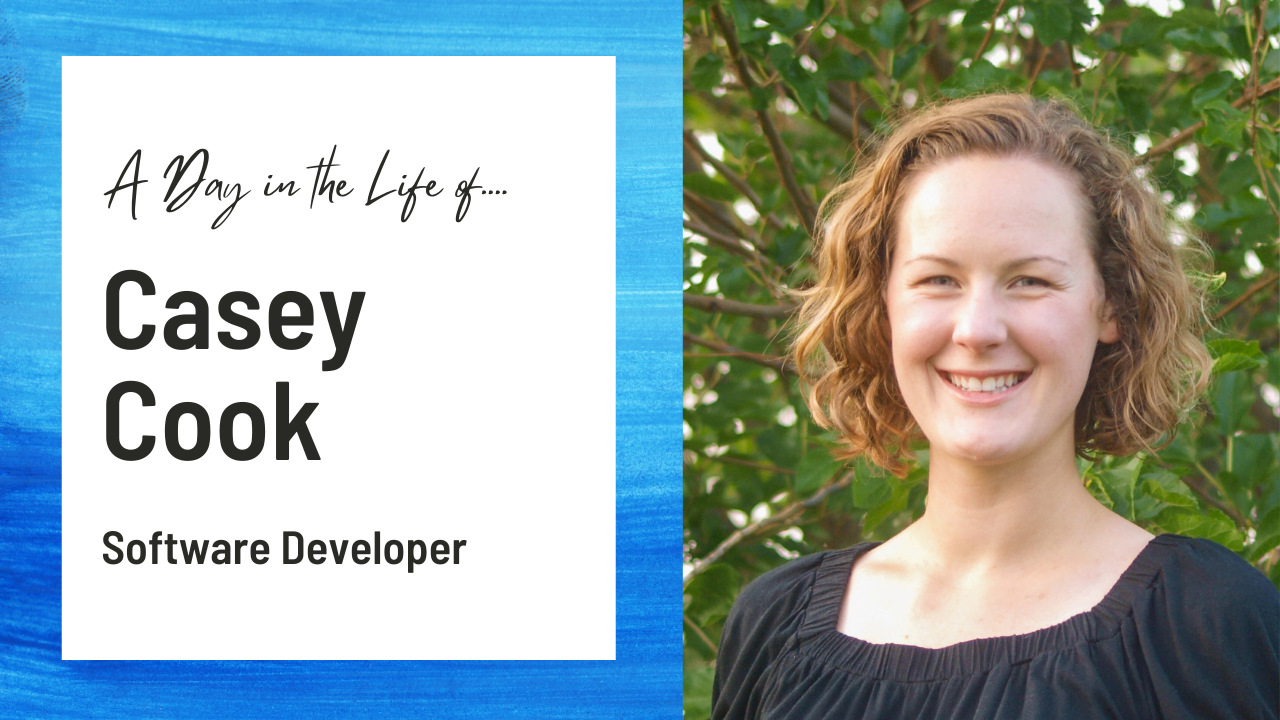
A Day in the Life of a Software Developer: Casey Cook on a Marketing Degree, a Coding Boot Camp, and Building a Career Sideways
Casey Cook is a software developer at State Farm, and she got there without a computer science degree. She graduated in marketing, worked as a risk and compliance analyst, and only recently, five roles into one company, stepped into writing code full time.
Her story is the clearest possible answer to anyone who thinks a career has to move in a straight line, or that you need the “right” degree to switch into tech. This is the full picture: how she got here, what the work is actually like, and the life around it.
A genuinely winding road into tech
The original blog called it a winding road, and Casey earns the title. Counting internships, developer is her fifth role at State Farm in about four years. She started in public affairs doing SharePoint and information architecture, moved to vendor management as a risk and compliance analyst with no background in it, and landed in reporting and databases. But one thing kept nagging her.
I always had in the back of my mind, what if I’d tried more computer science classes in college. I kept regretting it, like, you really liked this, maybe you should have given it a shot.
Casey Cook
So she went back to school for a graduate certificate in information systems, and through mentors at work found an entry-level developer role.
It was the most I’ve ever stepped out of my comfort zone in my entire life, and it was super scary. But now I am a developer.
Casey Cook
That sideways path echoes other guests who changed careers into new fields, and the tech-and-creativity pull she describes shows up in roles like product and UX design and narrative design in games.
How to become a developer without a CS degree
Casey’s route in was a company-sponsored coding boot camp, a detail worth underlining for anyone eyeing tech.
It’s basically like I’m getting paid to go to a boot camp. Nine to five I have instructors teaching us all there is to know about Java, JavaScript, React, and Spring. I deal with imposter syndrome daily, but I’m learning to be more confident and flex my growth mindset.
Casey Cook
Her honesty about imposter syndrome is part of the point. You do not arrive fully formed; you grow into it.
What a software developer actually does
Ask Casey to explain her job to a grandparent and she keeps it human.
When someone clicks save on their phone number on a website, I’ve told the computer what to do with that number, where to store it, and how to give it back to them later if they need to see it.
Casey Cook
She works back-end, handling the retrieval and manipulation of data that front-end services display, and she is candid that she is drawn to both sides: the visual creativity of the front end and the puzzle-like logic of back-end Java.
There’s something kind of addicting about the logic of a back-end system, and honestly something beautiful about how Java comes together with the class files and the structure. It’s so satisfying.
Casey Cook
Day to day she works on an agile team, picking up tasks from a storyboard, and in a DevOps model she also handles service work: watching logs, and pivoting to troubleshoot when someone reports that a service is down.
Why one company, and the strange math of switching roles
Casey stays at State Farm partly for a reason she calls cheesy but real: at a big company you can have several careers without ever leaving.
You can totally switch gears and do something completely different in another section of the company. I feel supported and invested in, and that’s a huge factor in my loyalty.
Casey Cook
She also shared a wonderfully counterintuitive detail about changing roles: moving from senior risk and compliance analyst to entry-level developer was technically a two-level demotion, and came with a raise, because more technical roles pay more even at the bottom rung.
A day in the life, mostly from home
Casey started her developer role during the pandemic and has never met her team or manager in person. As a self-described big introvert, she found working from home a relief.
We all say bring your authentic self to work, but it’s tough to always feel like you have to be on. At home I can let my guard down a little. I like getting to choose what level of communication I want to have.
Casey Cook
The life around the work
Off the clock, Casey is a self-described nature girl who hikes and kayaks with her husband whenever the Illinois weather allows. She is also a foster parent for a local shelter, having switched from fostering dogs to cats, currently caring for a two-month-old kitten named Squirt who takes four medications twice a day.
You take in animals who’ve had bad experiences, feed them and love them and teach them how to be with a human, and then you give them to their forever family and move on to the next one. Seeing them living their best life with a family that loves them makes it all worth it.
Casey Cook
She met her husband on a dating app, matched early, went on one date, and never opened the app again. Their planned Grand Tetons wedding fell to a cancelled permit four weeks out, so they married in her parents’ living room, her dad ordained for the occasion and her grandfather there to walk her down the aisle. What changed after marriage, she says, was basically nothing, except the quiet freedom of a life partner. And after twenty-five years in Bloomington, she is ready for somewhere new, planning a move once her husband finishes his own computer science degree.
FAQ
A few questions people ask most about becoming a software developer, answered from Casey’s winding path.
How do you become a software developer without a computer science degree?
It is very possible. Casey has a marketing degree and moved into development through a graduate certificate in information systems and a company-sponsored coding boot camp. Adjacent roles, mentors, and a willingness to be a beginner again all helped.
What does a software developer actually do?
Write and maintain the code that stores, retrieves, and manipulates data. On a back-end team like Casey’s, that means building and supporting the services (APIs) that front-end websites and apps rely on, working from a storyboard on an agile team, and troubleshooting when something breaks.
What is the difference between front-end and back-end development?
Front-end is the visual layer users see and interact with; back-end handles the data behind it, retrieving and manipulating information and handing it to the front end to display.
Is software development a good career?
Casey loves the puzzle of it and values working somewhere that lets her switch roles and grow. She is honest about imposter syndrome and the steep learning curve of stepping into something brand new.
Final thoughts
The thread in Casey’s story is that she kept following the quiet nudge she almost ignored. A marketing major who wondered “what if” about code did not talk herself out of it. She went back to school, took a scary entry-level role, and let a big company become the place she could build several careers in a row. Her path was not a straight line, and it did not need to be.
What is the “what if” you have been carrying in the back of your mind? What would it take to finally give it a shot?