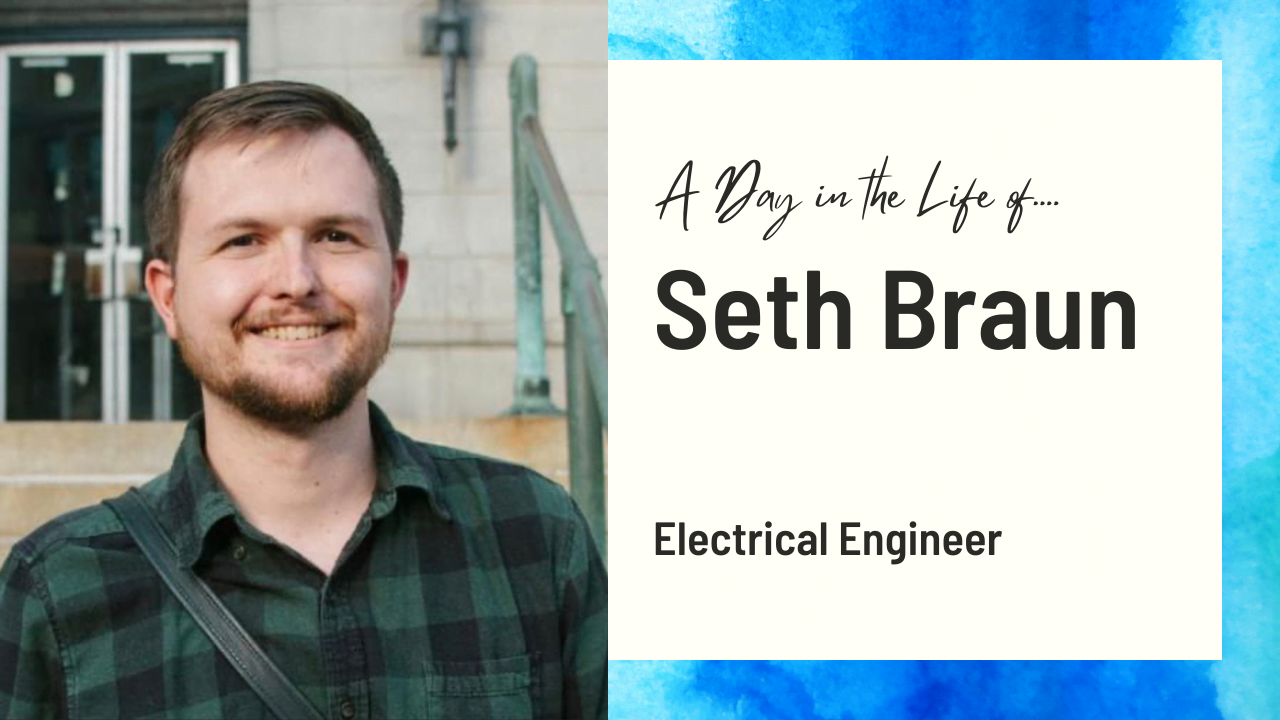
A Day in the Life of an Electrical Engineer: Seth Braun on Testing 5G Chips, Falling Into RF, and Running for Local Office
Seth Braun is an electrical engineer who spends his days testing radio-frequency parts, the switches and transmitters that make 5G work, as a test engineer at Analog Devices in the greater Boston area. He did not set out to work in RF. He studied signal processing, took the first job that came along, and grew into the specialty from there.
Here is the surprising part. A few days before a spring election, knowing almost no one in his new town, Seth wrote his own name onto the ballot for the local housing board and won with over 100 votes. Between the lab bench and the ballot, he also taught himself French, keeps chipping away at Japanese, and recently got married.
This is the full picture: what an RF test engineer actually does, the winding way Seth got there, and the life he has built around the work.
What an RF test engineer actually does
RF stands for radio frequency, and for most people right now that means 5G. Analog Devices makes parts that run at 5G frequencies, things like switches and transmitters, and Seth’s job is to test the parts that come off the line. A big piece of that is yield analysis: confirming that a high enough percentage of each batch passes so the fabrication process is not wasting silicon.
The scale is small and precise. A single silicon wafer can carry thousands of devices, each only a couple of millimeters wide, so Seth works with a microscope and a prober, a probe tipped with tiny positive and negative contacts, wired into standard lab gear like oscilloscopes, volt meters, and power amplifiers. Take a switch with one input and two outputs that has to operate anywhere from 2 gigahertz up to 70 gigahertz. He tests across that whole range to confirm that when the part is told to switch to one output, it actually does, and he watches for specific modes of failure along the way.
At a company this size, the role is narrow by design. One machine, his machine, and the parts that run through it. He finds that less overwhelming than his last job, where he wore every hat there was. The work reads a lot like other technical build-and-test careers, closer to a software developer checking that code behaves than most people would guess.
How Seth fell into RF engineering
His path was not a straight line. As an eight-year-old he announced he was going to be a genetic scientist, hooked by Pokemon and the idea of evolution. That faded, but a bigger pull replaced it: he wanted to understand how the world actually worked. He was into video games and electronics and wanted to know the principles underneath them, and he was good at math, so engineering felt like the right direction. He studied electrical engineering at Georgia Tech.
I actually kind of fell into RF. I didn’t specialize in RF in college, what I did was study signal processing, which is closely related. It just happened that the first job I got out of college was working for a startup as an RF engineer.
Seth Braun
Once an engineer lands in a field, he says, they tend to get pigeonholed there. RF turned out to be a good place to be stuck, since 5G keeps growing across the industry.
That first job was at a genuinely tiny startup in Maine, a spin-off from University of Maine research on temperature sensors. Three engineers, and Seth did a bit of everything: the testing, antenna design, sensor packaging at the materials level, and hands-on field installs.
We had some projects with power plants, so we’d actually go and climb in the boilers and attach antennas to pipes and test them.
Seth Braun
He moved to Maine on purpose. He had loved the state since a vacation after high school and decided he would apply for jobs where he wanted to live. During the pandemic he set his sights on a larger employer and landed at Analog Devices, going from about the smallest tech company you can imagine to one of the largest, then relocating from Maine down to the Boston area. Anyone weighing a scrappy startup against a big-company role will recognize the trade, an arc that also runs through the story of a data scientist who became an entrepreneur. The move from generalist to specialist is a familiar one too, the same scaling shift a software engineering manager watches from the other side of the org chart.
How to become an electrical engineer
Seth’s route offers a usable template for anyone eyeing the field:
– Build a strong math foundation early. He credits being good at math as a kid for pointing him toward engineering.
– Earn an electrical engineering degree. He went to Georgia Tech.
– A closely related specialization is plenty. He studied signal processing, not RF, and it carried over cleanly.
– Let the first job open the door. His first offer happened to be an RF role, and 5G demand did the rest. Picking a growing field early pays off later.
– Get hands-on range where you can. At the startup he learned testing, design, packaging, and installation all at once, and that breadth made him useful.
The same “how do I break in” question comes up for adjacent roles like the product manager path, where the first job also tends to set the trajectory.
The best and hardest parts
The best part, in Seth’s telling, is that he still thinks engineering was the right call, and RF specifically sits in a field that keeps expanding because of 5G. There is real security in that. He also loved the variety of the startup years, when he climbed into boilers one week and worked on sensor materials the next.
The harder parts are quieter ones. Engineers get pigeonholed, so the specialty you fall into can become the specialty you keep. Going from three coworkers to a multinational was an adjustment, and because he started during the pandemic, much of his team was remote and he had not met many of the people he worked with.
Is electrical engineering a good career? Seth’s honest take
His honest read is yes, with clear eyes about the tradeoffs. RF is a big, growing field, and 5G gave him room and stability even though he arrived by accident rather than design. The cost is specialization: at a large company you pick a niche and largely stay in it. He fell into RF, grew comfortable there, and still believes it was a good direction to go. For someone who values steady demand and deep technical work over constant variety, he makes it sound like a solid bet.
Running for local office, and the small seats nobody fills
The other half of Seth’s life is civic. When he moved to Maine and was living on his own for the first time, he realized he could take real initiative in his community, whether by volunteering or by running for office. He put in time on campaigns and in local and state party organizing, including a stint on a state committee and its rules committee, and he ran for Bangor city council a few times without winning. He also spent time on community efforts around food and health access, including building community gardens.
Then came Tyngsboro, Massachusetts, a town of roughly 11,000 to 12,000 people outside Lowell, smaller and more rural than the Bangor he had left. Instead of a city council it runs on a select board and an annual town meeting, where any registered resident can show up and vote directly on local policy. This spring a housing board seat sat open with nobody running for it.
I actually ended up getting over 100 votes for my write-in campaign without knowing anybody in town, just from posting on a few Facebook groups and talking to people.
Seth Braun
His wife Jess had met some people helping a select board candidate and mentioned that Seth was interested in writing himself in for the housing seat. Word spread, and he pulled the whole thing together in the days between that Saturday and the Tuesday election. The board’s work is concrete: create new affordable housing and maintain what the town already has. Seth is quick to point out how many local seats go unfilled, right down to a cemetery commissioner post in his town that drew no candidate at all, and how much these offices shape daily life even though they draw a fraction of the attention a presidential race gets.
He is also candid about what campaigning actually takes. Even a small city council race runs on money, voter lists, and hours of door-knocking, and a candidate might knock a few hundred to a thousand doors across an entire campaign and still miss most of the town. Name recognition matters, and growing up locally is an advantage he never had. He spent time greeting voters at the polls too, where local rules limited how much he could even say about his own candidacy.
The life around the work
Seth has been a sci-fi fan for a long time, back to a stint on his college’s sci-fi radio show at Georgia Tech, where the whole point was talking through everything science fiction.
Through the pandemic he leaned on ordinary things: bike rides all summer, walks around the neighborhood, and a lot of reading, plus a cat the couple adopted back in February. Massachusetts logged its rainiest July on record around then, so the bikes stayed in more than he would have liked. His current read is The Complete Stories by Clarice Lispector, a Brazilian writer whose surreal, magical style he likens to Latin American authors like Gabriel García Márquez. What draws him in is seeing a writer’s whole range in one volume, from her twenties to the end of her life.
The pandemic also turned him into a language learner, and he has kept at it for over a year. He taught himself French to a decent level and is working through Japanese. French made sense because New England sits close to Quebec: he has been to Montreal and Quebec City and wanted to talk with people there and read Quebec books in the original. His method started with Duolingo to build the habit, then grew into podcasts, YouTube videos, Netflix shows with foreign-language subtitles, French books shipped from Quebec, and grammar books. Japanese is slower going. After a year and a half he says he still reads at a beginner’s level, slowed by a writing system that runs to roughly 2,000 kanji on top of hiragana and katakana.
I think the key thing is just to do a little bit of it every day, no matter what. Consistency is key.
Seth Braun
As for the marriage, Seth and Jess met on Tinder in Bangor and went on a first date at a local Chinese place, with no prior connection between them. A little over three years later they married on paper in February, in the middle of the pandemic, and are holding the family celebration the following year at a venue in Maine near where her family still lives.
FAQ
A few of the questions people ask most about becoming an RF or test engineer, answered from Seth’s own path.
How do you become an electrical engineer?
Build a strong math foundation, earn an electrical engineering degree, and expect the first job to set your direction. Seth studied signal processing at Georgia Tech, then took an RF role at a startup, and that became the specialty he still works in today.
What does an RF test engineer actually do?
They test radio-frequency parts like switches and transmitters to confirm the parts perform across their full frequency range, using a prober, a microscope, and standard lab equipment, then analyze yield so a healthy share of each wafer passes.
Do you need to specialize in RF in college to work in it?
No. Seth studied signal processing, a closely related field, and moved into RF because it was simply his first job offer, then grew with rising 5G demand.
Is electrical engineering a good career?
Seth thinks so. RF is a large, growing field thanks to 5G, which brings real security. The tradeoff is that engineers tend to get pigeonholed into one specialty, and at a big company the work is narrower than at a scrappy startup.
Can you really win a local election as a write-in?
Yes. Seth won a housing board seat in his Massachusetts town as a write-in with over 100 votes, organized in a matter of days, because many local seats go unfilled and simply stepping up can be enough.
Final thoughts
Seth’s story is a string of doors he chose to walk through: an RF job he never planned on and grew to fit, a startup that taught him everything at once, and a ballot line he added himself on a weekend’s notice. None of it was mapped out when he was eight and set on being a genetic scientist. He followed what genuinely interested him and said yes when an opening appeared.
When the next opening shows up in front of you, the offer in an unfamiliar field or the empty seat nobody else wants, what would it take for you to write your own name in?