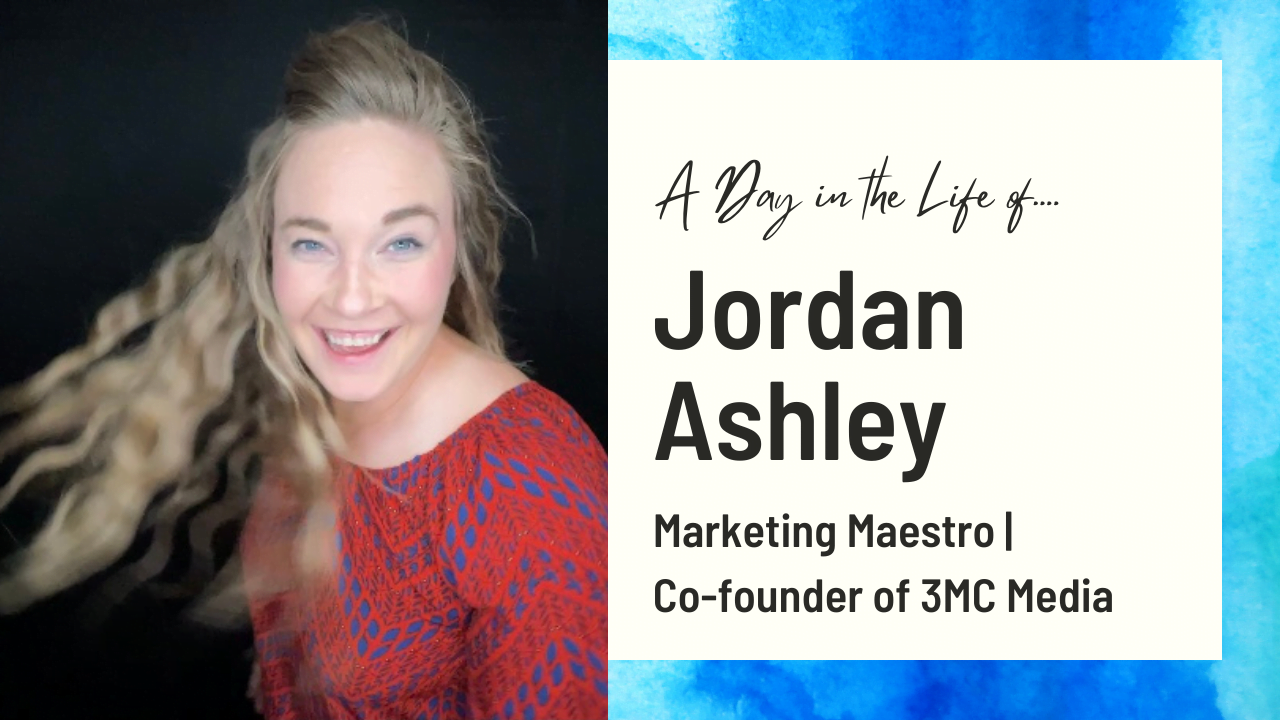
A Day in the Life of a Marketing Consultant: Jordan Ashley on Ditching Accounting, Building 3MC Media, and Why Stability Is a Facade
Jordan Ashley runs 3MC Media, a full digital marketing agency she co-founded, and she will be the first to tell you she did not plan a single step of it. She started college certain she would be an accountant, double-majoring in business management and accounting at Presbyterian College, aiming straight at the CPA exam. One accounting internship talked her out of it.
The surprising thing about Jordan is how much of her career grew out of a single question her father asked when she panicked as a senior: what is something that brings you joy? Her answer was sports. That answer carried her from an accounting track to a marketing assistant job, then to an MBA and a director of marketing role in college athletics, and finally to walking away from a steady paycheck to run her own agency.
This is the full picture: what the work looks like, the winding path that got her there, and the life she has built around it, thrifted bee brooches and softball knees included.
What a marketing consultant actually does
Jordan’s days are built around social media. Her clients range from someone buying six hours of her time a month to businesses that hand over their entire social presence, content creation and copywriting included. She runs social ads, builds personal-branding webinars, and takes keynote work: she is one of the featured speakers for a virtual nursing conference put on by the Illinois Society of Advanced Practice Nursing.
A large part of the business is building marketing campaigns for events, a skill she traces straight back to athletics. She realized that planning the marketing for a single game is nearly identical to planning it for a corporate event, so she took the reps she earned writing game-day promotions and translated them to companies and clients.
That game-day work was heavier than most fans picture. Marketing one game starts months out, with a promotional schedule and a target audience chosen for each matchup. It also means scripts. The copy an announcer reads at a football or basketball game, every sponsor recognition and on-court callout, is written by someone in the athletic department, usually the director of marketing. Jordan wrote scripts that ran up to thirty-five pages per game, sometimes for three games in a single week during what athletics departments call crossover season, when football, men’s and women’s basketball, volleyball, and sometimes soccer all overlap.
Keeping that many moving parts straight comes down to one tool. She lives in Trello, where she builds her social content calendars, sets deadlines, and assigns tasks to her team. She describes herself as deeply to-do-list and deadline oriented, the same organized rigor a product manager leans on to keep a dozen threads from unraveling. The appeal, for Jordan, is autonomy.
There’s just something about owning your time, and knowing that it’s yours and you get to dictate what you do with it. That is addicting.
Jordan Ashley
How Jordan became a marketer
Her path was, in her own words, all over the place. At Presbyterian College she was a softball student athlete and a business student, double-majoring in business management and accounting with a CPA in her sights. Then came the accounting internship that changed everything. She talked too much, felt boxed in, and craved more room to be creative than the work gave her. As a senior with a plan that had just collapsed, she had what she calls a mini freak-out.
Her father’s question reframed it: what brings you joy? Sports. She had been a committed athlete and had risen high in her school’s Student Athlete Advisory Committee, so when the Big South Conference took a chance on her and offered a first job as a marketing assistant in Charlotte, North Carolina, she took it, worked through a full rebrand, and cut her teeth on sponsorship fulfillment.
A year in, she wanted an MBA, and she wanted it without debt. She went looking for a graduate assistantship that met three conditions: a ranked MBA program, a job inside a collegiate athletic department, and a woman for a boss, because every supervisor she had worked for so far had been a man. Illinois State University checked every box. She prepped for two weeks, nailed the interview, and moved fourteen hours from home to Normal, Illinois.
Then things moved fast. Eight months into her assistantship she was offered a full-time role as assistant director of marketing for athletics. A year after that, she became director of marketing, a job whose daily reality looks a lot like a marketing director’s: scripts, sponsors, campaigns, and a calendar that never fully clears. She was still finishing her MBA at night, working eight to four-thirty and heading to class after.
The move to running her own agency started with a classmate. Emily McMahon pulled her aside after class, told her she clearly knew social media, and asked whether she had ever considered freelancing. Jordan’s first client paid two hundred dollars a month. Then came another, and another. In January 2020 the two of them launched 3MC Media, a full digital marketing agency that now runs with two employees and a handful of writers.
The timing looked catastrophic. Two months after launch, the pandemic shut sports down completely, which meant her full-time athletics job went quiet. She poured that restless energy into the business, and by the time games returned in person, she was earning more from her agency than from her salaried role. The math made the decision, though the leap still frightened her. She was twenty-seven, unmarried, no kids, and reasoned that if there was ever a moment to bet on herself, this was it. She gave three weeks notice to a boss she genuinely loved, then promptly fell apart.
I quickly realized stability is a lie. It’s a facade. There’s really no stability in life.
Jordan Ashley
Leaving a salaried role to build something of her own puts Jordan in good company with other guests who made the same jump, like this data scientist turned entrepreneur.
How to become a marketer
Jordan’s advice for breaking in starts with credentials and ends with hustle. She recommends some form of degree, whether an undergraduate major in marketing, a master’s, or an MBA with a marketing focus. After that, the real teacher is experience.
Two habits shaped her rise. The first was a piece of advice she took to heart at Illinois State: make your boss’s life easier. Her supervisor there had no appetite for social media and no time for it, so she claimed it, taught herself the research, and built an actual strategy. The second was practicing on her own accounts until the work became second nature. She got hooked on the feedback loop, and being fiercely competitive, she treats the algorithm like a game she wants to win. A few of her posts have gone viral, including a nature photographer’s penguin shot she seeded into wildlife Facebook groups back before groups caught on, and a mascot tweet for Illinois State’s Reggie Redbird that landed a win over Bradley University in two cheeky letters.
Craft matters as much as credentials. Jordan is an Instagram devotee, and she points out that consistency feeds the algorithm: post to your main feed on the same day each week and the platform flags your content as more valuable, and posting stories counts positively toward how the algorithm ranks you. Her number-one tip is to keep a content calendar, even a bare-bones one that only names a topic per day. Her second is to know your goals and make sure they match your personal brand, because audiences read exactly what you put in front of them.
Your social media is your digital resume. Would you ever turn in a sloppy resume?
Jordan Ashley
Setting rates is its own skill, and she learned it by asking around. She researched the social media management market and reached out to peers for real price ranges, then anchored on a simple question: what is her time worth? She measures each project by how long it takes and what she values that time at, and she cautions against underpricing yourself just to win business.
The best and hardest parts
Ask Jordan what she loves and the answer comes fast: owning her time, and her clients. She works with a wide range of people across very different industries, and she treats that variety as fuel, convinced that a real mix of people and work is part of what makes a life and a business thrive.
The hard parts are the flip side of the freedom. Without a boss, accountability lives entirely with her. The work only gets done if she or her business partner does it, so meeting deadlines and switching the workday off both take real discipline. Her word, she says, is the whole foundation, and she keeps it.
Some of the business lessons were unglamorous and entirely self-taught. She and her partner started as an LLC and later switched to an S corp, partly for legal protection while running issue-based ads for clients and partly to make room for ownership stakes as the team grew. Nobody teaches you the tax code, or how to buy your own health insurance, until you are suddenly responsible for both. She figured it out through quotes, agents, and trial and error, grateful the whole time to have a business partner beside her.
Is marketing a good career? Jordan’s honest take
Jordan is candid that marketing is a tough field precisely because everyone thinks they can do it. She points out that the chief marketing officer has the highest turnover of any C-suite role, because marketing gets judged on opinion.
Marketing is all about perception. Can you create the right perception for this target market?
Jordan Ashley
When a campaign misses, someone always believes they could have done it better, and that second-guessing comes with the territory. Her answer is to stay in a good culture, accept that much of the work is trial and error, and keep building real experience. The reward, for her, is autonomy and momentum. She describes herself as happier than she has ever been, energized by days that never look the same twice. That entrepreneurial itch is one she recognizes in others too, the same pull that shows up in guests like this entrepreneur coach.
The life around the work
Jordan’s mornings start with something deliberately small. She drinks a full glass of water, which she admits is harder than it sounds, then walks for fifteen or twenty minutes with a podcast in her ears, priming herself with something motivating before the workday begins, from Brené Brown to the financial show My First 100K. Back home she makes toast, writes a to-do list for the day against the weekly one she sets on Monday mornings, time-blocks her hours by client, and carves out time to play with her dog.
Softball still shapes her more than any single job did. She played Division I ball on a scholarship that covered her education, and she credits the sport with her leadership, her sense of team, and, half-joking, her eighty-year-old knees. She has a catcher’s worth of knowledge she is itching to pass on, and suspects that when she gives back to the game it will be as a coach rather than a casual player, since losing a slow-pitch match is not her idea of fun. Pickleball is her current compromise with her own competitiveness.
Off the clock she is a devoted thrifter, drawn to old clothes, enamelware, and rusty finds she inherited a love for from her mother. She collects bumblebee brooches and dreams of stitching them across a jean jacket. She likes long nature walks for the conversation and the change of scenery, minus the tent. She recently bought her first house after five years in Normal, Illinois, having decided that owning a home before thirty was a goal worth hitting and that a return to the South was the moment to plant roots. Her partner, Hayden Young, worked alongside her in the Illinois State athletic department as director of facilities and projects; they were friends first and have been together since an anniversary she rattles off as 10/20/20.
Adulthood, she reflects, sharpened her emotional intelligence and taught her what she needs from herself and from other people. It also introduced bills and a challenge she did not expect: making friends after college takes real intention once the built-in communities of a team, a sorority, and a shared major are gone.
FAQ
A few of the questions people ask most about becoming a marketer and going out on your own, answered from Jordan’s own experience.
How do you become a marketer?
Jordan recommends a degree in marketing, a master’s, or an MBA with a marketing focus, then immersing yourself in hands-on experience. She built her own break by taking on the social media work her boss did not want and teaching herself strategy from scratch.
What does a marketing consultant do all day?
She manages social media for a range of clients, runs social ads, builds personal-branding webinars, and creates marketing campaigns for events, all organized in Trello with weekly and daily to-do lists and time blocks per client.
How do you set your rates as a freelancer?
Research your industry, reach out to peers for real price ranges, and decide what your time is worth based on how long the work takes. Jordan cautions against lowering your rates just to land business.
What is the hardest part of running your own marketing business?
Accountability and routine. With no boss, the work only gets done if she or her partner does it, so meeting deadlines and closing the laptop at night both take genuine discipline.
Do you need to know exactly what career you want early on?
No. Jordan set out to be an accountant, pivoted after one internship, and found marketing through a job in college athletics before building her own agency.
Final thoughts
The thread running through Jordan’s story is that she kept following what actually brought her joy, even when it meant trading a title and a steady paycheck for a business she had to build herself. She let one honest question redirect an entire career, then bet on herself once the numbers finally backed the instinct she already trusted.
If someone asked you today what truly brings you joy, would your honest answer look anything like the life you are building right now?