The Zones of Technology
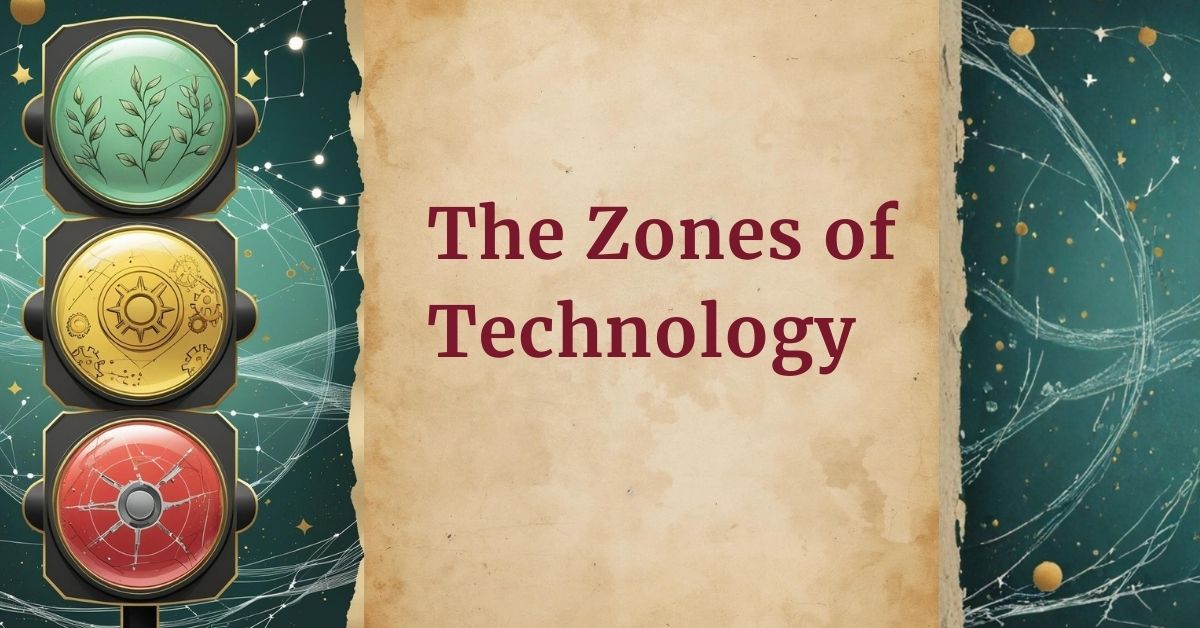
I like to think of the use of technology in terms of zones: green, yellow, and red.
Think like a traffic light:
- Green means go and, in this case, good, go ahead with what you’re doing.
- Yellow means slow down and think about what you’re doing.
- Red means stop and reconsider what you’re doing.
The zones can be applied to anything in your life. Any activity that you’re doing. Any action you’re taking. Any choice you’re making. How you spend your time.
Each zone is going to look different for everyone because we all have our own unique set of skills. What looks Yellow for me, might look Green for you and so on.
But, for the sake of illustrating the concepts, I’ll walk you through some examples as I dive into the zones more deeply.

Green Zone: Amplifier
Good to go! The Green Zone is anything that supports you and your sovereignty. It helps you achieve your goals without taking anything away from you. It’s an amplifier of capabilities you already possess.
As a writer, using a word processing document like Microsoft Word or Google Docs greatly amplifies my speed at writing. However, if my computer broke or I lost power, I could write the old-fashioned way and still get my ideas out there.
Using a calculator to check your math can be a way to speed up your calculations as long as you don’t forget how to do mental math.
A GPS on your phone can help you navigate new place, especially if you use it to figure out how to get there but then you do the navigation yourself.
Having a standing desk enables people to move their bodies throughout the workday and better their overall health.
Well-designed public transportation amplifies us by allowing us to reduce traffic on the road and, at a personal level, give us the time either to relax or do something productive.
A hallmark of the Green Zone is that the technology enhances capabilities but does not create dependency. When you sense that you’re becoming dependent on something, it’s time to question whether you’re in the yellow zone.
Yellow Zone: Efficiency
Caution! The Yellow Zone is where you want to question whether what might have been Green is becoming Red. It’s that in-between zone where you want to carefully question what you might be losing for the sake of efficiency.
The same technology can jump between all the different zones depending on how we use it. When we use our GPS for a new route, that’s probably Green. But when we use it repeatedly for the same route, that’s getting into the Yellow Zone. You might not notice your wayfinding skill has atrophied until your phone dies and you can’t figure out how to get to the grocery store from a road you’ve taken a hundred times.
Whenever I go into a store that sells kitchen supplies, I’m amazed at all of the specialized gadgets — often for one very specific purpose. A food processor or mandoline slicer saves so much time. Your food can be chopped so finely or perfectly with those tools. Over time though, what happens to your ability to cut with a knife? What if you travel somewhere, want to cook, and don’t have the kitchen gadgets you have at home? Does the convenience replace a skill you used to have without you deciding to give it up?
Streaming services can be genuinely enriching. It also means you never have to sit with boredom or choose too carefully what to watch because everything is always available. Often, the algorithm starts choosing for you and you might have spent 4 hours watching something you don’t care about because it autoplayed.
When approaching any form of technology, the question to ask yourself is: Am I losing anything by using this? In the Yellow Zone, the answer is usually “maybe, I’m not sure.”
And that’s okay! It’s going to vary between people and, even with you, it’ll vary depending on the time of day and the way you’re using it.
The goal here is not to judge yourself. It’s to bring awareness to your behaviors and help give you a way to choose intentionally.
Red Zone: Replacement
Danger! The Red Zone is where the technology has taken you over. It’s become a replacement for you. You may want to course correct here and see what you can do to help yourself get back in the territory of you being in charge.
When I used generative AI with writing a story, I drifted from the Green Zone of it being a research and brainstorming partner to the Yellow Zone of it giving me details, ideas, story beats, and concepts to write to the Red Zone of it writing for me. And the scary part was that I started to forget what my voice sounded like.
Headphones are a great tool for listening to music, audiobooks, podcasts, etc. They also can serve as a wall between you and the world. And maybe sometimes you want or need that in order not to be overstimulated. However, it can also replace your ability to be present in your environment. At the beach, on a forest trail, in the mountains, you start to miss the sounds of nature. At home or around people you love, you send a clear signal you don’t want to be engaged with. The question to consider might be: “What does it cost me to shield myself in this way?”
The latest car models these days have so many automated features. Lane assist, automatic breaking, parking assist. Not to mention backup cameras. Each one on its own could be considered Green. When you combine them though, what happens to the skills of the driver? Spatial awareness, reaction time, judgment all start to erode.
Food delivery and pickup systems have become very sophisticated in recent years. They can be exceedingly helpful sometimes. Maybe you’re trashed one day and just don’t feel like leaving the house, so you order something. Maybe you’re traveling for work and just want food delivered to your hotel. Maybe you need to place a grocery order because you can’t pick them up and you need specific things, so you order it so someone can grab it for you. When this becomes a daily occurrence, what gets lost then? When cooking has been entirely outsourced — not just shopping but also the preparing and choosing the ingredients you want — one has lost or never built the skill of feeding oneself.
The entire ecosystem of recommendation algorithms now determine what information you see. Historically, we all went looking for information. We went to libraries, we got newspapers, we gossiped with each other. Now, search engines, social media feeds, and news aggregators decide what information you encounter. The system decides what you see and your ability to seek out information and evaluate information independently atrophies. This happens to you whether you choose it or not.
Going back to the question: Am I losing anything by using this? In the Red Zone, the answer might look something like, “yes, and I might not have noticed.”
Same Tool, Different Zone
The Zone you’re in with a certain approach may frequently vary. It’s fluid. You could be in different zones all in the same day.
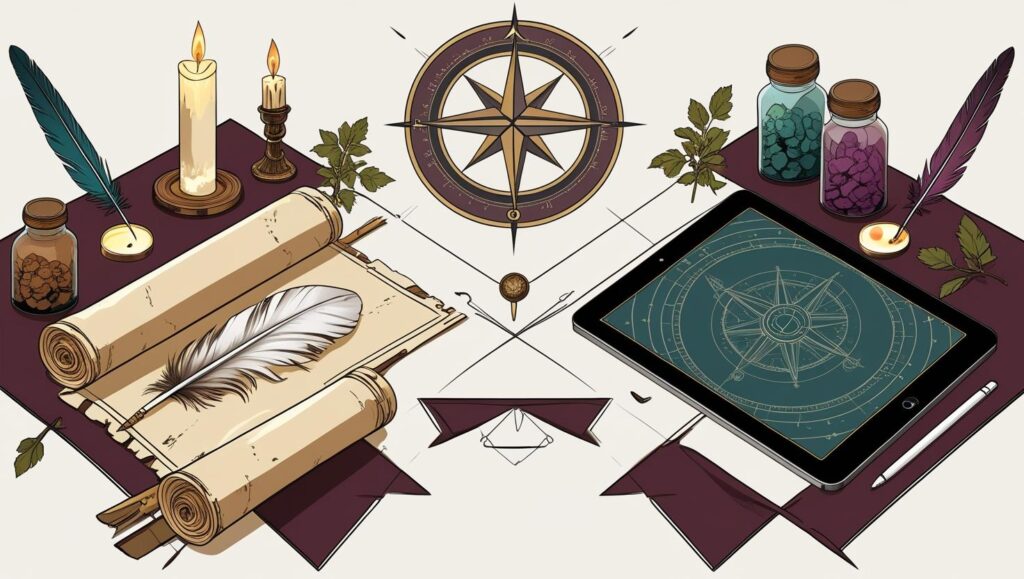
Let’s look at social media, for instance. Checking social media while you’re on the toilet to stay connected might be Green. Scrolling social media on your lunch break to decompress could be Yellow. Doom scrolling at 1 am when you can’t sleep might be Red. It’s the same app, same person, same day, yet all in different zones.
With using a GPS, it might be Green in a new city, Yellow when checking traffic on your commute, and Red when you’ve that way hundreds of times.
I’d always loved drawing as a kid and quit when someone made fun of a drawing. Wanting to get back into creativity as an adult, I first taught myself to paint by taking some digital illustration classes. For me, that looked like using the Procreate app on my iPad. It made sense at the time since I was moving around a lot and it got me creating.
Learning to create art initially started me off in the Green Zone. I could express my creativity. However, it became ONE more device for me to glue myself to and it shifted towards the Yellow Zone. To move myself back to Green, I started venturing into “traditional” painting and realized I could find ways to make that portable as well.
Many people — my husband included — attend “YouTube University.” There’s so much knowledge available there at their fingertips. My husband spends a lot of time watching videos on YouTube and the knowledge he gains is incredible. He learns a lot that way.
It impresses me how he has the patience and nerve to watch videos with opposing viewpoints. Like watching vegans talk about why veganism is the best and then doing the same for carnivores. Or watching videos from one political party and then another. It allows him to find the truth in the middle. That’s a Green Zone, the amplification of knowledge. But when he spends hours on YouTube getting distracted by whatever his feed throws at him it can quickly go from Yellow to Red.
I had a situation after a bad breakup where I still had the smartwatch my ex had given me. The smartwatch would buzz every time I got a notification. And, by default, all apps want to send you notifications, so it buzzed all the time. I would check the watch, desperately hoping he’d texted me and be disappointed when it was Facebook telling me someone had commented on a post. All these notifications created a ton of anxiety for me. That was the Red Zone. I got myself back into the Green Zone by turning off all notifications except texts and calls. And that’s still how I keep my phone.
In the United States, we’ve become accustomed to the convenience of Amazon Prime’s two-day delivery or less. And, as I spend my time between the U.S. and Serbia, when people ask me what I miss about the U.S., I say Amazon Prime. It feels very frivolous and of course it’s something I can live without, but the convenience is really nice. At the same time, when I’m in Serbia, it’s a fun game to figure out where to get stuff. There’s all these specialized stores for things and so you really have to get to know the area. But there can be things I don’t find that I’d easily be able to order on Amazon.
The same need of shopping is met by two different systems, with very different tradeoffs. Amazon is efficient and I get what I want right away. When I have to hunt for what I want, I build knowledge of my environment, relationships with shopkeepers and other people, and I ultimately get the satisfaction of figuring it out. With Amazon, I might not have to “waste time” to find something mundane (probably Green), but at the same time, I don’t get the experience of trying on the clothes or seeing the product before buying it (potentially Yellow).
The Zones aren’t meant to be scorecard or another way to criticize yourself. It’s to help you become aware and pay attention. Awareness is the first step towards choosing intentionally and consciously.
Applying the Zones in Your Life
I don’t want to tell you how to use the Zones. You don’t even have to apply them in your life if you don’t like them. I’m tired of people saying their way is the right way. That really did some damage to me over the years. I’m starting to believe there’s no RIGHT WAY. There’s just your way.
Instead, I’m going to share some ideas for you to consider and invite you to discover what works for you.
The Zones are not only for external technology. However, you can overdo internal technology too. You can meditate for eight hours a day and completely disconnect from the world around. That might be expected and fine if you’re a monk who lives in a monastery, but if you have a job, family, friends, the need to feed yourself, you might be overdoing it.
The main intention is to notice. The Zones are a lens for you to look at what you’re doing and why.
Here are some questions to consider as you’re thinking about the Zones in your life:
- Does the tool require me to give up a skill or capacity in exchange for using it?
- Am I losing anything by using this?
- Am I using this on purpose or out of habit?
- Did I choose it or did it choose me?
For example, you’re standing in the kitchen and find yourself reaching for your phone to look up a recipe for something you’ve made before. You might pause and ask yourself, “am I using this recipe on purpose or out of habit?” That’s it. That’s the practice of checking the Zones. You paused and questioned your impulse.
I’m focusing here on the Zones of technology, of course, but as you begin this practice with noticing your habits around technology, you may end up extending them to other areas of your life.
The Zones can be used for anything in your life. There are Green, Yellow, and Red Zones for food. For exercise. For interaction. For productivity. For play. For rest.
So, if you so desire, start with the Zones in the context of technology and watch what happens as you start to notice. And remember, you’re noticing without judging. This is harder than it sounds. Many of us have a tendency towards guilt and/or perfectionism. The art of noticing is a practice that you develop over time.
If you notice that you’re in the Red Zone, you don’t have to quit cold turkey. The awareness itself starts to shift things. Sometimes just seeing it clearly — and the part you’re taking in making the choice to interact with it — is enough to naturally change the behavior.
The first few times you try to notice, you might feel defensive or guilty. That’s normal. That’s totally fine. Acknowledge the feeling. Let it pass. And keep noticing.
Some of us are stubborn and it might take hundreds of times to finally come to the point where we notice and don’t feel guilty or judgmental. That’s also fine. It takes time.