Why do we need permission to like what we like?
A friend told me recently that she’d read a story generated by AI, and that she’d actually liked it. What stayed with me was how she said it.
Her voice dropped. There was a small apology tucked into it, the tone you use when you’re admitting to something you think you should know better than to enjoy. She liked the thing, and part of her was ashamed that she liked it.
New format, same shame
Once I noticed that flinch, I saw it wasn’t only about the AI story. My friend carries the same quiet shame around a few different things she reads.
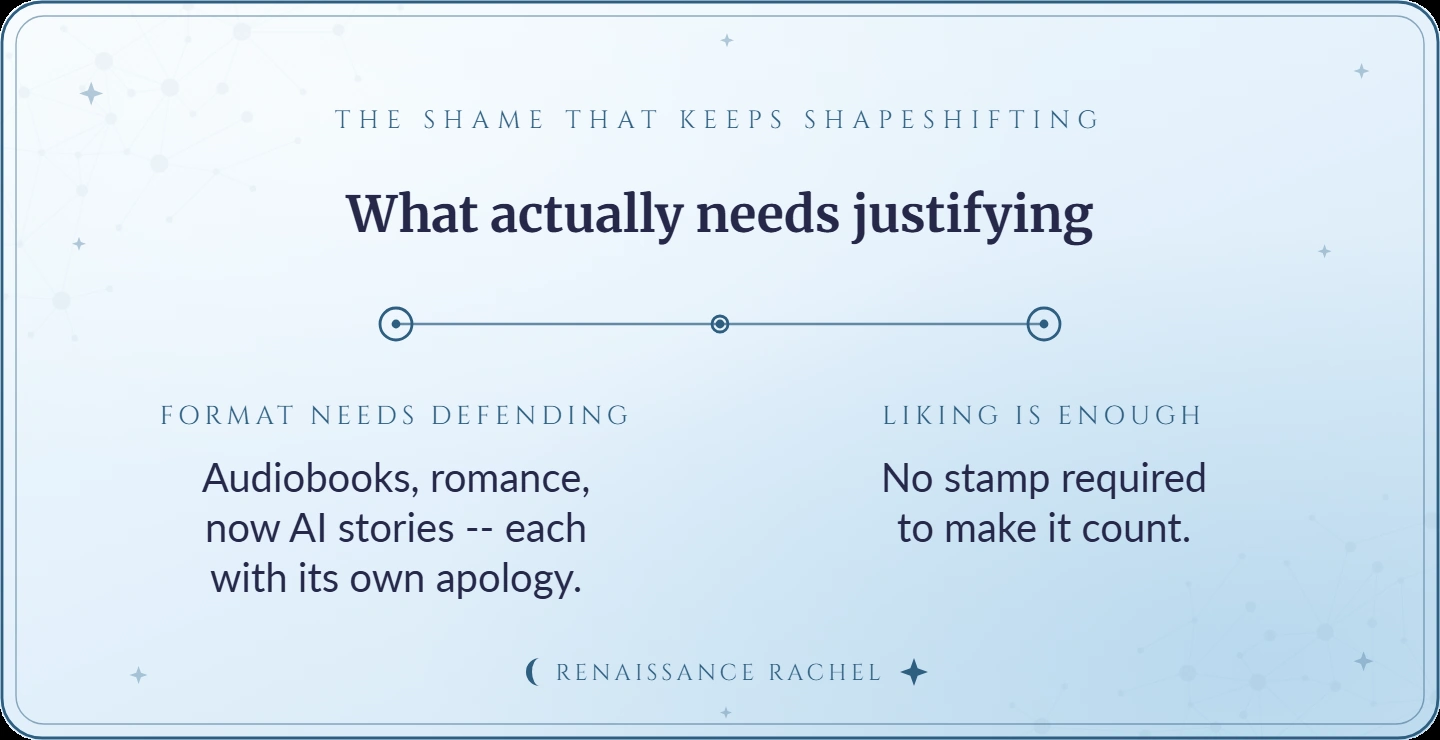
She feels it about spicy romance. She feels it about audiobooks. And now she felt it about a story an AI had written. Three separate things, each with its own little apology attached.
She isn’t unusual. Spend any time around romance readers and you’ll meet people ready to defend what they love before anyone has said a word against it. Underneath a lot of it sits the idea that certain books are the right books, and everything else is a guilty secret you keep to yourself.
Mention audiobooks and someone will tell you, kindly or not, that listening isn’t really reading.
Audiobooks weren’t “real reading” either
None of this is new. Ten or fifteen years ago, the line was that audiobooks weren’t real books. That one still lingers in places.
I grew up around audiobooks. We had them on CD, and my dad would check them out from the library by the stack. It never once occurred to me that they weren’t real reading. They were one more way a story could reach you.
What changed the audiobook conversation was more people doing it. The more ordinary something becomes, the quieter the shame around it gets. I think AI-generated writing is early in that same arc.
We’re already softening it with language, calling things “AI-assisted,” a neat phrase that lets everyone keep some distance. We keep finding new reasons to be ashamed of something, and new words to manage the shame.
The people who dismiss it usually haven’t tried it
The people quickest to dismiss a format are usually the ones who have spent the least time with it. They’re deciding from the outside, about something they’ve never actually picked up.
The people who have spent time with it, the ones who genuinely love it, are often the ones who get defensive. They brace to defend their taste before anyone challenges it. That bracing is the tell. When you’re ready to justify what you enjoy, you’ve already taken on the idea that your taste needs someone else’s approval to count.
I realize now that most gatekeeping is people discrediting a way of doing things they’ve never tried. It says more about their own comfort than about your choice.
Final thoughts
So here’s the question I’ve been sitting with. Why do we need to be defensive about what we read at all?
You’re the one reading it. You’re the one it’s reaching. The people ready to tell you it doesn’t count aren’t in the room with the book, feeling what you’re feeling. Their opinion was never part of the experience in the first place.
Liking something is enough. It doesn’t need a stamp that says real, or legitimate, or literary. You’re allowed to enjoy what you enjoy, in whatever form it reaches you, without rehearsing the defense first.
So let me ask you. What are you a little ashamed to love? And what would shift if you let yourself simply love it?