I spent 30 years consuming. Here’s what was underneath.
Something is shifting. You can feel it if you pay attention. There’s a growing restlessness with the endless scroll, the algorithmic feed, the sense that we’re being entertained but not nourished.
People are starting to ask what we actually lost while we were busy consuming and what it might look like to get it back.
There’s a phrase gaining traction for this moment: the human renaissance. I want to talk about what I think that actually means, because I don’t think it starts where most people are looking for it.
It starts inside.
The endless queue
For years I consumed content. Not casually. Compulsively. From shows to movies to video games to books. I thought of it as keeping up.
A friend would ask if I’d seen or read something and I’d add it to the list. Finish one series, start another. Some of those shows had seven seasons. The queue never emptied. It just grew.
What I didn’t understand at the time was that I wasn’t relaxing. I was hiding.
Hiding is a strong word. I mean it exactly. I had story ideas sitting in me for years. Ideas I’d never touched. Dreams I’d named to myself in private and then walked away from.
Every. Single. Time.
The consuming gave me somewhere to put my attention that wasn’t those dreams, wasn’t the question of why I kept not pursuing them. It was a full-time occupation that left no room for anything that might require something of me.
The algorithm didn’t do this to me.
I was already gone.
The algorithm just made it more comfortable to stay gone.
The story I never wrote
I was fourteen or fifteen, lying in bed, when a story idea came to me like a bolt of lightning. I remember the moment. I looked out the window and the whole thing arrived, vivid and complete in the way that only certain ideas are. I knew then that it was something.
I didn’t write it.
I had wanted to be a published author since I was a child. I had read voraciously my entire life. And had I finished a single personal writing project by the time I was in my thirties? No.
It’s not that I was lazy. I’m a high-achieving individual.
I needed the permission.
The first time I showed my writing to someone who mattered, they read it and gave me honest critique. This person loved me and I loved them. The critique wrecked me.
Not long after, one of my teachers called on students to read our writing assignments aloud. I hadn’t known that was coming when I submitted mine. I’d written double the minimum requirement.
I stood up and read as fast as I could, trying to get through it, trying to be invisible. On the bus afterward, someone told me they liked the story. I hardly heard it. I didn’t believe that was possible.
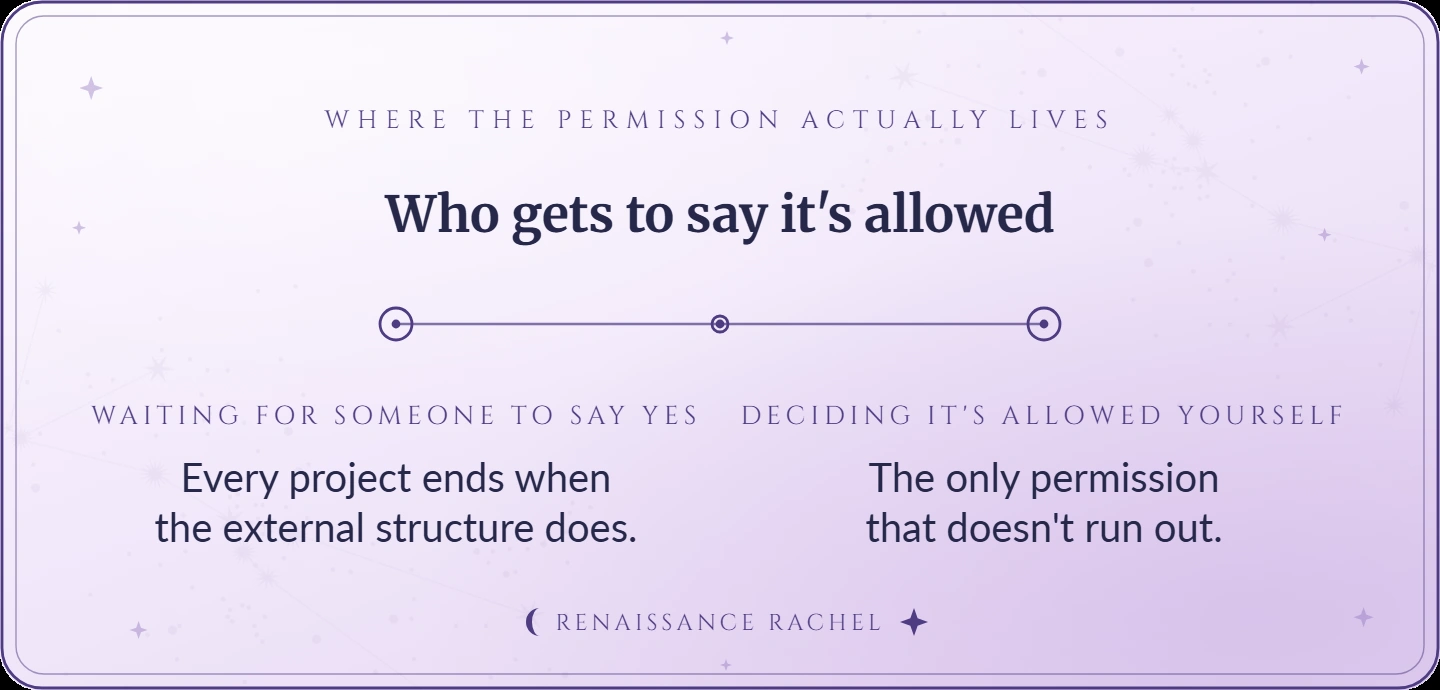
I kept writing, but only when someone said I could. A creative writing class. School assignments. Newspaper internships. Every time, it was external structures that gave me access to myself. Every time the structure ended, so did the writing. One summer I wrote fanfiction. It was someone else’s world with my story built inside it. That felt safer. My own worlds stayed locked.
I took a drawing class in college. I remembered that I loved to draw. That I’d loved it as a child until someone made fun of me and I stopped for ten years. The class gave me permission to pick it back up. When the class ended, I stopped again.
The inspiration was there all along. I was waiting for someone to tell me it was allowed.
What’s stopping you?
About six years ago, I was talking about my dreams with someone I loved. I told them about the writing, the stories, and the things I’d wanted since I was small. They asked me a simple question.
What’s stopping you?
I sat with it. I turned it over. I looked for the external answer, the circumstance or the obstacle I could point to.
Only one answer made sense.
It was me.
I was stopping myself.
I was the one who required permission to do the thing I most wanted to do.
And I was the one who kept withholding it.
That realization didn’t fix everything. Realizing you’ve been your own obstacle for thirty years is not a clean moment. It doesn’t feel like liberation. It feels, at first, like thirty years of lost time.
But it started my journey of reclaiming my creativity.
What reclaiming actually looks like
I started painting. I got back into writing. I built this blog.
I would love to tell you it felt natural and joyful from the start. But the first thing that showed up was the voice. You probably know the one. This is junk. This doesn’t look right. This doesn’t look like what I meant it to look like.
The gap between the image in my head and the thing that appears on the canvas or the page is brutal. Especially at the beginning. Especially after I’d spent years telling yourself stories about why I couldn’t do this.
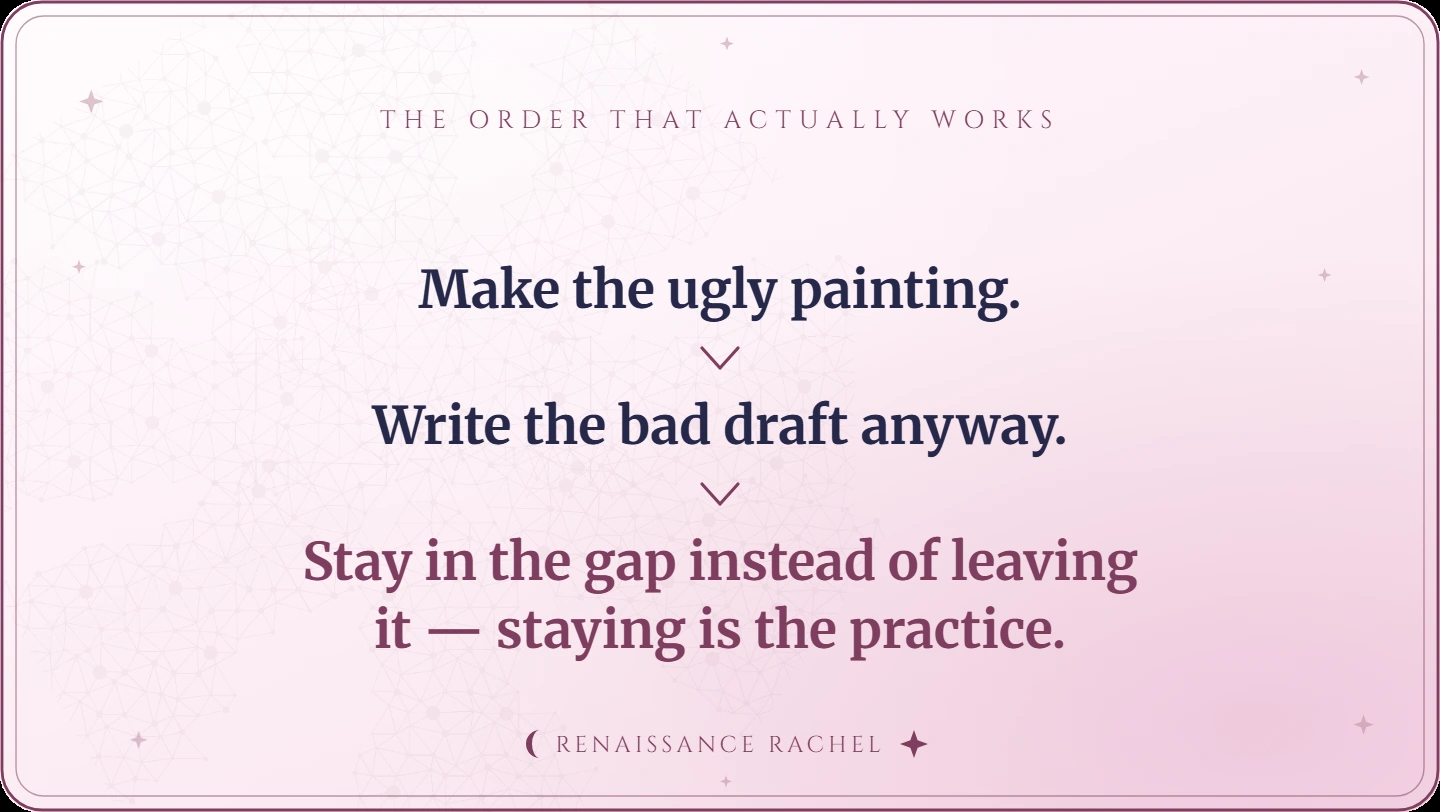
I had to learn to stay in the gap instead of leaving it. To keep painting the ugly painting. To trust the process. To keep writing the bad draft. The bad draft needed to be there to get to the gold.
Staying was the point.
Staying is the practice.
The negative self talk doesn’t disappear on its own. I got less willing to let it make decisions for me.
I look back now at the early work and I feel something I didn’t expect: pride. Because I did it. Because I stayed.
The story from the window when I was fourteen is still on my list. I haven’t written it yet. I’m telling you that because I think the human renaissance doesn’t require a finished product or a tidy arc.
It requires a decision to stop outsourcing your own interiority. To stop letting consumption fill the space that belongs to creation. To stop waiting for someone to hand you permission that was always yours to give.
The ripple
Here’s what I’ve come to believe: when one person reclaims this, it expands to everyone around them.
It happens in small, specific ways. Someone watches you try something you might fail at. Someone sees you make the ugly painting and keep going. Someone asks you what you’ve been working on and you tell them honestly, without apology. That lands somewhere in them. It opens something.
Algorithms or AI or the attention economy are all real obstacles. Deep down though, we fight the part of ourselves that decided, somewhere along the way, that we needed permission to be alive in the way we most wanted to be alive.
The human renaissance begins when you stop waiting for someone to grant it.
It always started with you.