The Language of Empowerment: How the Words You Repeat Build Your Life
Try something with me before you read another line. Do not picture a red door.
You pictured the door. Everyone does. Your mind skips right over the word “not” and reaches for the nearest image, so the instruction you gave yourself and the instruction your mind carried out were two different things. Hold onto that, because it is the whole idea of this piece.
We treat the way we talk to ourselves as a running commentary, a play-by-play of a life that is happening to us. I have come to believe it is closer to a set of instructions. The sentences you repeat are setting the terms of your life. Your mind takes a phrase you say often, treats it as a directive, and goes to work making the world match it. Say “I’m so behind” enough mornings and you start to feel behind, move behind, and collect the evidence that proves it right.
This is the heart of a practice I have been living with for a while now, the Language of Empowerment. The premise is small enough to say in a breath and deep enough to keep unfolding for years: every word you speak is a directive to your body, your mind, and the space around you. Change the words, and you change the instruction.
Let me walk you through how it actually works, because once you hear it, you hear it everywhere, in your own mouth first.
Why your mind holds onto what you are trying to avoid
Come back to the red door. The reason it appears is the same reason so much of our everyday speech works against us: the part of you listening skips the word “not” and keeps whatever comes after it.
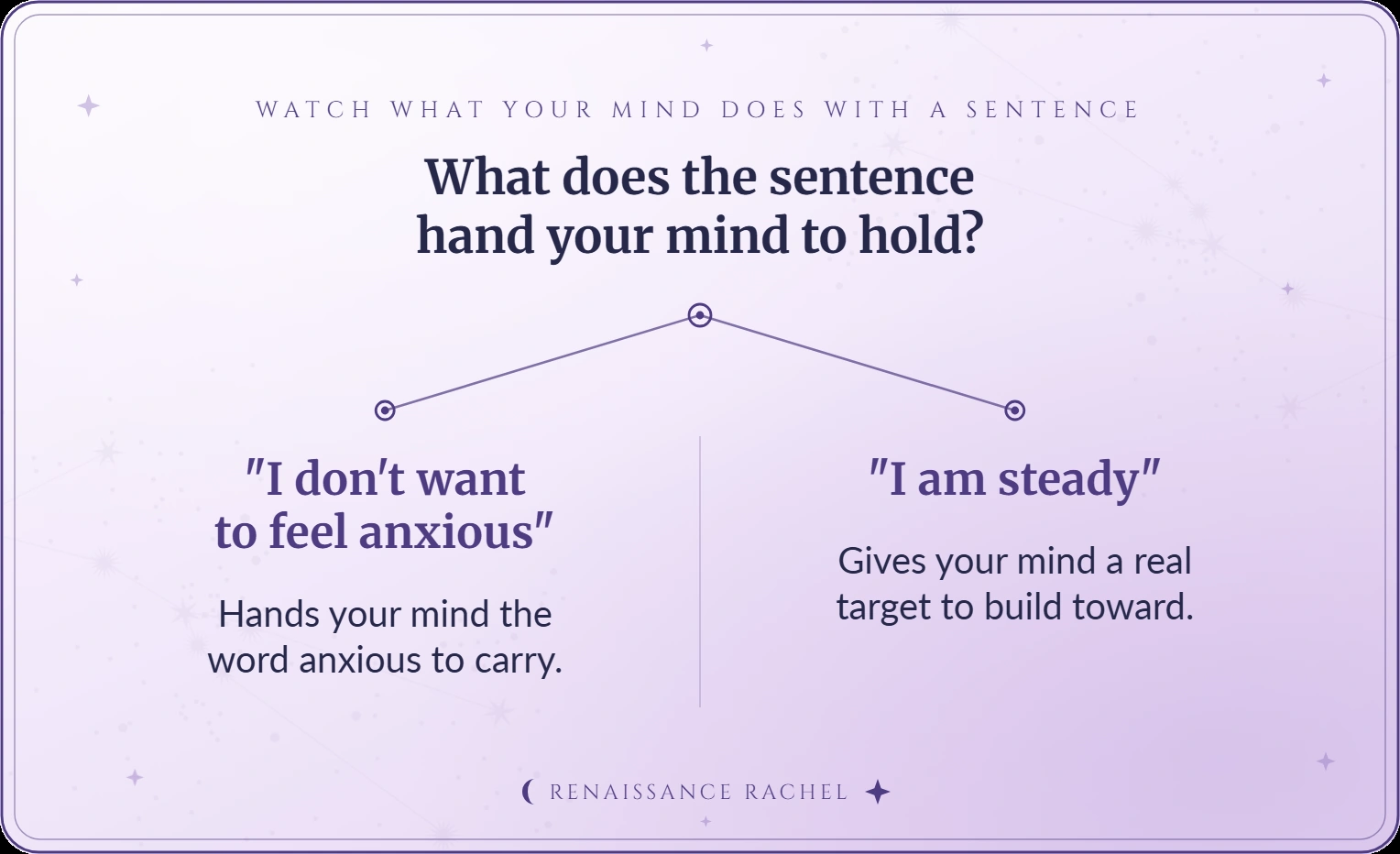
Watch what that does to an ordinary sentence. “I don’t want to feel anxious” hands your mind the word “anxious” to hold. “I don’t want to mess this up” plants “mess this up.” “I don’t want to be like my mother” keeps her front and center. Every time you build a sentence around the thing you are moving away from, you name that thing out loud and ask your body to go find it.
The shift is to say the state you are choosing instead. “I am steady.” “I am at ease.” “I have what I need.” Now your mind has something real to build toward, a target instead of a hazard. This one change, made first thing in the morning, changed how I meet my whole day, and it costs nothing but attention.
“I want” and “I need” keep it one step away
Here is the next one, and it felt strange to me until it landed. “I want” and “I need” are both sentences about absence. They announce that you are without.
Say “I want more calm” and you confirm, out loud, that the calm is missing, and your mind agrees and keeps the gap in view. Say “I need more time” and you file the message that time is scarce, then spend the day proving it. The wanting holds the thing at arm’s length, because wanting is the state of not yet having.
The practice trades the announcement of lack for a claim of having. “I choose calm.” “I am calling in more calm.” “I have enough time for what matters.” You stay honest about what you desire. You stop repeating the gap, and you start naming what you are drawing toward you. Try saying “I have enough time for what matters” and notice how differently you move through the same afternoon.
“Trying” is a waiting room with no door out
“I’m trying” might be the most exhausting sentence we say, because it feels like effort while keeping you permanently on the way to somewhere. You can try to rest, try to write, try to be more patient for years and stay exactly where you began. The word itself holds the door half open and never lets you through.
Name the outcome as present and true instead. “I rest well.” “I am writing.” “I am patient with myself.” When I swapped “I’m trying to be more patient” for “I am patient with myself,” something in my shoulders dropped before I had done anything differently. Naming the outcome as already true gives your body a target, and bodies move toward the targets we name. It reads like a small trick and it works like a big one.
“To me” or “for me”: where you put the power
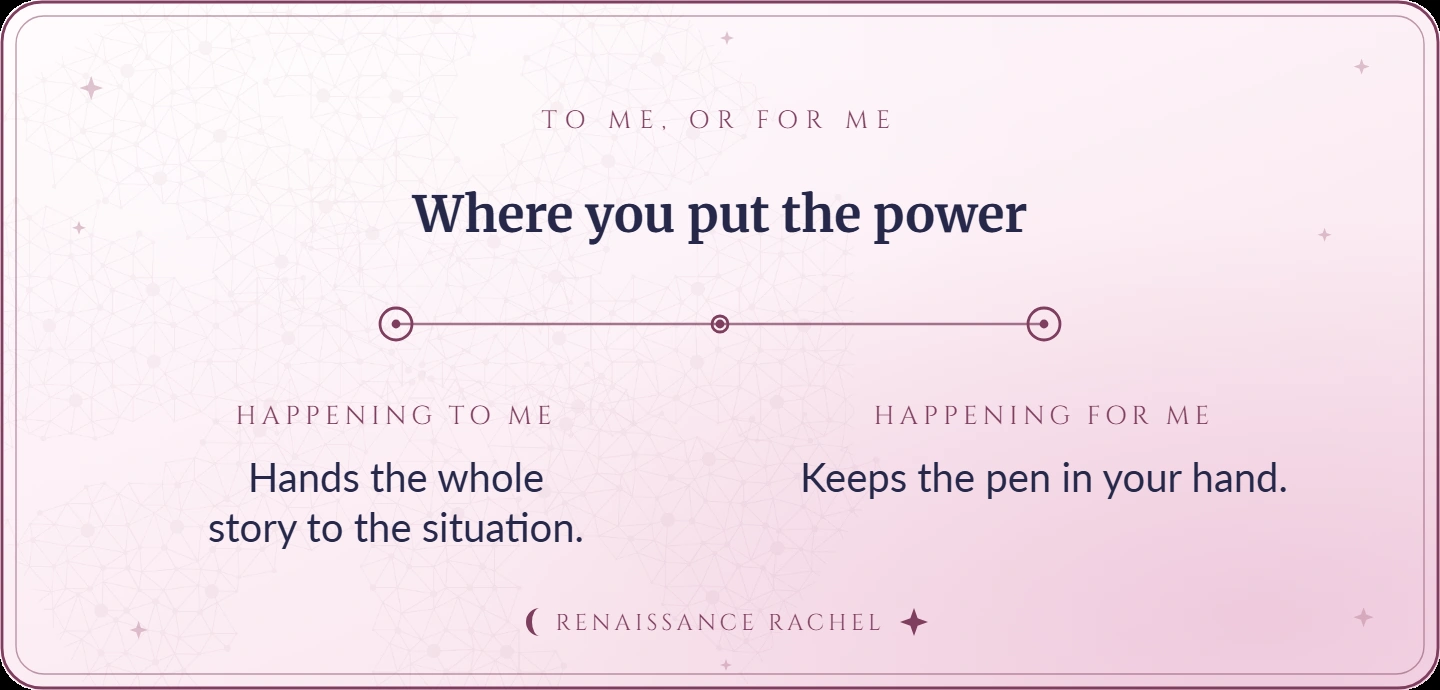
Two of the smallest words in the language carry a startling amount of weight. “This is happening to me” hands the whole story to the situation and leaves you waiting to see what it does with you. “This is happening for me” keeps the pen in your hand.
Let me be careful here, because this one gets misused. You do not have to feel grateful for hard things or pretend they stop hurting. Some days the honest sentence is heavy, and it deserves to be spoken plainly. The reframe asks for something steadier than forced gratitude. It asks you to stay the person who gets to ask what this is showing you, what it is making room for, and what you will build from here. When something knocks you sideways this week, try asking what it might be here to teach you. You may dislike the event, and you will still get to author your response to it.
Radical acceptance comes before the reframe
There is a real risk hiding in everything above, and I’m naming it before you run into it yourself. If you take “this is happening for me” and use it to skip past pain, you have not practiced the Language of Empowerment. You have practiced denial wearing a better outfit.
The piece that has to come first is called radical acceptance. It means accepting reality exactly as it is, before you change a single word about how you speak of it. Radical acceptance does not mean agreeing the hard thing is fine, or approving of it. It means you stop fighting the fact that it happened, because that fight is where a second layer of pain lives on top of the first. There is the pain a hard thing causes, and there is the extra suffering that comes from refusing to believe the hard thing is real. Radical acceptance sets down that second layer.
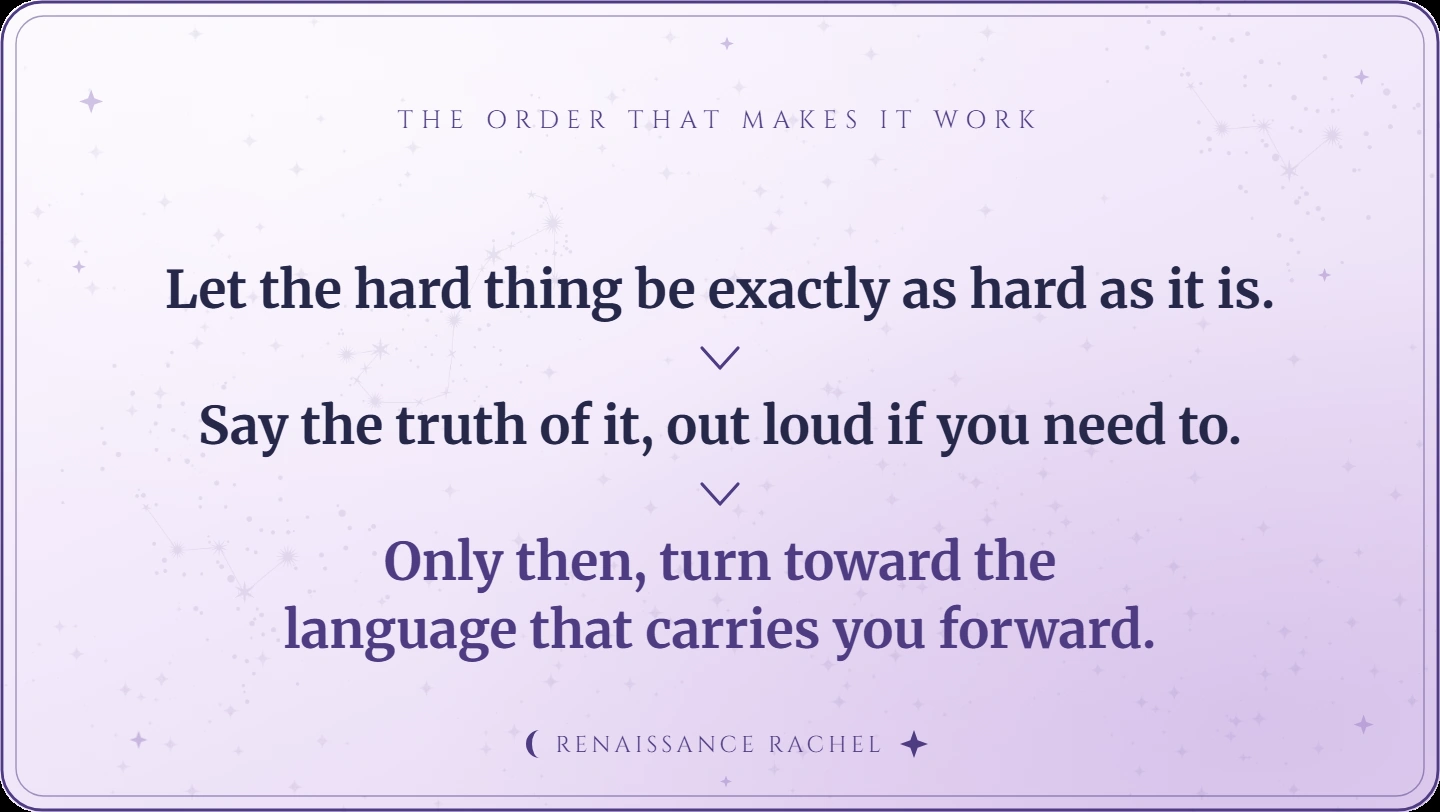
So the order matters more than the words. First, let the hard thing be exactly as hard as it is, out loud if you need to say it out loud. This happened. It hurts. I did not want it. Only from that honest, grounded place do you turn toward the language that carries you forward. “This is happening for me” was never meant as a shortcut past the acceptance. It is the sentence that becomes available to you once you have already accepted what is true and are looking for where you go from here.
This is why nothing in this practice asks you to feel grateful for hard things, or to paste on a silver lining you don’t believe. Accept the whole truth of it first. Then choose the words that build what comes next.
The everyday swaps
Once you have the pattern, the swaps become almost playful. A handful I come back to:
“I don’t want to feel stuck” becomes “I am ready to move.”
“I hope it works out” becomes “I trust this is working out.” Hope lives close to fear on the emotional scale; trust stands somewhere steadier.
“If this comes together” becomes “when this comes together.” “If” tells your mind the outcome is in doubt and keeps you hovering. “When” makes a decision your body can plan around.
“I don’t know” becomes “I’m still figuring this out.” Said on repeat, “I don’t know” is an instruction to stop searching, and it cuts you off from your own clarity.
The reflex “I’m sorry,” offered for taking up space or needing a minute, becomes “thank you.” “Sorry I’m late” becomes “thank you for waiting.” You hand the other person warmth instead of your smallness, and you keep your own footing. Save the real apology for real repair.
None of these ask you to force false cheer. They aim the instruction. Pick one this week and let the rest come slowly.
Decrees: speaking what is already true
The most direct form of this practice is the decree, a sentence you say to yourself as already true, out loud, until your body catches up to the words. A decree is built on a few rules that make it hold:
Present tense. “I am,” never “I will be.” Confidence set in the future is confidence you never quite reach.
Zero negatives. “I no longer struggle” still plants “struggle.” Name the calm you are claiming instead.
First person. It is a command to your own mind, not a wish sent out to the weather.
Say what is, out loud, until it stops feeling hollow. If it feels hollow at first, that is the work, and staying with it is how the sentence becomes true.
One I return to on the small mornings: I speak my life on purpose. I choose the words that build me. I trust what I know. I lead from my own authority. Notice there is nothing in it you are getting rid of, only what you are claiming, because the part of you that is listening holds onto whatever you name.
You will slip. So will I.
Let me clear up the worry I hear most, because I had it too. Choosing your words on purpose is not toxic positivity, and it is not monitoring every syllable until speaking feels like a test you keep failing. You will slip a hundred times a day. So do I.
The practice is kinder than perfection. Picture a child you love, and think of the sentences you would never let anyone say to them: you are too much, you always ruin this, you will never figure it out. Then notice how easily those same sentences land on you, from you, in a voice you would call cruel coming from anyone else. The whole invitation is to catch one, and to offer yourself a better instruction in its place. That is the work. Not flawless speech. One kinder sentence, and then another.
If you have spent time with mindfulness writing, you already know the muscle this asks for: noticing, without judgment, what is running on autopilot. And if you have read my thoughts on the technology within, you know I believe the most powerful tools you own are the internal ones. Your language is the first of them.
Where this is going
I am putting this into words now because it has become the ground under everything I care about: reclaiming your own internal authority, raising the vibration you carry into a room, communicating from a settled place, leading your life instead of narrating it from the passenger seat.
So sit with this for a second. Imagine a week where the voice in your head stops rehearsing what might go wrong and starts naming what you are creating. The hard conversation you have been dreading comes out steady, because you spoke to yourself as capable before you walked in. The boundary lands clean. The ask leaves your mouth without the apology stapled to the front of it. This is what opens up when your language starts working for you, and it is far more learnable than it looks.
It is the practice I keep returning to in my own life, and the body of work I am slowly shaping into workshops and one-on-one guidance. There is nothing to sign up for yet. I am planting seeds, and I would love to have you in the garden early. If a room existed to practice this together, out loud, with real feedback on the sentences you actually use, I would love to know whether you would want in.
A place to begin
You do not overhaul the way you speak in an afternoon. You pick one word and follow it for a week. Choose a single culprit, maybe “trying” or “I can’t” or the reflex “sorry,” and every time it slips out, pause and say the version you would rather live inside. By the end of the week the new sentence starts arriving on its own, because you have been rehearsing it.
Your words are not describing your life. They are building it. So choose them on purpose, one sentence at a time, starting with the next thing you say to yourself.
The framework I draw on here is called the Language of Empowerment, developed by Sophie Howell. I have shaped how I practice and teach it to fit my own voice and work, and the practice itself belongs to anyone willing to try it.