What Is the Human Renaissance? My Answer, Rather Than a Forecast.
We went to my in-laws’ for Sunday lunch a few weeks ago. My mother-in-law offered me a few pillows she wasn’t using anymore, and I took them home without thinking much of it. The next Sunday, she came over and saw them sitting out. She told me, in Serbian, where they came from. One of them, she said, her mother had embroidered.
I understood her — which was a big win and yay! moment for me as I’m still learning the language — and that day, I followed every word. I thought, that’s so sweet. I love that she kept it all these years. It made me happy to think someone had sewn it with love, decades before it ever sat on my couch.
A person made that pillow. An actual person, decades before I ever touched it. It’s such a small thing to notice, but I’ve started asking a version of that question about almost everything now that AI can write the caption, plan the trip, or draft the email before a person ever gets to it: did a person make this? Or did something else?
It turns out that question already has a name. People just call it “human renaissance” now — keynote titles, business book covers, a stack of recent think-pieces all reaching for the same thing.
There’s a marketing consultant’s conference recap making the rounds right now, telling brands how AI is reshaping who their customers even are. There’s a business book promising the expansion of human potential. There’s a stack of think-pieces asking whether AI will spark some kind of cultural rebirth, or whether the whole idea is wishful thinking dressed up in Renaissance-era metaphors. All of it is zoomed out, talking about society, the economy, the 2030s, some version of the future none of us can actually see yet.
I keep meeting the same question somewhere smaller and harder than any of that: my calendar, or a researcher I mentor who wants to skip straight to the shortcut before she’s built the judgment to know if it’s even right. So here’s my answer instead, built from an actual week rather than a decade I can’t see yet.
What does “human renaissance” mean?
The human renaissance is what happens when survival stops being the default problem most of us are solving. Most people alive right now have more time, comfort, and connection than any generation before them.
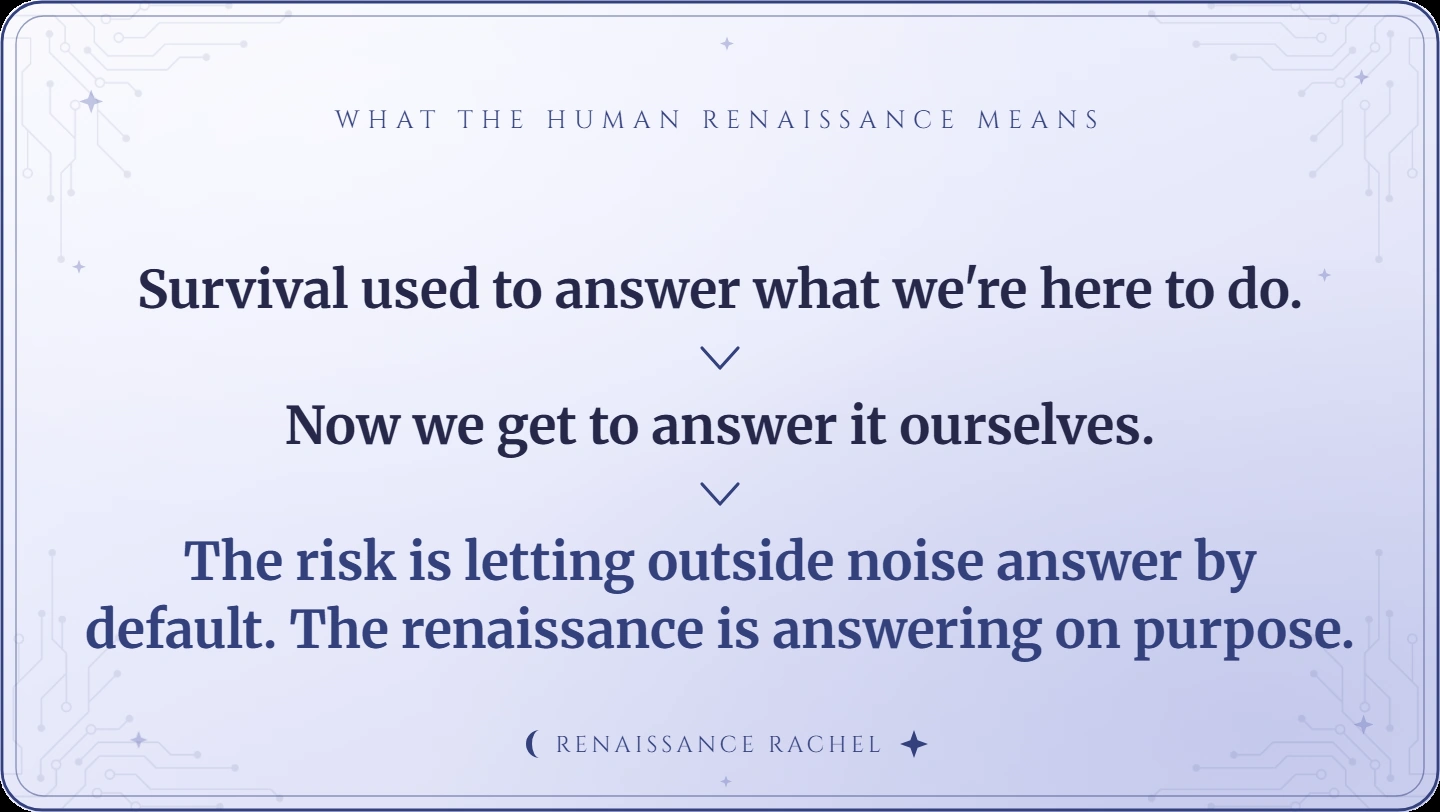
Survival used to answer the question of what we’re here to do. Now we get to answer it ourselves.
The risk is letting algorithms and outside noise answer it for us by default. The renaissance is answering it on purpose.
Most of what gets written under this phrase right now is about scale. Business consultants use it to describe what happens to customer behavior and brand strategy once AI reshapes an industry. History channels use it to draw a straight line from the 1400s to the 2030s, betting on what an entire culture will look like a decade out. Academics use it to describe what might happen to universities once the current crisis in the humanities burns itself out.
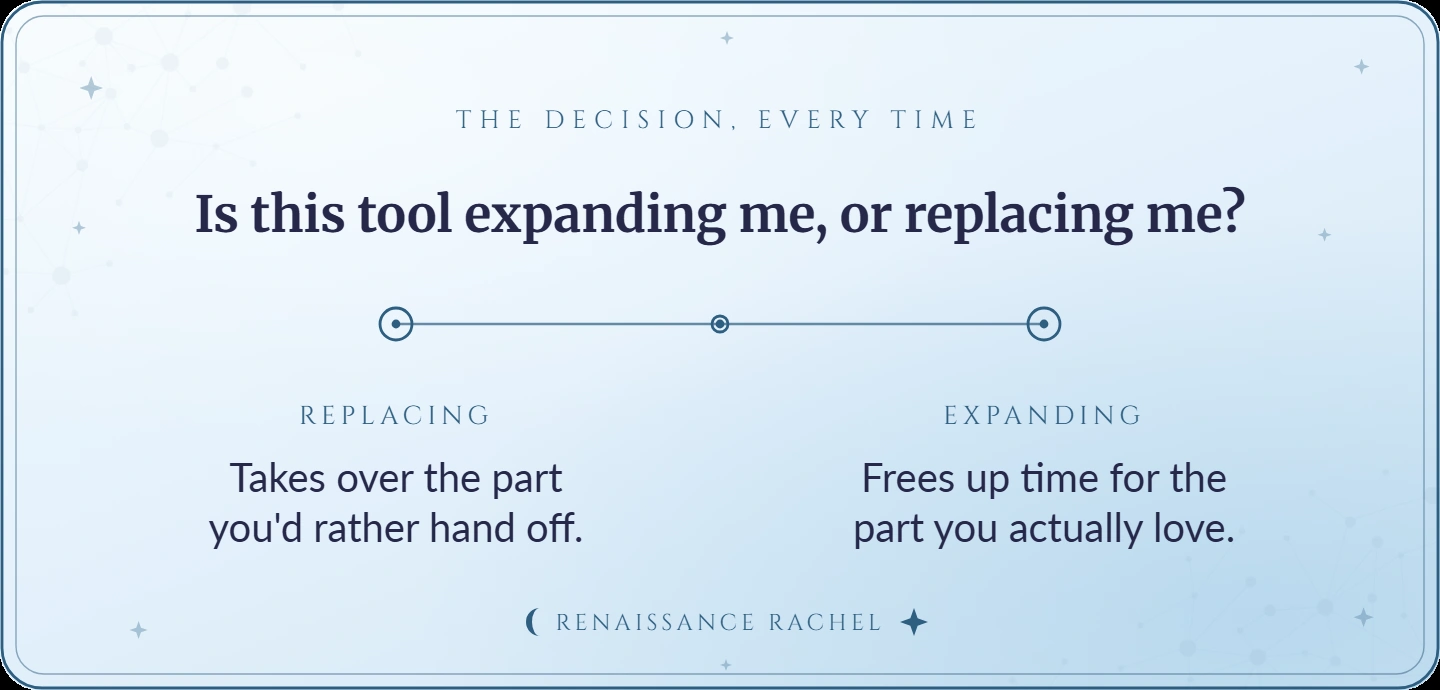
My version is smaller than all of that, on purpose. I’m describing what happens inside one person, this week, when she has to decide in real time whether a tool is expanding her or replacing her. That decision doesn’t wait for the 2030s. It shows up on a Tuesday, over a content calendar, a pillow, or a boundary she hasn’t crossed yet.
Some of that writing, even outside the AI conversation entirely, circles back to some version of becoming a polymath, a renaissance man, someone admired for range. My point is different: who’s actually driving, day to day, matters more than how many rooms you can walk into and sound smart in.
None of this is happening in a vacuum. The phrase is popping up everywhere right now because of where we actually are: watching AI move faster than any of us can process, wondering what happens to a career, a skill, or a sense of purpose once a machine can do the visible parts of it. That’s the fear this whole term is actually responding to, whether the person using it says so or not.
Why the fear is real
This fear is real, and it has specifics behind it. In May 2026, former Google CEO Eric Schmidt spoke at the University of Arizona’s commencement and got booed multiple times the moment he brought up AI. He kept going, telling the graduating class they still have real power to shape how the technology develops. The boos kept coming anyway.
He wasn’t the only one. A business executive got the same reaction weeks earlier at the University of Central Florida. So did a music industry CEO at Middle Tennessee State. Same reaction, school after school, all spring.
This goes beyond graduates. A recent national survey found that half of American adults feel more concerned than excited about AI’s growing role in daily life. This particular graduating class started college the same year ChatGPT launched. They’ve spent nearly their entire education watching the ground shift under whatever they were being trained to do, while facing a noticeably harder entry-level job market than the rest of the workforce.
I think those students are right to be scared. I think the fear is one of the most honest reactions happening right now.
That fear deserves something more useful than reassurance: an actual answer for when to reach for the tool and when to leave it alone. Here’s how I actually decide.
So when do you actually reach for it?
I have a process I teach anyone who works with me. Go through the data by hand. Tag it yourself. Sit in the tedium of it before you reach for a shortcut.
I eventually found a much faster way to do this with large language models. But the years I spent doing it manually are exactly what taught me what to look for. So when a new researcher starts with me, I start them on the slow way. They need their own judgment before any part of this gets handed off. I might show them the faster way eventually. Not yet.
I read about a mother recently whose nine-year-old son loves writing Zelda fanfiction. He asked if he could use AI to help him write it. She encouraged him to come up with his own ideas, because they’re his.
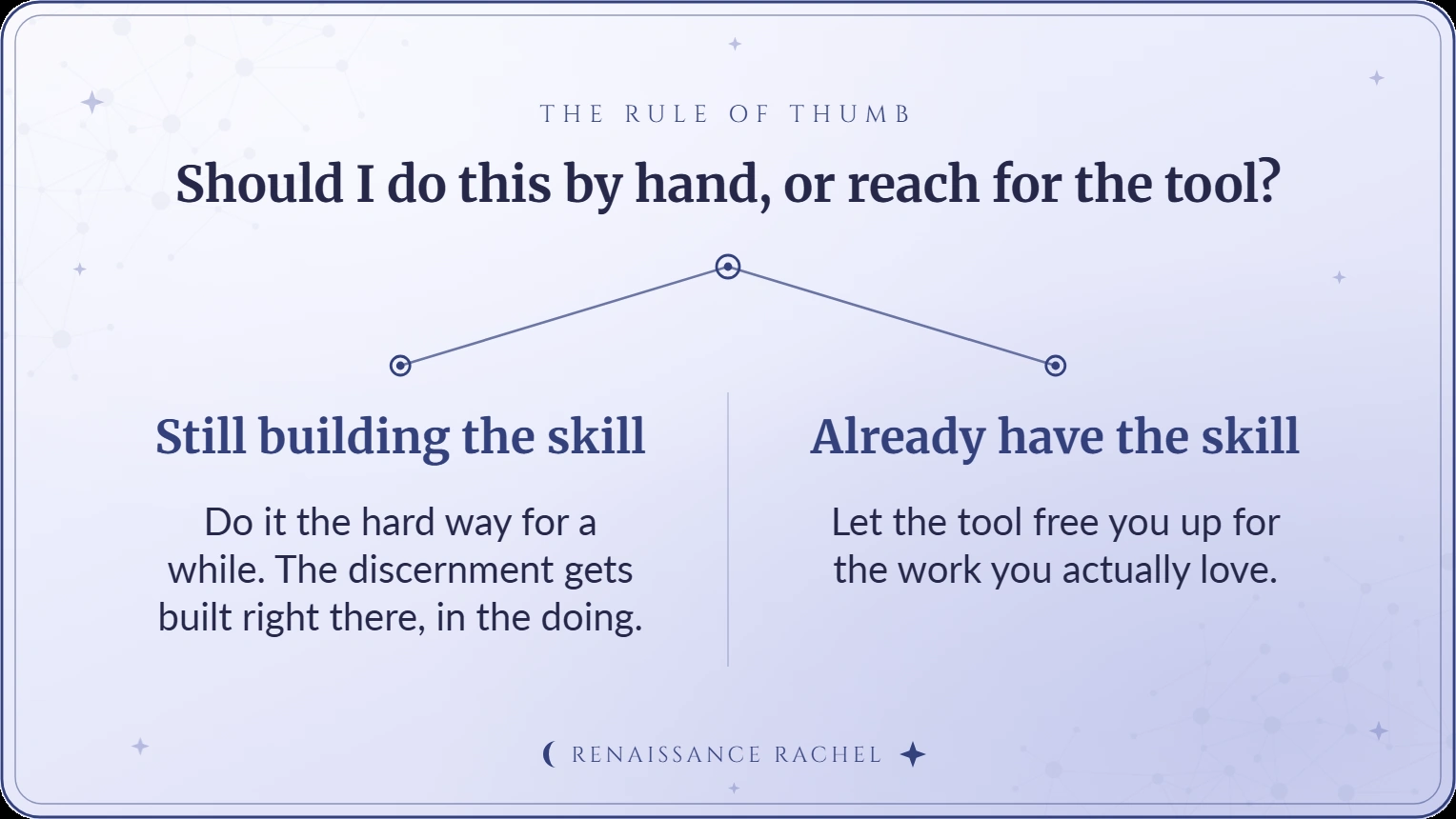
These examples sum up the rule of thumb I’ve developed around technology and cognitive atrophy. If you’re still building the skill, still forming your own point of view, do it the hard way for a while. The discernment gets built right there, in the doing.
If you already have the point of view, if you already have the skill, the tool is there to free you up.
That’s where I am with my own content pipeline right now. I built a system with review and approval steps for me at every stage, so I’m still the creative director of everything that goes out. It frees me up to spend my time on the part I actually enjoy: long-form writing. Video production, for me, is the part I’d rather hand off.
Another creator might feel the exact opposite and want to hand off the writing instead. Either way, that freed-up time goes toward getting outside, doing chores around the house, or just thinking without anything else demanding my attention.
And there’s a place I still haven’t crossed. I don’t give any AI agent access to my calendar or my email. Someone else built that model, and it would know a lot about my life if I let it in. I’ve looked at the safeguards. I still don’t fully trust it. So that one, for now, I keep doing the hard way too.
Three questions I actually ask myself
When I’m actually deciding, it comes down to three questions:
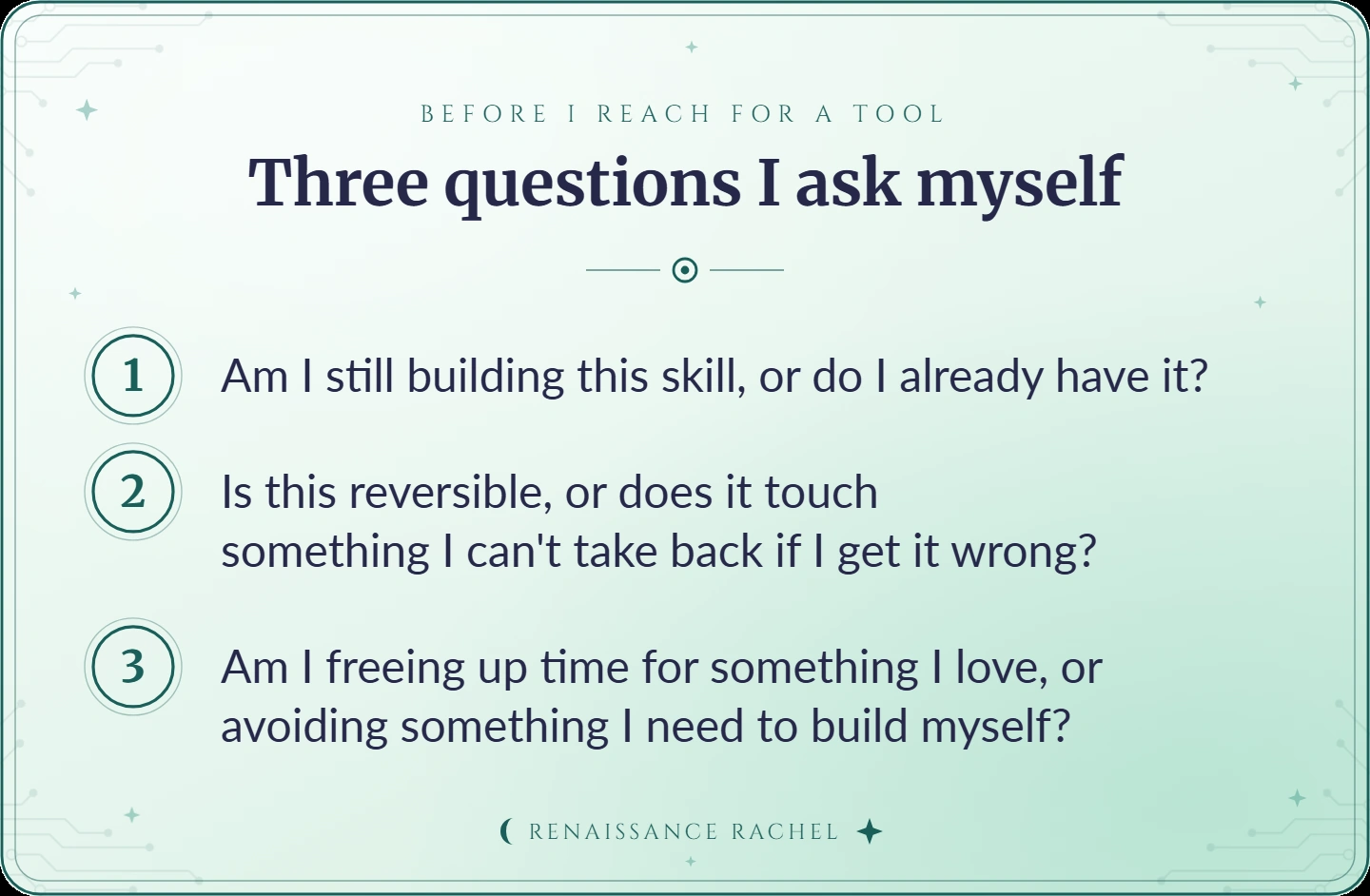
- Am I still building this skill or do I already have it?
- Is this reversible or does it touch something I can’t take back if I get it wrong?
- Am I freeing up time for something I love or avoiding something I need to build myself?
Most of the time, the answer sorts itself out fast. The hard cases are the ones where I’m still figuring it out.
Final thoughts
Everyone sounds certain right now. And they’re certain about different things.
Some of that certainty is fear. Some of it is a business book telling you AI will expand your potential if you just adopt the right mindset. Some of it is a nine-year-old’s mother making a clean call I might make a little differently.
It’s messy and I’ve stopped expecting it to be anything else. I have a pipeline that runs while I do the writing I actually love. I have a boundary around my calendar currently holding in place.
And I have a pillow on my couch that my husband’s grandmother made with her hands, a long time before any of us were worried about any of this. The next ten years are still uncertain. This past Sunday, I understood everything I needed to.