
The outsourced self: What we lose when we stop trusting ourselves
Think about the last decision you made today. Did you make it on your own? Or did you check something first?
When deciding what to wear for the day, so many of us check the weather app rather than stepping outside or opening a window. We might mindlessly turn on Google Maps for a route we’ve driven dozens of times. Asking a friend to validate a decision we’ve already made.
I’ve been teaching myself how to be more confident in my own decision making. It’s been a thread I’ve followed throughout my healing journey. I have had a tendency to outsource my authority: relying on external opinions to make judgements and decisions for me. This is an underdeveloped internal technology I am intentionally growing.
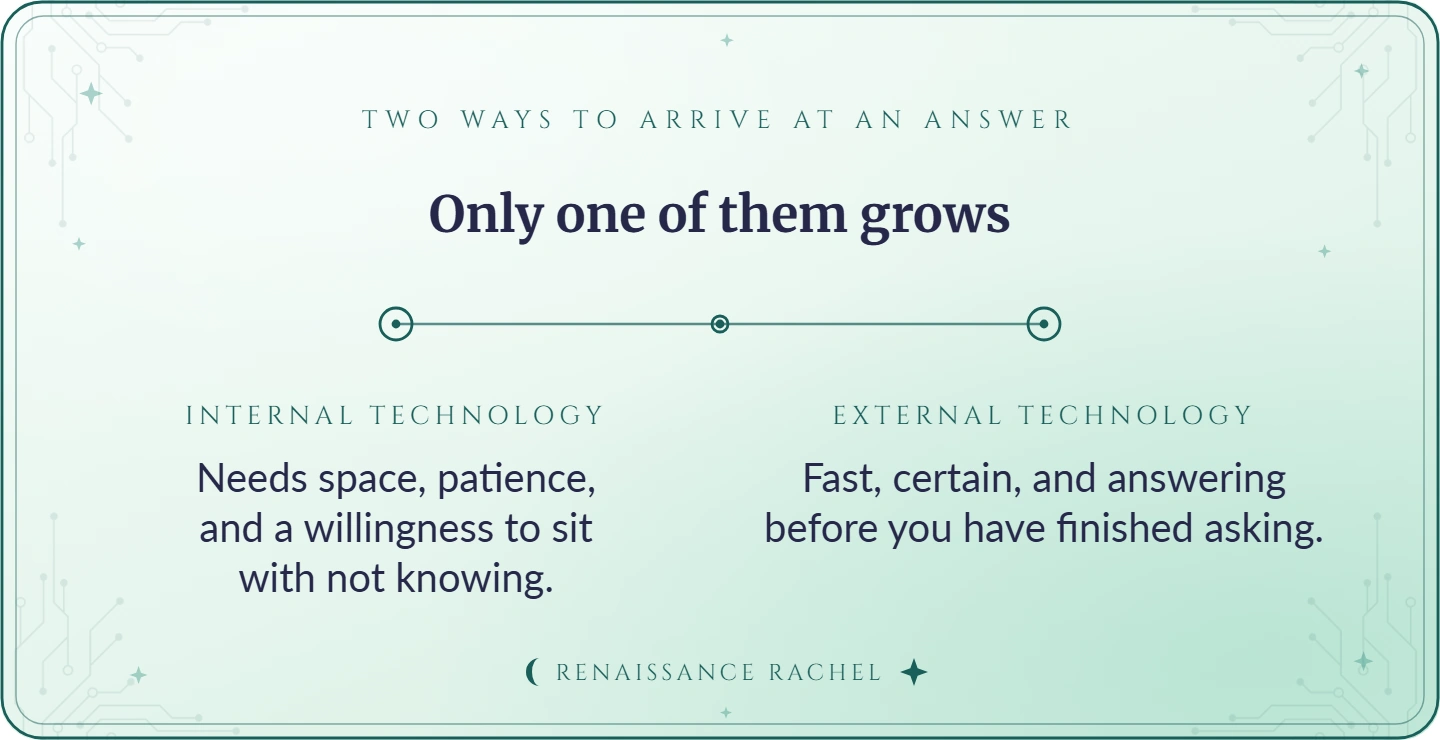
Internal technology is the capacity inside you that knows things. It’s your ability to find your way, to sense what’s true, to sit with a question long enough for an answer to surface. It’s not mystical. It’s just yours, and like any capacity, it grows when you use it and atrophies when you don’t.
External technology amplifies the tendency of all of us to rely on external authority rather than our own. It’s seductive. Subtle.
How external technology became the most seductive authority ever built
I’ve found that with using AI tools, I’ve asked it to validate my opinion even when I already know the answer. I look up something on Google to back something up rather than just trust I know the right thing for myself.
Have you ever been in a conversation where someone asks you something and you need a bit of time to come up with a response? Yet, rather than waiting for you, the other person kept talking or just moved on. They might have waited a beat or two, but you needed more time and they didn’t give that to you. The thing you wanted to say? That was internal technology trying to surface. It needed time and didn’t get it.
In the same way, when we distract ourselves constantly, we silence our internal technologies trying to tell us something. We’re not just filling the silence while walking, waiting for our coffee order, or riding in an elevator. We’re filling the silence within ourselves.
Internal technology requires space, patience, and comfort with ambiguity. And, perhaps most difficult of all, a willingness to fail.
External technologies are fast and give you an answer, whether it’s right or wrong. Large language models like ChatGPT are the latest iteration of this. They’ll give you an answer that sounds so confident that it could be telling you the sky is green and you’ll wonder if you’re actually colorblind. We were already getting conditioned to this with Google searches and having unlimited information at our fingertips. It’s now amplified to a much greater degree.
What I’m still figuring out
I’ve been using a large language model to help extract ideas out of me, not to write it for me, but to ask me questions to develop my concepts. I’ve been telling myself that it’s helping me and speeding me up. That I need it because I have a deadline. Yet, what if I let all my ideas come to me organically? Sure, I think of ideas in between my writing and brainstorming sessions, but when I hit a block I turn to the chatbot to help unblock me rather than unblocking myself. I think about this a lot and am still questioning what I lose and what I gain in this process.
As we use external technologies, it’s important to consider what we might lose in the process. It’s not about giving it all up and living off the grid. It’s about learning how to use all forms of technology with intention.
By learning how to trust ourselves and ground ourselves in what we know to be true, we are less likely to be swayed by fear-mongering and hype cycles. We do this by making the commitment to develop our internal technologies.
It does this slowly
With the way external technology became so pervasive, so quickly, we didn’t notice the ways it began to replace our internal technologies. External technology is the most sophisticated and seductive authority ever created. It doesn’t just replace your choices. It replaces your capacities: your ability to find your way, cook, write in your own voice, validate your own decisions, and sit with not knowing.
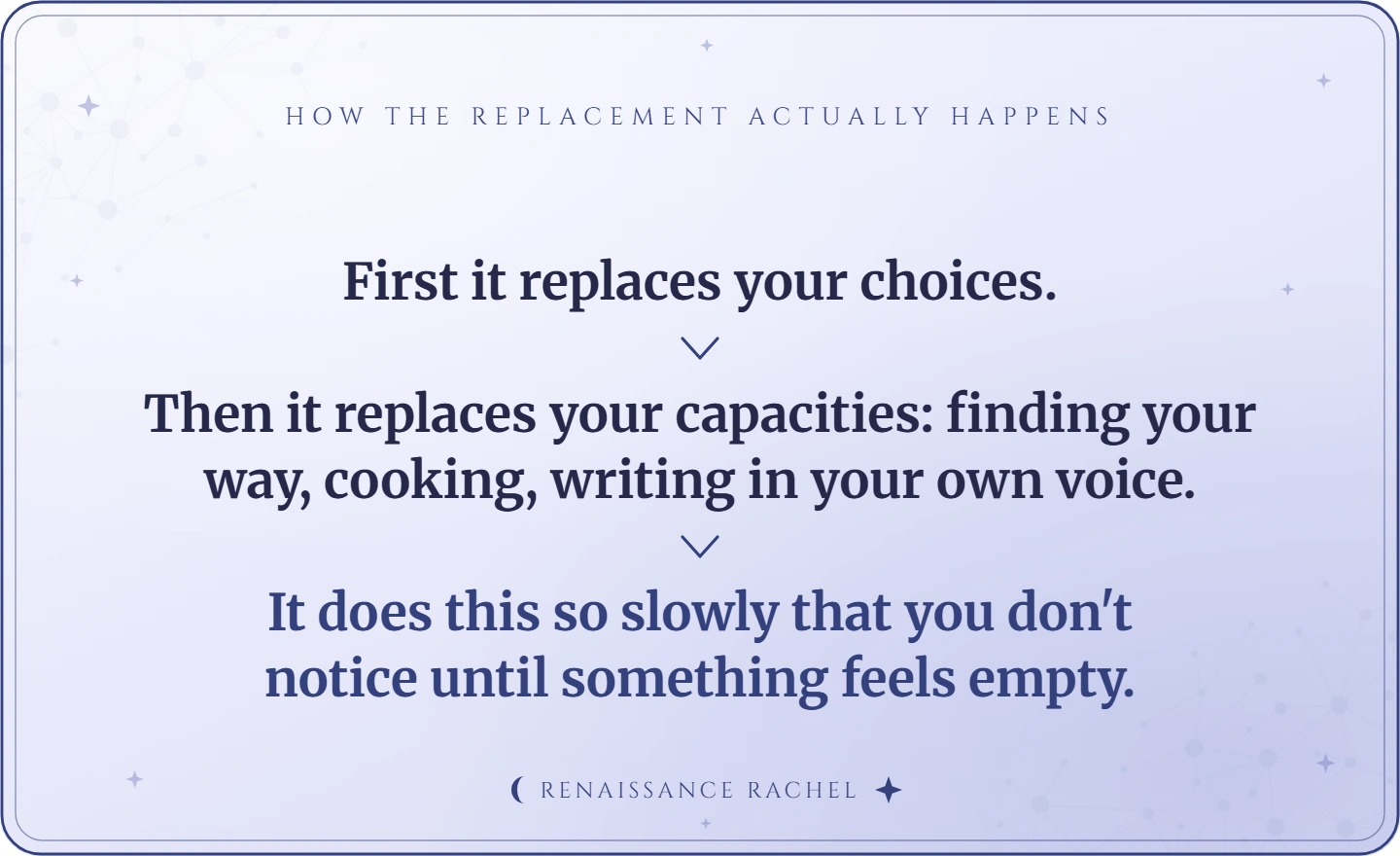
It does this so slowly that you don’t notice until something feels empty.
This is something I’ve been sitting with for a while, a tension I keep living inside rather than a conclusion I’ve reached. We have more tools than ever to help us think, decide, navigate, and create. And yet something feels like it’s getting smaller. I think it’s us.
Final thoughts
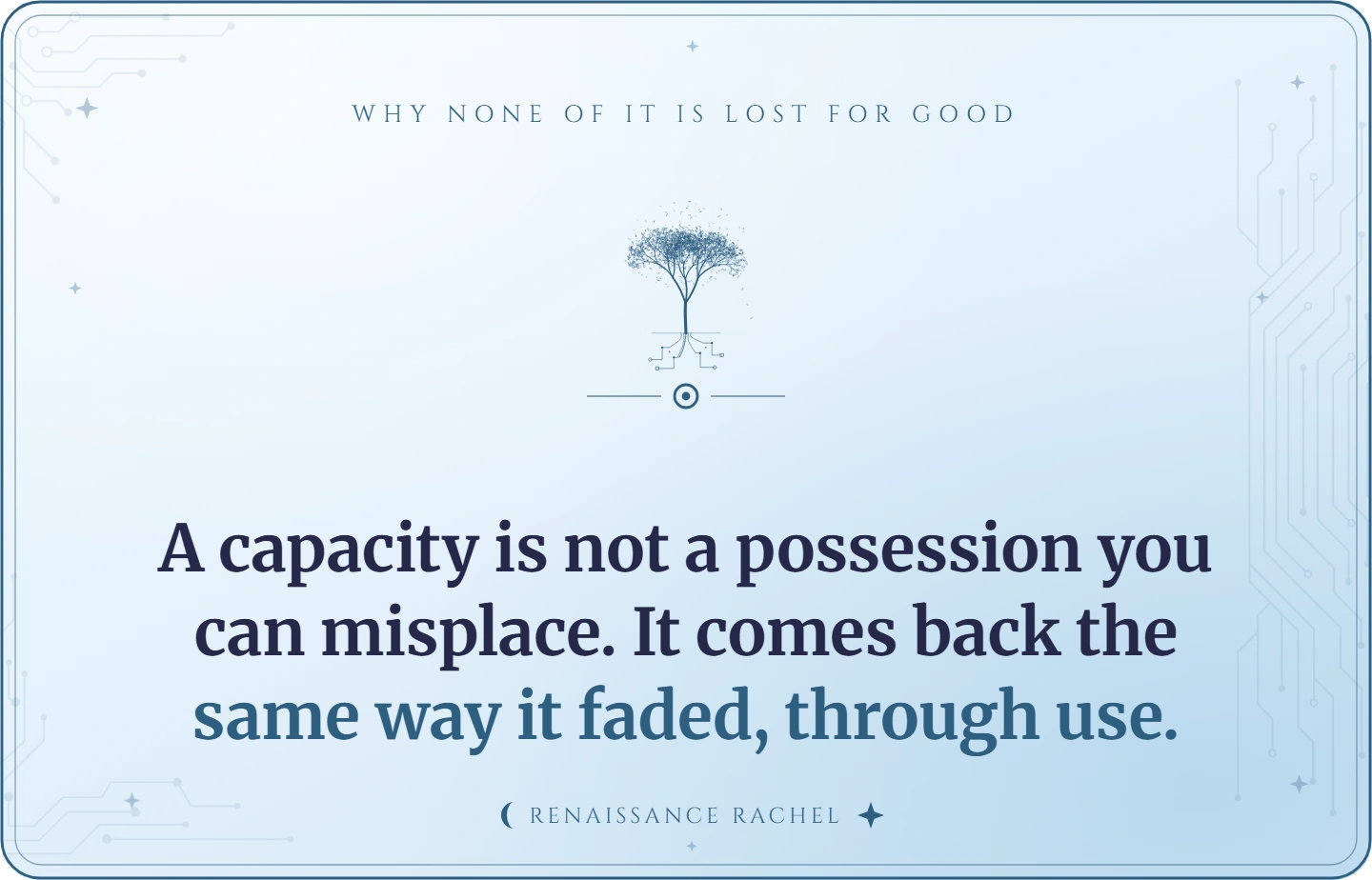
A capacity is not a possession you can misplace. Internal technology fades when you stop using it and it comes back the same way it faded, slowly, through use. None of it is lost for good.
So I am practicing. I step outside to feel the air before I open the weather app. I sit inside a block a little longer before I reach for the chatbot to pull me out of it. When someone needs a moment to find their words, I give it to them, and I am learning to give the same moment to myself.
The self I have been outsourcing is still here. It is quieter than the app, slower than the search, and far less certain than an answer delivered with total confidence. It is also mine. Every time I choose it first, even in something as small as what to wear today, it grows a little louder.
The smallness I feel is real. It is also a choice point. We get to decide whether the capacity keeps thinning, or whether we begin, in small and deliberate ways, to grow it back.