Technology Looking for a Problem: Why the Latest Tool Isn’t Always the Answer
There’s a pattern I keep seeing: in the companies I’ve worked for, in the products I’ve helped build, and honestly, in my own life. We find a new technology and then go looking for a place to put it. We’ve got it backwards.
I work in the field of user experience (UX) and software design. Our main function is to think about the way people are going to interact with a piece of software and make it as easy for them as possible. If you’ve ever used a website, app, or piece of software and gotten mad because it’s hard to use, I’m here to tell you: it’s not your fault. Either the people like me aren’t doing their job correctly, or that company didn’t invest in a UX function.
Or the company has different priorities than a good user experience and won’t allow the UX team to perform their job optimally.
For instance, a company might push implementing “dark patterns”: blocking you from core features unless you make an account or hand over your information, throwing up pop-ups that pressure you into enabling location tracking or buying a premium plan, hiding the option to reject or opt out, like with cookie collection.
It’s a core conflict for people in my type of role. We want to build the best product for our customers and, yet, the people who run the company, and give us our paychecks, demand that we create experiences that benefit the bottom line more than the customer’s best interest.
When the Business Asks for It
I remember when I worked in the digital department at a large company that sold power tools. They had started introducing Bluetooth to things like drills, lights, and other construction equipment. At the time, I was an associate digital product manager, learning how to prioritize what the product teams work on so that we could build and deliver a product. I helped a more senior product manager with an app for a laser distance measuring device.
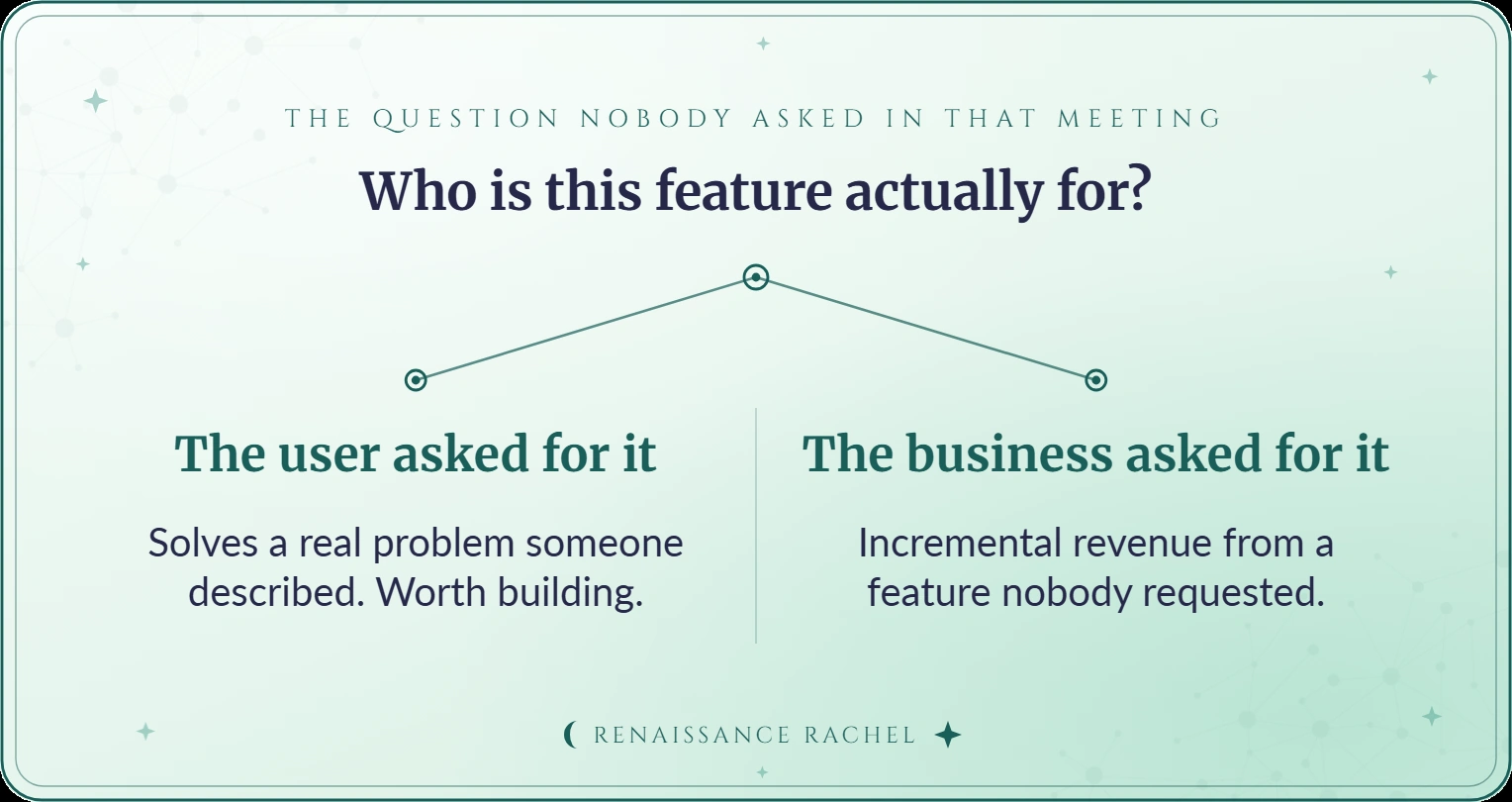
In a meeting with other product managers, we were all sharing what we were working on. One product manager had taken on delivering an app for a light at a construction site. It confused me. Where was the value in an app that just switched a light on and off? In the meeting, they never discussed the value to the user, just that the business asked for it.
After the meeting, I walked with my mentor in the hall and asked him, “Why do we need to build apps for all these different Bluetooth tools?” He looked at me and said, “It’s all about incremental revenue. The company can charge more for a light, a drill, or a measuring device that has Bluetooth.”
It bothered me that we weren’t asking the people who used the construction equipment what would actually be useful for them. That question is what led me to becoming a UX researcher, where my role focuses on interviewing the people who use the product, or might use the product, to find out what would actually provide value to them.
This isn’t unique to power tools. I’ve noticed plenty of times when a new technology makes things harder instead of easier: self-checkout lines that are supposed to be faster but break down so often someone still has to stand there and help you, digital ordering systems that won’t let you ask for a simple substitution, tablets showing up in classrooms when the real problem is too few teachers and class sizes that are too big.
This kind of thing happens when companies use technology to go looking for a problem. They’re taking the latest thing (apps, AR/VR, AI) and throwing a lot of money at it.
They task their employees: think of a way to use augmented reality so we can sell it for extra money. This is backwards. We should be solving problems with or without the latest fad technology. This phenomenon is called technosolutionism.
Sometimes solving a problem is a simple fix. It could be moving equipment or changing something about the way they work rather than adding in another application.
What This Looks Like in Your Own Life
At the personal level, this might look like buying a bread machine instead of learning to knead, or a sleep tracking app instead of just going to bed earlier. It’s an activity blocker instead of the willpower to close the app yourself, or delete it. It’s a fitness tracker nagging you to move instead of learning to feel your own body — the same internal-capacities idea I go deeper on in Harnessing the Technology Within.
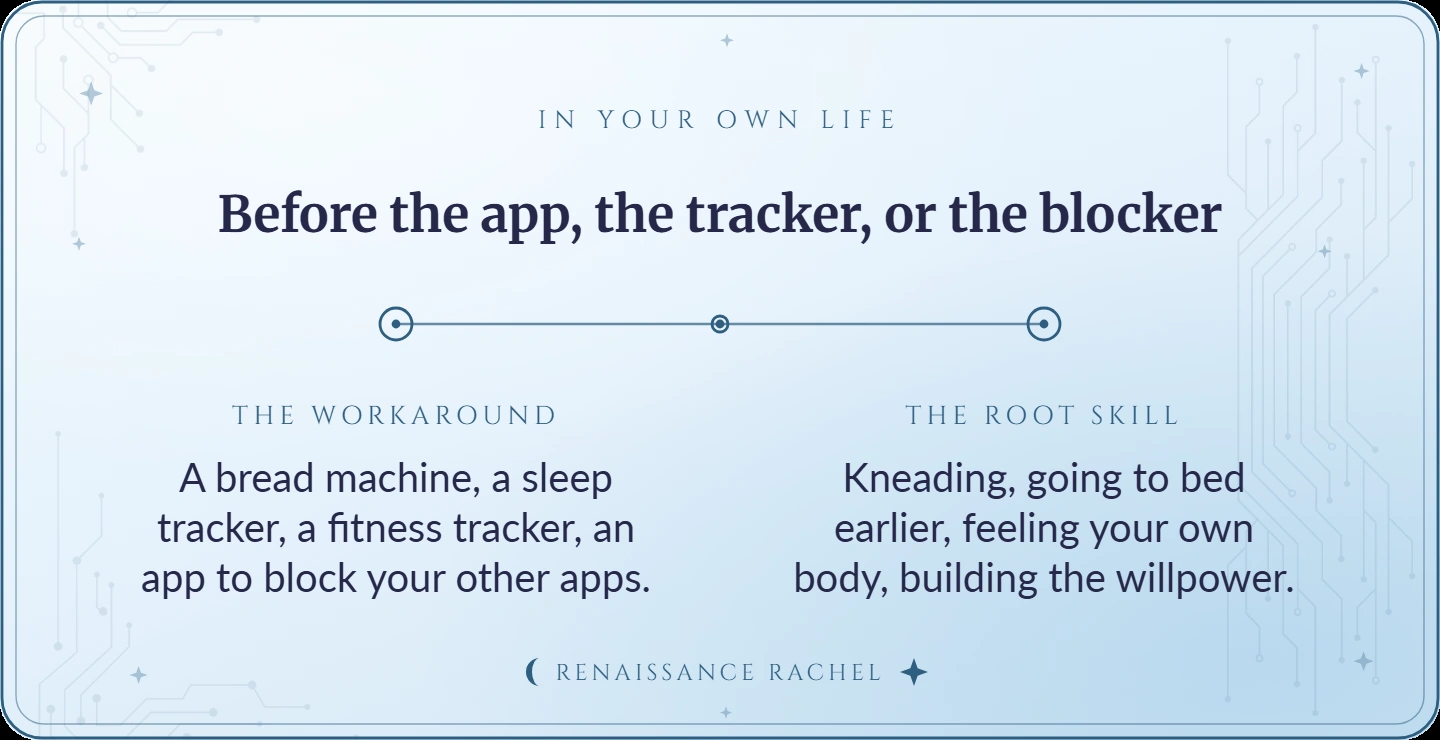
I’ve learned, through experience and observation, that the real answer is usually a better question, not another app. These days, that’s just as true of AI tools.
Before downloading, subscribing, or buying, the question to consider is: what problem am I actually trying to solve? And is this tool the most direct path to solving it? When I need a quick gut-check in the moment, I use the framework I built in The Zones of Technology — green, yellow, red, sorted before I ever open the app store.
Sometimes the tool is the answer. More often, the real work is somewhere else: a habit to build, a boundary to set, a skill to relearn. I trust that question a little more each time I ask it, in what I build and in what I buy. It’s the same trust I write about at length in The Human Renaissance — reclaiming your own judgment, one decision at a time.
If AI is the tool you’re weighing most often right now, the free AI mini course is a seven-day way to build that judgment on purpose instead of by accident.
So: next time you reach for the latest thing, what problem are you actually trying to solve, and could you solve it yourself?