They’re building a data center in the town where I grew up
My mom told me about it. A data center in the actual town where I grew up.
I had mixed feelings when she told me. I still have mixed feelings. My mom felt confused and upset about it, which makes sense. The concerns going around are totally valid. Data centers use a lot of electricity and water. They make noise, a constant sound that carries, and certain hearing ranges pick it up more than others. Children hear those ranges. This one is going up near schools. I’ve written about the hidden costs of AI before.
The land had been zoned for industrial use years ago and no one had mentioned a data center. The announcement seemed to come out of nowhere. People in the county felt like the decision had already been made somewhere above their heads.
Then the next day, more than five hundred people showed up to the public open house the company held for questions.
My mom is confused, and I understand why
She hears a lot of people talking about the bad uses of AI. Stealing people’s work. Copyright infringement. That’s a whole other topic and I have thoughts on it for another day.
Then she hears me talking about all the ways I use AI at work, on my blog, across my creative projects.
So she’s standing between two loud positions, holding both, unsure how to weigh them. Of course she’s confused.
She’s the most recent person to say it out loud, and she’s far from the only one. I have this conversation with friends, family, and people in my circles regularly. Even my colleagues feel confused, though they try to hide it. The words change and the shape stays the same: something big is happening, everyone sounds certain, and it’s hard to know what to think about it.
I feel exactly that way about plenty of topics. Someone hands me a strong opinion from each side and I stand there aware that I have the background to evaluate neither.
This is a confusing topic. Sitting with it for as long as I have, though, I’ve landed somewhere. Most of what I landed on starts with one misunderstanding I keep running into.
Data centers are built for data
I follow an artist who got upset about this recently. He said something close to: we didn’t need data centers before AI, so why are they building them?
That’s when I realized how many people are unclear on what a data center is. The name says it. Data. Our whole digital world runs on them. All of our Netflix shows, our movies, our endless scrollable content. The cloud sounds like a nebulous thing floating above us. In reality, it’s where your Facebook data lives, your Google Drive, the transactions that get processed every time you tap a card.
Our increasing digital footprint contributes to the increasing demand for more data centers to store and process all the data that powers our digital society. AI models live on top of that data.
I used to work in a building that had a data center inside it. Sealed off from the rest of us, maintained by a few people, in the same building where I went to work. I got permission on a couple of occasions to go inside. I remember walking in and seeing the giant servers running and thinking: oh wow. So this is what a data center looks like. This is what’s powering our world.
That moment stays with me because the cloud stopped being a metaphor. It became a room I could stand in, humming, in a building I already knew. This was about eight years ago. Before generative AI and the AI powered data centers.
What’s genuinely different this time
AI has been around a long time too, in various forms, prevalently for almost two decades now. The part that changed is the hardware.
The way large language models are built now requires enormous graphical power, as much as a high-res video game or more. I learned this while looking into running my own models at home. I found out I’d need a serious graphics card, that those are expensive, and that the models have been optimized for NVIDIA cards specifically. That last part irritated me. Getting anything else to work means custom configuration and a learning curve I’m still climbing.
And here’s what’s irritating: people working on this have already found ways to run these models more efficiently. And the industry keeps choosing to run them the way they’re running them.
That’s a question worth asking loudly. I notice it gets asked far less often than the question of whether any of us should use AI at all.
The energy I love and the energy I question
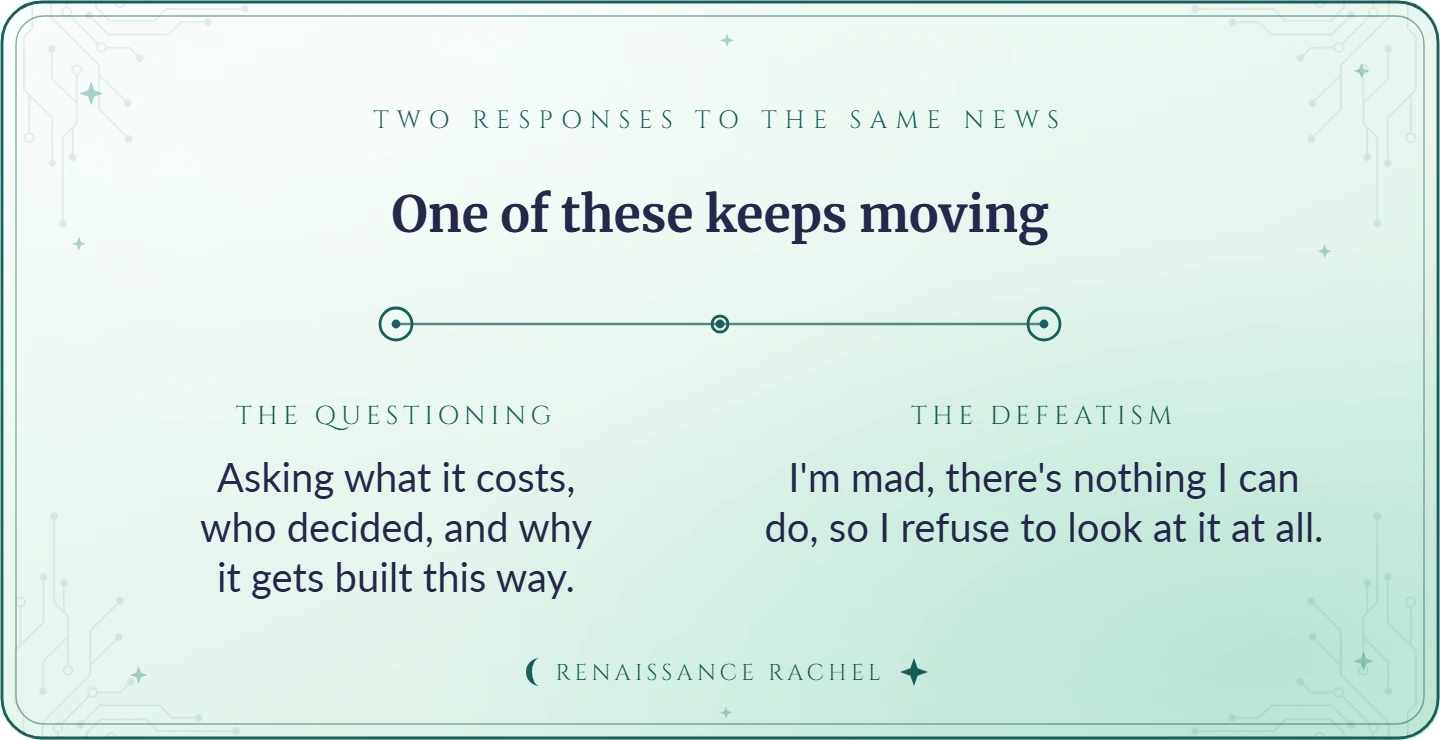
The questioning energy around AI and data centers showing up right now is good. I’m glad people are asking the tough questions.
At the same time, I see a lot of defeatist energy. It sounds like: I’m mad, there’s nothing I can do about it, so I refuse to use AI because it’s destroying the world.
People can do what they want. For me, when I’m going to outright hate something, I choose to understand it first. I want a sense of how it works and how it can be used before I decide. For me, generative AI is definitely worth using.
I struggle with the refusal to understand where another person is coming from. I’m generalizing here, and I’ll own that. Still, I see people who oppose AI entirely declining to see how it serves others. I’ve heard from people who have great ideas and struggled to express them in the way this world understands. People with creative visions and a gap between what they see and what they can execute. This technology opens something for them.
It’s okay for us to have differing stances. I’d love for the people who see only the harm to step back and look once, honestly, before they close the door.
What got us here
I’d also love for people to understand that many things contributed to where we are today.
A lot of choices were made for us. We complied with them. We perpetuated them for convenience, year after year, until they stopped registering as choices at all. Every year we recorded more, stored more, streamed more, backed up more. That appetite is what these buildings serve.
Now that we’re here, we have the opportunity to ask ourselves how we can reclaim more autonomy in our society and our world, and how we stand up for the rights we have.
I think that looks like a lot of different things, and protesting is one of them. Protesting is an outward demonstration and I admire the people who showed up to that meeting in my hometown to ask the tough questions or to show their displeasure about the data center. There are also small things we can do every day that stay off the news and add up anyway.
I’m just one person, what can I do?
One of my high school teachers had a student who made an animation I’ve thought about for years.
It showed a person sitting in traffic, and gasoline pouring out of the car into the air, and the person said: I’m just one person, what can I do? Then someone throwing trash on the ground, saying the same thing. Then another situation, and another, each one a small harm, each one followed by the same line.
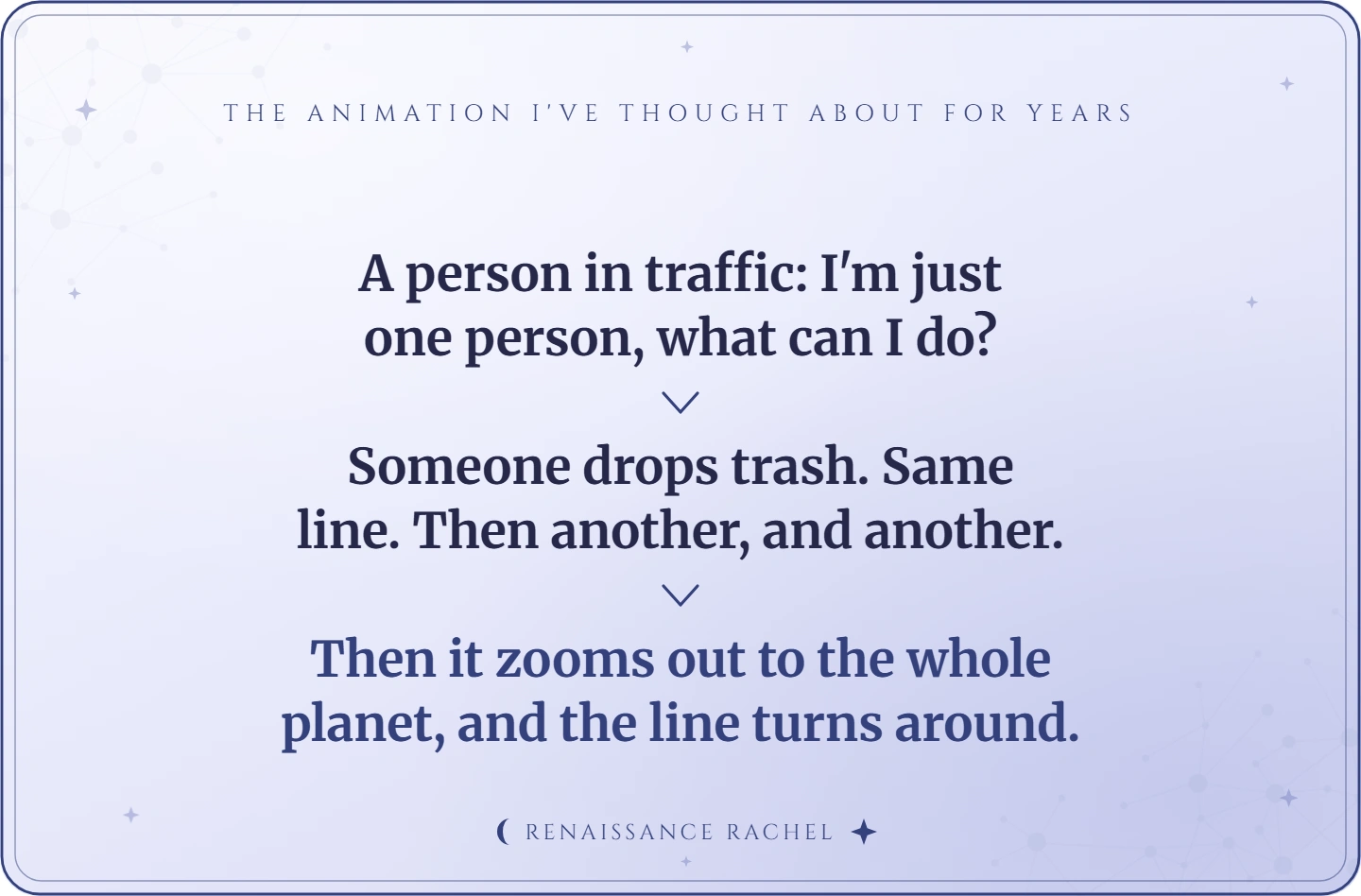
I’ve searched for that animation since. It was a student film back before we uploaded everything, so it may have never made it online. It stays with me because it holds the thing I believe about all of this: cumulatively, our small actions add up to something meaningful when we take them consistently.
Then it zoomed out to the whole planet, and the line turned around: it’s just one planet, what can you do?
For me that looks like walks, and breathing the air outside, and appreciating that it’s there. Picking up trash when I see it. Composting, giving food back to the earth. Supporting local farmers and regenerative practices when I can. Buying whole foods that nourish my body. Shopping in my own town, going to the places near where I live, walking rather than driving whenever the choice is available to me.
It also looks like using these models intentionally, for purposes I believe will benefit me and the world around me. I weigh all of it. Then I choose.
Final thoughts
I’ve been sitting on this data center question. I’m still sitting on it.
Where I am right now is that my use of AI is upleveling my creative vision, and what I bring into the world creatively feels like my contribution to bring more good to the planet. My life’s work. I also love this earth, this planet, this home I live on. So I do what I can every day, and I hold both of those at once.
For me it’s a yes, and. Yes, these data centers appear to carry a serious cost. And this same infrastructure gave us the internet, remote work, the ability to reach each other across the world, a transformation in how we live. There’s a duality in almost everything. When we hold both sides and examine both and find the way that feels harmonious for us, we’re already doing a lot right there. That may be the best any of us can do.
Right now it seems a lot of people have reached a conclusion, and conclusions can turn into rigid thinking. What if the answer is more nuanced than the one we’ve settled on? What if it’s a yes, and?
The more of us who bring our different talents together, the more likely we build the world we can picture. So I’ll leave you with the invitation I keep giving myself: keep questioning. Continue examining. Go deeper.
There’s a lot of stuck energy and anger right now. When it feels hard, ask more questions. The answers come, or the ideas do, or the solutions we haven’t imagined yet. The more we question and refuse to stop, the more we see.